
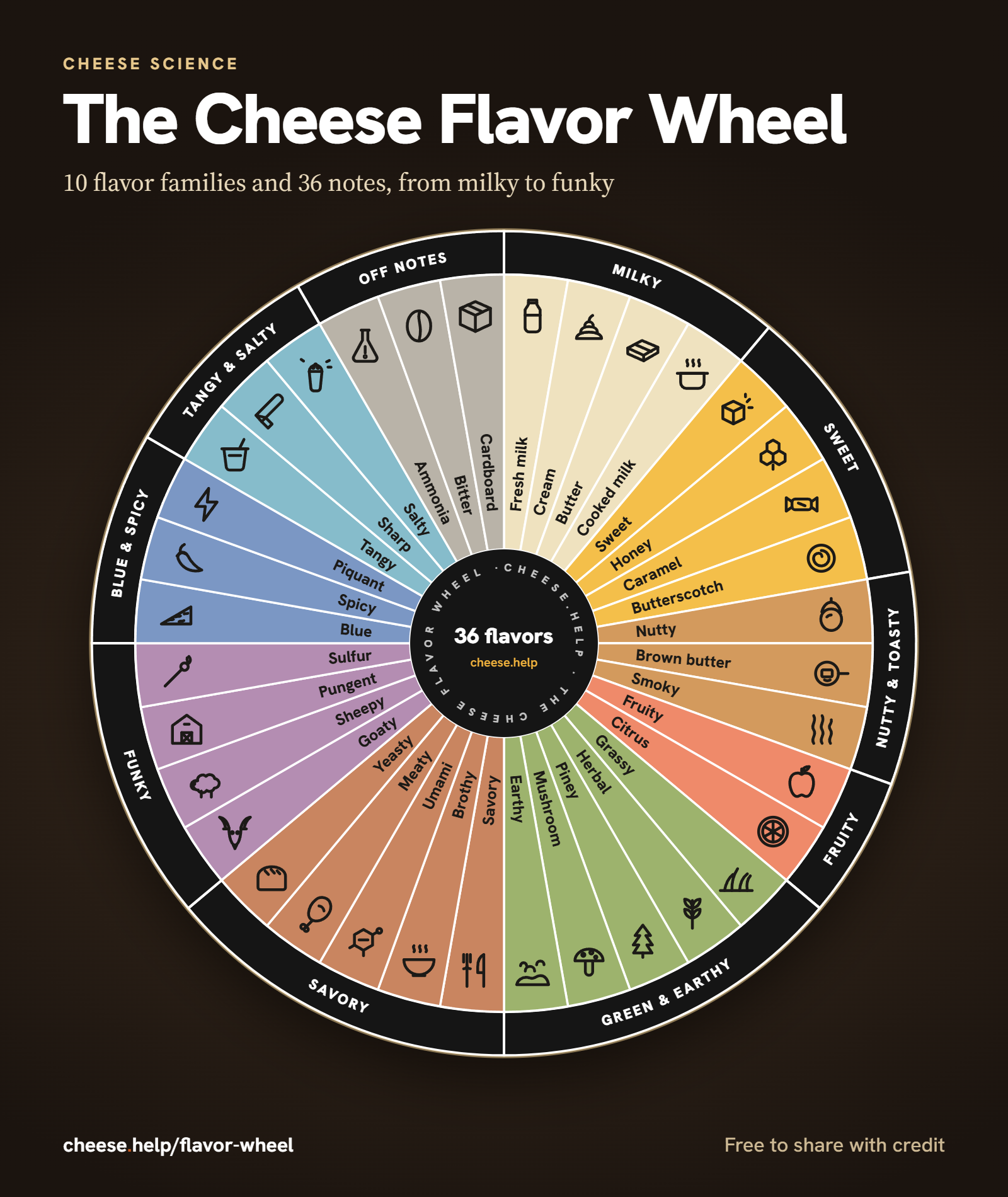
This one has 36 notes in 10 families; every flavor note links to the cheeses in the cheese.help directory that show it, and most explain the science behind the flavor.
Pick a slice to open a note, or tap the rind to zoom into a whole family. The finder under the wheel matches up to three notes at once, so "nutty and sweet" turns into a short list of cheeses to buy.
How to use the cheese flavor wheel
To use the cheese flavor wheel well, taste first and name the broad family before you hunt for the exact note. Five habits make the names come faster:
- Let the cheese warm up. Cold cheese tastes muted, and 20 to 30 minutes out of the fridge is enough for most pieces, as the guide to bringing cheese to room temperature explains.
- Smell before you taste. Flavor is taste plus aroma: the brain combines what the tongue reports with what the nose picks up, so most of the wheel's notes are smells.
- Start in the middle. Ask the broad question first. Is it milky, sweet, nutty, earthy or funky? Then move out to the slice that fits best.
- Taste the rind and the center apart. Earthy and mushroom notes often come from microbes on the surface, so they are usually strongest near the rind and fade toward the middle.
- Taste side by side. Comparing two cheeses makes each note easier to name than tasting one alone.
Dairy scientists train tasters the same way. The University of Wisconsin's Center for Dairy Research teaches each flavor term with a cheese that shows it strongly, such as whole milk ricotta for milky or fresh chèvre for goaty. Where a note has one of those teaching cheeses, the wheel lists it as "Learn it on".
How the cheese flavor wheel is organized
The cheese flavor wheel is organized from broad to specific: 10 families around the rind and 36 notes on the slices.
Flavor wheels have a long history in cheese science. A European research group published a guide to the sensory evaluation of hard and semi-hard cheeses in 1997, sorting odors and aromas into families and proposing a cheese aroma wheel. The makers of Comté use their own wheel of 83 descriptors in six families: lactic, fruity, vegetal, roasted, animal and spicy.
This wheel keeps that structure but is written for shoppers and home cooks rather than trained panels. Technical terms such as "ketone" become "blue", and every note is matched to cheeses you can actually buy.
The matches come from the cheese directory, so the wheel and the directory agree. A cheese lands on a note when its directory entry lists that flavor, when its milk explains it (goat and sheep cheeses sit on goaty and sheepy), or when a source names it, as with the glutamate figures behind umami. Tangy is the most common note, on 45 of the 89 cheeses, and nutty is second, on 37.
Off notes sit in their own gray family. Ammonia, bitter and cardboard are faults rather than flavors to look for, and each one says what it means for the cheese in front of you.
Where cheese flavors come from
Cheese flavors come from a few chemical processes that run while cheese is made and aged, plus what the animals ate and what grows on the rind.
Acid from starter cultures
Acid from starter cultures is the first flavor in almost every cheese. The bacteria eat milk sugar and turn it into lactic acid, which lowers the pH and tastes sour or tart. Young fresh cheeses stay close to that clean tang, and very old Cheddar is acidic enough that people call it sharp.
Fat breaking down
Fat breaking down, a process called lipolysis, frees fatty acids that taste different depending on their length. Short ones such as butyric acid read as piquant or, in large amounts, rancid. Medium ones are partly behind the flavor of goat cheese, and longer ones taste soapy. Blue mold goes a step further and turns fatty acids into methyl ketones such as 2-heptanone, the compound most tied to the classic blue flavor.
Protein breaking down
Protein breaking down, or proteolysis, makes peptides and amino acids, and those drive the savory, brothy and sweet notes of aged cheese. Some peptides taste bitter. Free glutamic acid is a key umami compound: Parmesan holds 1,200 to 1,680 mg per 100 g, against 182 mg in Cheddar, according to an Academy of Nutrition and Dietetics white paper. The crunchy white specks in aged Gouda and Parmigiano-Reggiano are usually tyrosine, another amino acid freed the same way, and the guide to crystals versus spoilage shows how to tell them from mold.
Microbes on the rind
Microbes on the rind add the mushroom, earthy and pungent notes. The white mold on Brie and Camembert makes 1-octen-3-ol, known as mushroom alcohol. Washed rinds are washed with brine or alcohol as they age, which grows bacteria such as B. linens, and their sulfur compounds are part of the smell. Cave microbes can make earthy compounds such as geosmin, which is why those notes usually fade toward the center. The guide to rind types covers which rinds are worth eating.
Milk, pasture and wrapping
Milk, pasture and wrapping set the starting point before any aging happens. Goat and sheep milk carry distinctive fatty acids, so even a young goat cheese tastes goaty. Pasture shows too: summer Comté, made while the cows graze fresh grass rich in carotene, is a deeper yellow than winter Comté from hay-fed cows. A spruce band around Vacherin Mont d'Or adds pine, and smoke adds phenolic compounds from burning wood.
Every note on the cheese flavor wheel
Every note on the cheese flavor wheel is listed below with what it tastes like, why it happens and the cheeses that show it.
Milky flavors
Milky flavors are the mild, fresh tastes of milk, cream and butter, and they are easiest to find in young cheese. Lactones form when milk is heated during cheesemaking and are believed to carry into the finished cheese, where they are thought to be a main source of milky, creamy and even coconut-like aromas.
- Fresh milk
Tastes like: Clean, sweet and delicate, like a glass of cold whole milk. It shows best in fresh cheeses such as ricotta, fresh mozzarella and mascarpone, and in very young Cheddar, Colby and Gouda. Source: Cheese Science Toolkit.
Taste it in: Queso Fresco, Scamorza, Stracchino, Burrata, Fresh Mozzarella, Manouri, Ricotta, Colby, Paneer, Tomme de Savoie and 7 more in the finder.
Learn it on: whole milk ricotta.
Read more: The Mildest Cheeses, Ranked From Fresh to Firm.
- Cream
Tastes like: Rich and rounded, like heavy cream. Tasters often group milky, creamy and milkfat notes together; cream is the fuller, fattier end of the range. Source: Cheese Science Toolkit.
Taste it in: Gorgonzola, Cambozola, Cashel Blue, Robiola, Mascarpone, Pont-l'Évêque, Reblochon, Vacherin Mont d'Or, Brillat-Savarin, Burrata and 8 more in the finder.
- Butter
Tastes like: Fresh sweet butter. Diacetyl, a compound with a butter flavor, is made by some starter bacteria as they use the small amount of citric acid in milk. It is part of what makes Gouda-style cheese taste the way it does. Source: Cheese Science Toolkit.
Taste it in: Cheddar, Double Gloucester, Lancashire, Mahón, Serra da Estrela, Brie, Brillat-Savarin, Butterkäse, Havarti, Tetilla and 22 more in the finder.
Learn it on: juustoleipa (bread cheese), warmed.
- Cooked milk
Tastes like: Warm milk and custard, sweet and lightly browned. Heating milk brings out sweet, browned and faintly sulfurous notes. Mascarpone, set by heating cream and adding acid, is the teaching example. Source: Center for Dairy Research, University of Wisconsin-Madison.
Taste it in: Mascarpone.
Learn it on: mascarpone.
Sweet flavors
Sweet flavors in cheese run from the soft sweetness of low-acid young cheese to the candy notes of long-aged Gouda. In aged cheese, sweet and caramel notes are linked to compounds called furanones and to sweet-tasting amino acids freed as protein breaks down. The culture Lactobacillus helveticus is a likely source.
- Sweet
Tastes like: A gentle sweetness, more milk than sugar. Sweet means three things to tasters: low acid (Colby next to Cheddar), very milky cheese like mascarpone, and cheese that really tastes sugary, like aged Gouda. Swiss-type cheeses get much of their sweetness from the propionic acid bacteria that also make their holes. Source: Cheese Science Toolkit.
Taste it in: Coolea, Dubliner, Brunost, Maasdam, Allgäuer Bergkäse, Graviera, Red Leicester, Manouri, Ricotta, Gouda and 8 more in the finder.
- Honey
Tastes like: A mellow, honey-like sweetness. A soft, floral sweetness rather than the cooked-sugar taste of caramel.
Taste it in: Wensleydale.
- Caramel
Tastes like: Brown sugar, molasses and toffee. Common in aged Alpine cheeses, Parmigiano-Reggiano and aged Gouda. Brunost takes a different route: whey is boiled down until its milk sugar caramelizes. Source: Cheese Science Toolkit.
Taste it in: Gouda, Coolea, Mimolette, Brunost, Manchego.
Read more: Brunost: Norway's Brown Whey Cheese, Types and How to Serve It.
- Butterscotch
Tastes like: Buttery caramel, like butterscotch candy. It is the caramel note with a buttery edge.
Taste it in: Coolea, Gouda.
Nutty and toasty flavors
Nutty and toasty flavors cover toasted nuts, browned butter and smoke, the warm, roasted side of cheese. In Swiss-type cheeses, the propionic acid fermentation that forms the holes also gives the nutty, sweet flavor. Nutty is the second most common note in the cheese.help directory, after tangy.
- Nutty
Tastes like: Toasted hazelnut, almond or walnut. Swiss research describes the propionic acid fermentation in Emmental-type cheese as the source of both its eyes and its nutty flavor. Imported Emmentaler is the teaching example for the note. Source: Agroscope Liebefeld-Posieux.
Taste it in: Sbrinz, Allgäuer Bergkäse, Comté, Fontina, Grana Padano, Graviera, Gruyère, Idiazábal, Manchego, Mimolette and 27 more in the finder.
Learn it on: imported Emmentaler.
Read more: Swiss Cheese vs Gruyère vs Emmental: What's the Difference?.
- Brown butter
Tastes like: Butter cooked until golden and nutty. It sits between the butter and nutty notes on the wheel.
Taste it in: Comté.
- Smoky
Tastes like: Wood smoke and campfire. The two main methods are cold smoking the finished cheese in a smoke chamber and adding liquid smoke. Phenolic compounds from burning wood are among the main sources of the smoky taste. Source: Cheese Science Toolkit.
Taste it in: Idiazábal, Scamorza.
Read more: The Best Cheeses to Smoke, and the Best Smoked Cheeses to Buy.
Fruity flavors
Fruity flavors in cheese range from ripe and dried fruit to bright citrus. Many fruity aromas come from esters, which form when acids and alcohols in the cheese react. They can smell like pineapple, strawberry or apple.
- Fruity
Tastes like: Ripe fruit: pineapple, apple, even dried fruit. Wisconsin's cheese grading terms describe fruity as a sweet, apple-like flavor that grows stronger as cheese ages. In Cheddar, graders count a strong fruity note as a defect. Source: Cheese Science Toolkit.
Taste it in: Morbier, Taleggio, Comté, Raclette, Tête de Moine, Parmigiano-Reggiano, Mimolette.
Learn it on: Parmigiano-Reggiano.
- Citrus
Tastes like: Lemony, bright and fresh. Dairy scientists tie this sour, citrus-like aroma to citric and acetic acids, and they use fresh goat cheese to teach it. Source: Center for Dairy Research, University of Wisconsin-Madison.
Taste it in: Humboldt Fog, Valençay, Chèvre (Fresh Goat), Manouri.
Learn it on: fresh goat cheese.
Read more: Goat Cheese Pairing: What Goes With Goat Cheese.
Green and earthy flavors
Green and earthy flavors come from pasture, bark wrappers and the molds and microbes that grow on rinds. Some of these notes start with what the animals ate. Others come from the bark a cheese is wrapped in, or from the molds and microbes growing on its rind.
- Grassy
Tastes like: Fresh-cut grass and green pasture. Grassy aroma is linked to compounds such as hexanal and to milk from grass-fed cows. Pasture shows in the cheese: summer Comté, made while the cows graze fresh grass rich in carotene, is a deeper yellow than winter Comté from hay-fed cows. Source: Cheese Science Toolkit.
Taste it in: Morbier, Manchego, Allgäuer Bergkäse, Pecorino Sardo, Saint-Nectaire.
Learn it on: Irish grass-fed Cheddar.
- Herbal
Tastes like: Fresh herbs and meadow plants. Herbal notes come from a large mix of aroma compounds. Added herbs are the obvious source, but some cheeses, such as Reblochon, can show them on their own. Source: Cheese Science Toolkit.
Taste it in: Reblochon, Serra da Estrela.
- Piney
Tastes like: Pine, spruce and resin. Many bark-wrapped cheeses take it from the wood. Vacherin Mont d'Or ripens inside a spruce band, and terpenes such as linalool can seep from the bark into the paste, the most likely cause of its piney aroma. Source: Cheese Science Toolkit.
Taste it in: Vacherin Mont d'Or.
- Mushroom
Tastes like: Raw mushrooms and damp forest floor. The white mold on Brie and Camembert, Penicillium camemberti, makes 1-octen-3-ol, a compound known as mushroom alcohol. Source: Cheese Science Toolkit.
Taste it in: Camembert, Saint-Nectaire, Brie, Pont-l'Évêque, Tomme de Savoie, Robiola.
Learn it on: stabilized Brie.
Read more: White Mold on Cheese: Which Is Safe and Which Is Not.
- Earthy
Tastes like: Damp cellar, soil and stone. Microbes on cave-aged and natural rinds can make earthy compounds such as geosmin, so the earthiness usually fades as you move from the rind toward the center. Source: Cheese Science Toolkit.
Taste it in: Saint-Nectaire, Tomme de Savoie, Camembert, Fontina, Gruyère, Reblochon, Limburger, Cantal, Crottin de Chavignol, Humboldt Fog and 2 more in the finder.
Learn it on: cave-aged Cheddar.
Read more: Cheese Rind Types: Bloomy, Washed, Natural and More.
Savory flavors
Savory flavors are the broth, roast meat, bread and umami notes that build as cheese ages. Aging breaks milk protein into peptides and amino acids. Some taste savory on their own, and others go on to form new flavor compounds.
- Savory
Tastes like: Deep and mouth-filling, more dinner than dessert. It is the broad note under brothy, meaty and umami, and it grows as a cheese ages. Source: Cheese Science Toolkit.
Taste it in: Appenzeller, Brick, Caciocavallo, Chimay, Pont-l'Évêque, Raclette, Époisses, Livarot, Munster, Sbrinz and 26 more in the finder.
- Brothy
Tastes like: Like a rich stock or bouillon. Like the broader savory note, it builds as aging breaks protein down. The Cheese Science Toolkit names aged Cheddar and aged Parmesan as examples. Source: Cheese Science Toolkit.
Taste it in: Allgäuer Bergkäse, Gruyère.
- Umami
Tastes like: The fifth basic taste: savory, full-bodied and meaty. Free glutamic acid, a key umami compound, builds up as aging breaks down protein. Parmesan carries 1,200 to 1,680 mg per 100 g, about seven to nine times Cheddar's 182 mg. Source: Academy of Nutrition and Dietetics, Evidence Analysis Library.
Taste it in: Parmigiano-Reggiano, Roquefort, Comté, Stilton, Danish Blue, Grana Padano.
Read more: Parmigiano-Reggiano: PDO Rules, Age Classes and How to Buy It.
- Meaty
Tastes like: Cured meat, bacon or roast beef. Every cheese with this note in the cheese.help directory is a washed-rind cheese, aged with a rind washed in brine or alcohol where bacteria such as B. linens grow. Source: Cheese Science Toolkit.
Taste it in: Limburger, Taleggio, Époisses, Livarot, Munster.
- Yeasty
Tastes like: Fresh bread dough and beer. Chimay, the directory's yeasty cheese, comes in versions made or washed with the abbey's beer, which gives a yeasty, savory edge.
Taste it in: Chimay.
Read more: Chimay Cheese: The Trappist Cheese of Scourmont Abbey.
Funky flavors
Funky flavors come from goat and sheep milk and from the bacteria that grow on washed rinds. Some funk is in the milk: goat and sheep milk carry fatty acids that taste animal. The rest grows on the rind, where bacteria such as B. linens make strong-smelling compounds, sulfur compounds among them.
- Goaty
Tastes like: Tangy, waxy and a little animal. Goat milk fatty acids such as 4-methyloctanoic and 4-ethyloctanoic acid, freed by lipase enzymes, make the flavor. It is easiest to spot in fresh chèvre. Source: Cheese Science Toolkit.
Taste it in: Crottin de Chavignol, Valençay, Humboldt Fog, Chèvre (Fresh Goat).
Learn it on: fresh chèvre.
Read more: Goat vs Sheep vs Cow Milk Cheese: How They Differ.
- Sheepy
Tastes like: Woolly and animal, often with a sweet, caramel-like edge. Sheep milk has fatty acids much like goat milk, plus phenolic compounds thought to add the sweet, caramel side. The flavor varies a lot with the cheese's style and age. Source: Cheese Science Toolkit.
Taste it in: Roquefort, Kefalotyri, Pecorino Romano, Feta, Graviera, Idiazábal, Manchego, Pecorino Sardo, Serra da Estrela, Kasseri and 1 more in the finder.
Learn it on: Manchego.
- Pungent
Tastes like: Strong and room-filling: barnyard, broccoli, sweat. Washed-rind cheeses are washed with brine or alcohol as they age, which grows bacteria such as B. linens on the rind. That bacterium is also behind foot odor, and sulfur compounds from the surface growth are part of the smell. Source: Cheese Science Toolkit.
Taste it in: Cabrales, Herve, Limburger, Époisses, Livarot, Munster, Brick, Raclette.
Read more: The Smelliest Cheeses in the World.
- Sulfur
Tastes like: Struck match and boiled egg. It is the note that made aged Vermont Cheddar famous. Microbes break the sulfur-containing amino acids methionine and cysteine into compounds such as methanethiol. Source: Cheese Science Toolkit.
Taste it in: Cheddar.
Learn it on: Vermont sharp Cheddar.
Read more: Aged vs Young Cheddar: What Age Changes and What to Buy.
Blue and spicy flavors
Blue and spicy flavors are the peppery bite of blue mold and other sharp, tingling notes. The mold Penicillium roqueforti breaks milkfat into fatty acids, then turns them into methyl ketones such as 2-heptanone, the compound most tied to blue cheese flavor.
- Blue
Tastes like: Peppery, mineral and a little medicinal. Sensory scientists call it the ketone or medicinal note, and they use Danish Blue or Roquefort to teach it. Source: Center for Dairy Research, University of Wisconsin-Madison.
Taste it in: Cambozola, Cabrales, Roquefort, Danish Blue, Gorgonzola, Stilton, Cashel Blue.
Learn it on: Danish Blue or Roquefort.
Read more: Blue Cheese 101: What It Is, How It's Made and the Main Styles.
- Spicy
Tastes like: A tingle of heat on the tongue. In Pepper Jack the heat comes from added peppers. In strong cheeses such as Gorgonzola, Cabrales and Herve the bite comes from the cheese itself: histamine-type compounds and free fatty acids are thought to cause that prickling burn. Source: Cheese Science Toolkit.
Taste it in: Pepper Jack, Cabrales, Herve, Appenzeller, Gorgonzola.
- Piquant
Tastes like: A sharp, prickly tang, like sharp provolone. Short fatty acids such as butyric acid, freed when fat breaks down, give a piquant edge. At high levels the same note reads as rancid. Source: Cheese Science Toolkit.
Taste it in: São Jorge, Roquefort.
Learn it on: sharp provolone.
Tangy and salty flavors
Tangy and salty flavors cover two basic tastes, sour and salty, plus the strong bite people call sharp. Starter cultures turn milk sugar into lactic acid, which lowers the pH and gives a sour, tart taste. Salt comes from the cheesemaker, added to the curd or soaked in from brine.
- Tangy
Tastes like: Pleasantly sour, like yogurt or buttermilk. In most cheeses, tang is lactic acid at work, and it is the single most common note in the cheese.help directory. Source: Cheese Science Toolkit.
Taste it in: Stilton, Cantal, Crottin de Chavignol, Humboldt Fog, São Jorge, Valençay, Chèvre (Fresh Goat), Cream Cheese, Gorgonzola, Brick and 35 more in the finder.
Learn it on: quark or cream cheese.
- Sharp
Tastes like: A strong, biting flavor, mostly in aged Cheddar. Sharp has no fixed meaning. Some tasters mean acidity, some mean sulfur and some simply mean a lot of flavor, so naming the actual note helps. Source: Cheese Science Toolkit.
Taste it in: Danish Blue, Roquefort, Cotija, Kefalotyri, Pecorino Romano, Sbrinz, Cheddar, Dubliner.
Read more: What to Look for in a Good Cheddar.
- Salty
Tastes like: Clean salt, sometimes briny. Brined cheeses like feta stay salty because they are kept in salt water for weeks or months and often sold in it. Source: Wisconsin Cheese.
Taste it in: Roquefort, Cotija, Kefalotyri, Pecorino Romano, Cheshire, Feta, Halloumi, Kasseri, Danish Blue, Cabrales and 5 more in the finder.
Learn it on: mizithra or Pecorino Romano.
Read more: Low Sodium Cheese: The Lowest Options per Ounce.
Off notes in cheese
Off notes in cheese are flavors that mean it is past its best or was stored badly. Most come from the same chemistry as good flavors, pushed too far: protein breaking down to ammonia or bitter peptides, or fat reacting with light and air.
- Ammonia
Tastes like: A sharp, cleaning-product smell. Protein breakdown in ripe soft cheese can produce ammonia, one of the aromas of white mold cheeses. A strong whiff can mean a bloomy cheese such as Camembert is overripe; dairy scientists use overripe Camembert to teach the smell. Source: Cheese Science Toolkit.
Learn it on: overripe Camembert.
Read more: How to Tell If Cheese Has Gone Bad.
- Bitter
Tastes like: A lingering, quinine-like bitterness. Some peptides made as protein breaks down taste bitter. Wisconsin's cheese grading terms describe bitter as a quinine-like flavor found most often in aged cheese. Source: Cheese Science Toolkit.
Learn it on: aged Cheddar.
- Cardboard
Tastes like: Stale cardboard, crayon or plastic at the surface. Light and oxygen react with the fat in cheese left under bright store lights, sometimes within hours, bleaching the surface. Many people blame the wrapper, but the plastic itself is inert. Source: Cheese Science Toolkit.
Read more: How to Store Cheese Properly.
Print, share or embed the cheese flavor wheel
You can print, share or embed the cheese flavor wheel for a class, a tasting or a shop counter, as long as you credit cheese.help with a link to this page.
Questions about the cheese flavor wheel
These questions about the cheese flavor wheel come up most when people start tasting with one.
What is a cheese flavor wheel?
A cheese flavor wheel is a chart that groups the flavors and aromas of cheese from broad families in the center to exact notes at the edge. Tasters use it to find the right word for what they taste, and sensory panels use the same idea to describe cheese consistently.
What are the main flavors of cheese?
The main flavors of cheese on this wheel are milky, sweet, nutty and toasty, fruity, green and earthy, savory, funky, blue and spicy, and tangy and salty. Underneath them sit the basic tastes: sour, salty, sweet, bitter and umami.
Why do some cheeses taste nutty?
Some cheeses taste nutty because of how they ripen. In Swiss-type cheese, the propionic acid fermentation that makes the holes also makes the nutty, sweet flavor, and nutty is the second most common note in the directory, from Gruyère and Comté to Manchego.
Why does Brie taste like mushrooms?
Brie tastes like mushrooms because its white rind mold, Penicillium camemberti, makes 1-octen-3-ol, a compound known as mushroom alcohol. You smell it most at the surface of a ripe wheel that is not yet overripe.
Why do some cheeses smell like feet?
Cheeses that smell like feet are usually washed-rind cheeses such as Limburger, Époisses and Munster. They are washed with brine or alcohol as they age, which grows bacteria such as B. linens on the rind, and the Cheese Science Toolkit notes that B. linens is also responsible for foot odor. The list of the smelliest cheeses ranks the strongest.
What does umami mean in cheese?
Umami in cheese is the savory, mouth-filling taste that free glutamic acid triggers, and that acid builds up as aging breaks down protein. Parmesan, Roquefort and Comté carry more than 1,000 mg per 100 g, while Cheddar has 182 mg.
Can this cheese flavor wheel be used in a class or a shop?
This cheese flavor wheel can be used in a class, a tasting or a shop, and printed as often as you like, as long as you credit cheese.help with a link to this page. The PDF version adds a blank tasting sheet.
Start tasting with the cheese flavor wheel
Start tasting with the cheese flavor wheel by setting out three very different cheeses: a fresh one such as ricotta, an Alpine one such as Gruyère, and a washed rind or a blue. Taste from mild to strong, name the family first and the note second, then check your answers against the slices. For a crowd, the board builder works out how much of each to buy.
Sources
- Sensory Resources: cheese flavor and texture training, Center for Dairy Research, University of Wisconsin-Madison
- A guide to the sensory evaluation of smell, aroma and taste of hard and semi-hard cheeses (Bérodier and others, 1997), Agroscope Institutional Repository
- Comté Cheese Association Updates Aroma Wheel, culture: the word on cheese
- Questions de goût, Comité Interprofessionnel de Gestion du Comté
- Swiss cheese: technical-scientific information (ALP science 518), Agroscope Liebefeld-Posieux
- Umami in Foods: What is Umami and How Do I Explain It?, Academy of Nutrition and Dietetics, Evidence Analysis Library
- Cheese Rind Types, Wisconsin Cheese
- Flavor Basics, Cheese Science Toolkit
- Cheese Crystals, Cheese Science Toolkit
- Cheese Flavor Wheel, Cheese Science Toolkit
- Microbes 101, Cheese Science Toolkit