
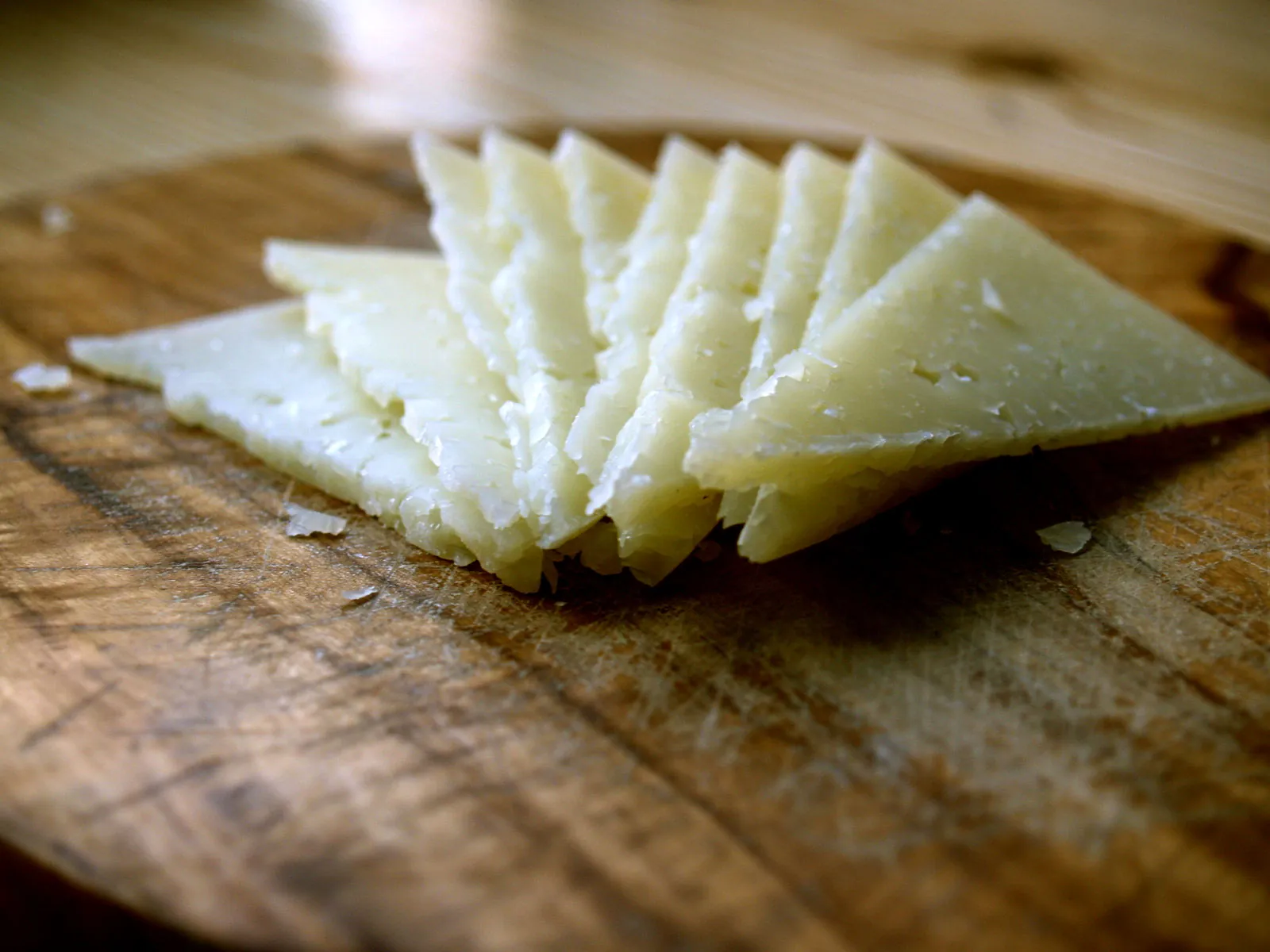
It ages from 30 or 60 days up to two years, turning from buttery and mildly tangy to sharp, spicy and a little grainy.
The marks matter because Manchego is a legal name, a protected designation of origin (PDO) since 1996, and the word alone is not proof. oriGIn, an international alliance of protected-name producers, lists imitations sold in the US and Mexico that are made from cow's milk with no minimum aging.
Manchego cheese at a glance
This Manchego cheese at a glance table covers the cheese and the rules behind the protected name.
| Manchego | |
|---|---|
| Milk | Manchega sheep only; pasteurized or raw, with raw labeled Artesano |
| Where | La Mancha, central Spain: the provinces of Albacete, Ciudad Real, Cuenca and Toledo |
| Protected name | Queso Manchego, EU PDO since 1996 |
| Size | Up to 4.7 in (12 cm) tall and 8.7 in (22 cm) across; 0.9 to 8.8 lb (0.4 to 4 kg) |
| Minimum age | 30 days for wheels up to 3.3 lb (1.5 kg), 60 days for larger ones; 2 years at most |
| Rind | Hard, from pale yellow to brown, with a woven pattern on the side and a flower mark on each face |
| Texture | Firm and compact, buttery and slightly floury; grainy when very old |
| Flavor | Slightly acidic and savory, spicier with age, with a lingering taste of sheep's milk |
Where Manchego cheese comes from
Manchego cheese comes from La Mancha, the high, dry plain of central Spain that Cervantes made famous with Don Quixote, and the protected area covers parts of four provinces. Only milk from the Manchega breed is allowed, and the regulatory board, the Consejo Regulador, says it cannot be mixed with milk from other animals, not even other breeds of sheep. The flocks graze all year on natural pasture, with extra feed when needs rise in pregnancy and lactation.
The name took decades to settle. The Consejo says the PDO was organized provisionally in 1982 and had its first regulations in 1984, and that after a long legal battle Spain's Supreme Court ruled that only cheese made to those rules may be called Queso Manchego. EU registration followed in June 1996.
How to spot real Manchego cheese
To spot real Manchego cheese, check four marks: the rind, the casein plate, the numbered back label and the wording on the commercial label.
- The rind. The side shows a woven, plaited pattern called the pleita, once pressed by molds of woven esparto grass and now by plastic molds that copy the design, and each flat face carries a flower mark, the flor. The color runs from pale yellow to brown, and the rules ban anything that turns the rind black.
- The casein plate. A ring set into the rind, stamped D.O.P. QUESO MANCHEGO with a series of five digits and three letters.
- The back label. A numbered label stuck to the commercial label beside the Denominación de Origen logo, with a blue stripe in its top right corner on cheeses under 3.3 pounds (1.5 kg) and a green stripe on wedges in plastic film.
- The wording. "Denominación de Origen Queso Manchego," a statement that the cheese is made entirely from Manchega sheep's milk, and the EU PDO logo. Raw-milk cheese adds the word Artesano.
The pattern is the first clue, not the proof: the plate and back label come from the Consejo, and "Manchego-style" on a package is not the protected cheese.
What each Manchego age tastes like
Each Manchego age tastes different, and Spanish labels use four words to sort them. Spain's cheese quality standard sets minimum ripening times for those words on wheels over 3.3 pounds (1.5 kg), and Manchego's own 60-day floor sits above the first one.
| Label | Minimum ripening (wheels over 3.3 lb) | What to expect |
|---|---|---|
| Semicurado (semi-cured) | 35 days in the standard; 60 for Manchego | Buttery and slightly acidic, the most supple |
| Curado (cured) | 105 days (about 3.5 months) | Stronger and more savory |
| Viejo (old) | 180 days (6 months) | Spicy, drier, sometimes grainy |
| Añejo (extra old) | 270 days (9 months) | Spicy and drier still |
The Consejo's tasting notes describe a lactic, intensely acidic aroma that develops spicy hints with age, and a texture with low elasticity, buttery and somewhat floury, that turns grainy in very mature cheeses. Curado is the safest first buy: firm enough to slice thin, with enough savor to stand up to ham and quince paste.
How to serve and cook with Manchego cheese
Serve Manchego cheese the Spanish way, as a tapa: thin triangles with quince paste (membrillo), Marcona almonds, olives and cured ham, with the rind trimmed off. Take it out of the fridge about half an hour before serving so the flavor opens up, and cut it as shown in the charcuterie cheese guide.
Trim the rind because the rules let makers coat it with paraffin or olive oil. Semicurado melts into a sandwich or an omelet, while curado and viejo are better shaved over salads or eaten as they are. A Rioja or Tempranillo suits it, as does a dry sherry, and the pairing guide has more.
Manchego cheese, raw milk and rennet
Manchego cheese can be made from pasteurized or raw milk, and the label tells you which: raw-milk cheese may carry the word Artesano, and an artisan cheese made on its own farm may add queso de granja. The regulator's description limits the 30-day minimum to small cheeses made with pasteurized milk, so an Artesano wheel ages at least 60 days.
The CDC advises people who are pregnant, adults 65 and older and anyone with a weakened immune system to avoid raw milk cheese unless it is heated to 165°F or until steaming hot; see cheese during pregnancy for safer choices. The rules also name natural rennet or other authorized coagulating enzymes, so Manchego is not guaranteed vegetarian.
What most Manchego cheese advice gets wrong
Most Manchego cheese advice gets the ages and the rind wrong, and both mistakes change what you buy.
"Viejo" does not mean a year. It is often described as a year or more, but Spain's quality standard sets viejo at 180 days for a large wheel and añejo at 270, and the PDO caps every wheel at two years.
The 60-day minimum is not universal. The EU single document sets 30 days for wheels up to 3.3 pounds (1.5 kg) and 60 for larger ones, so a small wheel can reach the shelf younger than the 60 days often quoted.
A dark rind is not a flaw, but a black one is a warning. Aging browns the rind, and the specification allows paraffin or olive oil on it, but it forbids any substance that turns the rind black.
Questions about Manchego cheese
These are quick answers to common questions about Manchego cheese.
What does Manchego cheese taste like?
Manchego cheese tastes buttery and slightly tangy when young, and stronger, spicier and drier as it ages, with a lingering taste of sheep's milk.
What milk is Manchego cheese made from?
Manchego cheese is made only from the milk of Manchega sheep, with natural rennet or other authorized coagulants and salt. No cow's or goat's milk is allowed.
What is the pattern on Manchego cheese?
The pattern on Manchego cheese is the pleita, a plaited design on the side once pressed by woven esparto grass molds, plus a flower mark on each flat face.
Is Manchego cheese pasteurized?
Manchego cheese can be pasteurized or raw, and raw-milk cheese may be labeled Artesano.
Can you eat the rind on Manchego cheese?
Trim the rind off Manchego cheese before eating, because it is hard and the rules let makers coat it with paraffin or olive oil.
What cheese is similar to Manchego?
The cheese most similar to Manchego is Zamorano, another Spanish sheep's milk cheese, and Pecorino is the usual Italian stand-in; Manchego vs Pecorino compares them.
Buying your first Manchego cheese
For your first Manchego cheese, buy a curado wedge and check that its back shows a piece of the casein plate and that the package carries the numbered back label with a green stripe. Slice it thin, serve it with quince paste and almonds, and taste a young semicurado beside it to learn what the extra months add.
Sources
- Consejo Regulador: Identification, Elaboration, Sensory notes, Protected designation of origin and Manchega breed sheep, Fundación Consejo Regulador de la Denominación de Origen Queso Manchego
- Communication of an approved standard amendment, 'Queso Manchego' (single document, C/2025/3216), Official Journal of the European Union; Pliego de condiciones D.O.P. Queso Manchego (product specification, in Spanish), eAmbrosia register, European Commission
- Real Decreto 1113/2006, norma de calidad para quesos y quesos fundidos (Anexo I), Boletín Oficial del Estado, Government of Spain
- Preventing Listeria Infection, Centers for Disease Control and Prevention
- Manchego fact sheet, production zones, oriGIn (Organization for an International Geographical Indications Network)