
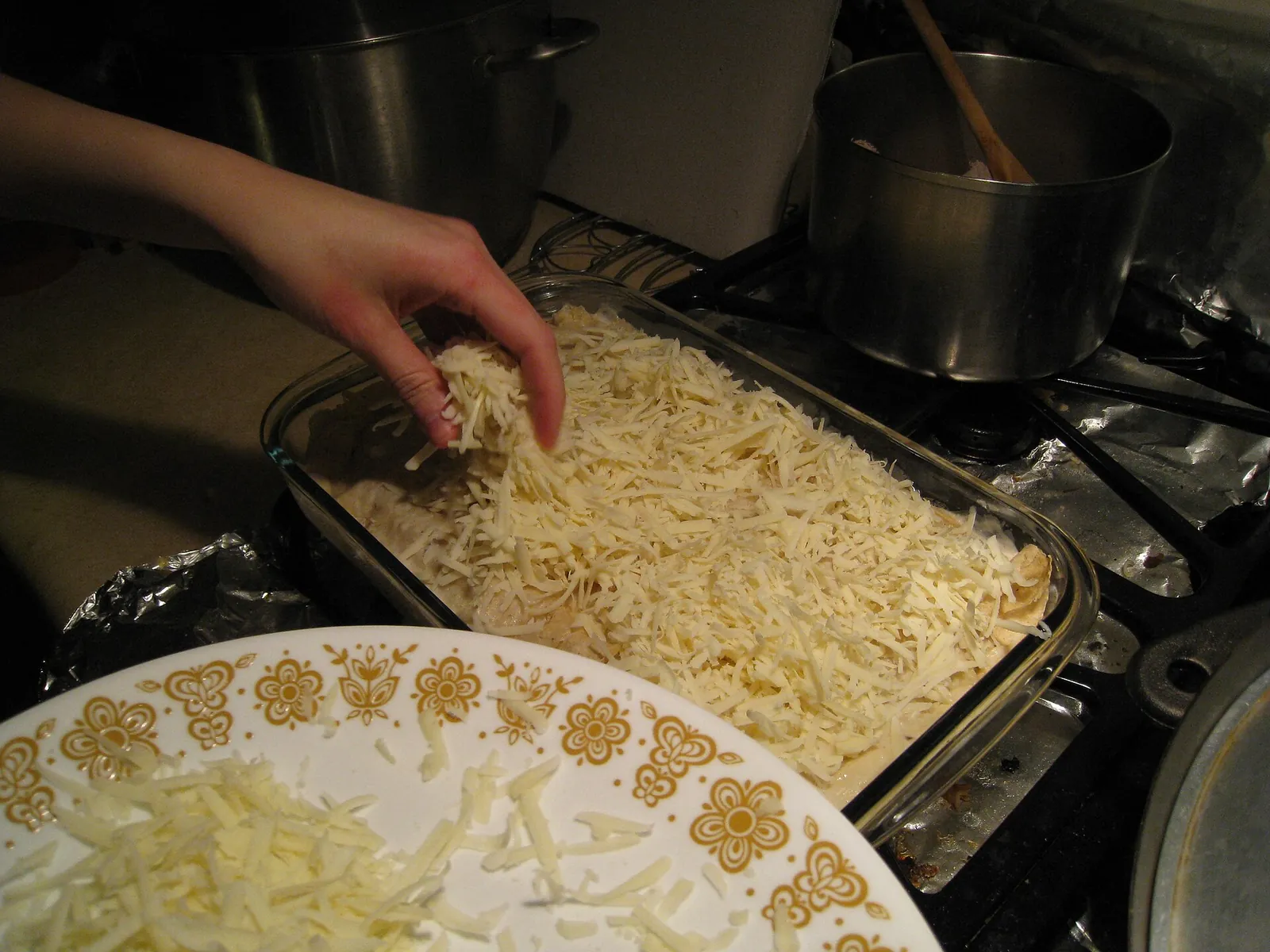
What makes Jack useful is water. The federal standard lets it hold up to 44 percent moisture, more than Colby or cheddar, and makers keep the curd young and soft, so it flows evenly under heat instead of splitting. Age a wheel for months and it becomes Dry Jack, a hard cheese for grating.
Monterey Jack cheese at a glance
This table shows Monterey Jack cheese at a glance, using the federal standard, USDA's 1953 handbook and USDA nutrient data.
| Monterey Jack | |
|---|---|
| Milk | Cow's, pasteurized |
| Origin | Monterey County, California |
| Protected name | None; federal standard 21 CFR 133.153 |
| Moisture | 44% at most; USDA measures 41.0 g water per 100 g |
| Milkfat | At least 50% of the solids |
| Age | Fresh Jack is cured a few weeks; Dry Jack, 6 months or more |
| Texture | Semisoft, supple, sliceable |
| Flavor | Mild and buttery |
| Melt | Fast and smooth |
| Per ounce (USDA) | 106 calories, 6.9 g protein, 8.6 g fat, 170 mg sodium |
Where Monterey Jack cheese came from
Monterey Jack cheese came from Monterey County, California, though who made the first wheel is still disputed. USDA's 1953 handbook says Monterey (or Jack) cheese was first made on farms there about 1892 and in factories from about 1916. Dairy Farmers of Wisconsin adds that friars made early versions in the 1700s and that businessman David Jacks was among the first to sell it widely, in the 1880s, which is how it took his name.
The Monterey County Weekly laid out the rival stories in 2007: a Carmel Valley dairyman, the Boronda family and Jacks himself. A Monterey library historian told it the clues are "not definitive," and the paper presents the friar tale as legend. The historians it quotes do agree that a country cheese, queso del país, existed before Jacks sold it.
What the federal standard says about Monterey Jack
The federal standard for Monterey Jack, 21 CFR 133.153, sets moisture, fat and milk treatment. "Monterey cheese" and "monterey jack cheese" are two names for one food. It must contain at least 50 percent milkfat in the solids and no more than 44 percent moisture, and its dairy ingredients must be pasteurized, so unlike cheddar it has no raw-milk route through a 60-day cure.
Makers set the milk with a lactic culture and rennet, cut and heat the curd, drain part of the whey, and press the curd in a cloth or a hoop. A wetter cousin, high-moisture jack, has its own standard at more than 44 and under 50 percent moisture. USDA's handbook says it is heated less, cooled fast and cured cold, and it ends up wetter and softer.
Why Monterey Jack melts so well
Monterey Jack melts so well because it is wet and mild, and its makers keep it that way. USDA measures 41 percent water in Jack, against 38 in Colby and 37 in cheddar. The University of Wisconsin's Center for Dairy Research notes that makers choose water-holding cultures for higher-moisture cheeses like Jack and add calcium chloride so they can use less rennet, because they do not want much protein breakdown in those varieties.
The result is a soft, young cheese that goes smooth when warmed. Jack flows rather than strings, so it suits a quesadilla or a pan of nachos, while Oaxaca and mozzarella are the picks for long pulls. Water alone does not explain it, since queso fresco is wetter and never melts, and the melting cheese ranking explains the rest.
Dry Jack, pepper jack and Colby-Jack
Dry Jack, pepper jack and Colby-Jack all start from Monterey Jack, but each behaves like a different cheese. Colby-Jack marbles Jack with Colby, and the Colby and Colby-Jack guide covers that pairing.
Dry Jack
Dry Jack is Monterey Jack aged until it turns hard enough to grate. USDA's 1953 handbook describes this "grating-type" Monterey as made from partly skimmed or skim milk and cured at least 6 months, sometimes coated with oil and pepper. Culture magazine says Vella's Dry Jack in Sonoma is aged 7 to 10 months, with Special Select wheels at a year or more and a rind of cocoa, vegetable oil and black pepper, and credits San Francisco wholesaler D. F. DiBernardi with developing Dry Jack during the First World War to replace imported Italian cheeses. Grate it over pasta and salads, or break it into chunks for a board.
Pepper jack
Pepper jack is Monterey Jack with chile peppers and herbs, and it keeps Jack's melt. Dairy Farmers of Wisconsin describes a noticeable kick that is usually not overwhelming. A flavored cheese still has to meet the Monterey standard, and its name must say what flavors it, under the federal rule for flavored cheeses. The pepper jack guide and the Monterey Jack vs. pepper jack comparison go further.
How to use Monterey Jack cheese
How to use Monterey Jack cheese comes down to its melt: put it where you want a smooth, mild blanket of cheese.
- Quesadillas and nachos: about 2 ounces (1/2 cup shredded) is enough for an 8-inch tortilla. Jack is a standard part of Mexican-style blends, which Wisconsin cheesemakers say also use queso quesadilla, asadero, Oaxaca, Chihuahua and cheddar. The quesadilla guide covers the pan.
- Burgers, grilled cheese and omelets: Jack softens fast at low heat and never fights the other flavors.
- Mac and cheese: make it a third to a half of the blend, with sharper cheddar for flavor, as in the mac and cheese guide.
- Boards: choose Dry Jack, or serve fresh Jack with something bright, like pickled jalapeños or fruit.
Buying and storing Monterey Jack cheese
Buying Monterey Jack cheese is easy: pick a block, check that the label says Monterey Jack or Monterey, and grate it yourself. The federal rule for grated and shredded cheeses lets bagged shreds carry anti-caking agents and mold inhibitors, so a block grated at home gives the smoothest melt. Wisconsin cheesemakers advise wrapping pepper jack in wax or parchment paper inside an airtight container in the refrigerator, which keeps it two to three weeks, and the same routine suits plain Jack.
What most Monterey Jack advice gets wrong
Most Monterey Jack advice repeats the same few facts, and three of them are worth a second look.
Jack, Monterey and Monterey Jack are one cheese. The federal name is "monterey cheese" or "monterey jack cheese," and USDA's 1953 handbook says "Monterey" has largely replaced "Jack," except for high-moisture jack.
Mild is the standard, not a flaw. USDA's grade standard lets a top-grade AA Jack be "lacking in flavor development." Buy it for the melt, and add flavor with peppers, sharp cheddar or Dry Jack.
Jack is never orange. Its standard lists no added color, while the cheddar and Colby standards allow it, so the orange in Colby-Jack comes from the Colby.
Questions about Monterey Jack cheese
These questions about Monterey Jack cheese come up most when people are shopping or cooking.
Does Monterey Jack cheese melt well?
Monterey Jack cheese melts very well, quickly and smoothly, because it is young and moist. It flows rather than strings.
What is the difference between Monterey Jack and pepper jack?
Pepper jack is Monterey Jack with chile peppers and herbs added, so the two share a base cheese and a melt. Pepper jack adds heat.
Is Monterey Jack the same as Colby Jack?
Monterey Jack is not the same as Colby-Jack. Colby-Jack is made from Colby and Monterey Jack curds that are pressed together while still warm, which gives it the marbled look.
What can you substitute for Monterey Jack cheese?
You can substitute cheddar or Colby for Monterey Jack cheese, which Wisconsin cheesemakers say melt well in most recipes. For quesadillas, Oaxaca cheese is the stretchier swap, and the substitute finder has more.
Is Monterey Jack cheese pasteurized?
Monterey Jack cheese is pasteurized, because the federal standard requires pasteurized dairy ingredients.
Choosing Monterey Jack cheese
Choosing Monterey Jack cheese is about the job. Buy a block of fresh Jack for melting and grate it yourself, pick up pepper jack when you want heat, and look for Dry Jack when you want a grating cheese with age. A quick first test is a quesadilla made with plain Jack, then the same one with pepper jack, to taste what the peppers add.
Sources
- 21 CFR 133.153, Monterey cheese and monterey jack cheese, with 133.154, High-moisture jack cheese, 133.193, Spiced, flavored standardized cheeses, 133.146, Grated cheeses, 133.113, Cheddar cheese and 133.118, Colby cheese, eCFR (FDA standards of identity)
- Cheese Varieties and Descriptions (Agriculture Handbook No. 54, 1953), U.S. Department of Agriculture
- United States Standards for Grades of Monterey (Monterey Jack) Cheese (1996), USDA Agricultural Marketing Service
- Measuring and Controlling Acidity and Moisture During the Cheesemaking Process, Center for Dairy Research, University of Wisconsin-Madison
- You Don't Know Jack (Jessica Lyons, October 4, 2007), Monterey County Weekly
- Dairy Farmers of Wisconsin: Monterey Jack Cheese, Mexican Cheese Blends, Complete Guide to Pepper Jack Cheese and How To Swap Cheeses in a Recipe, Dairy Farmers of Wisconsin
- Dry Jack Special Select, Culture: the word on cheese
- USDA FoodData Central (SR Legacy): Monterey, Colby, cheddar and queso fresco, U.S. Department of Agriculture