
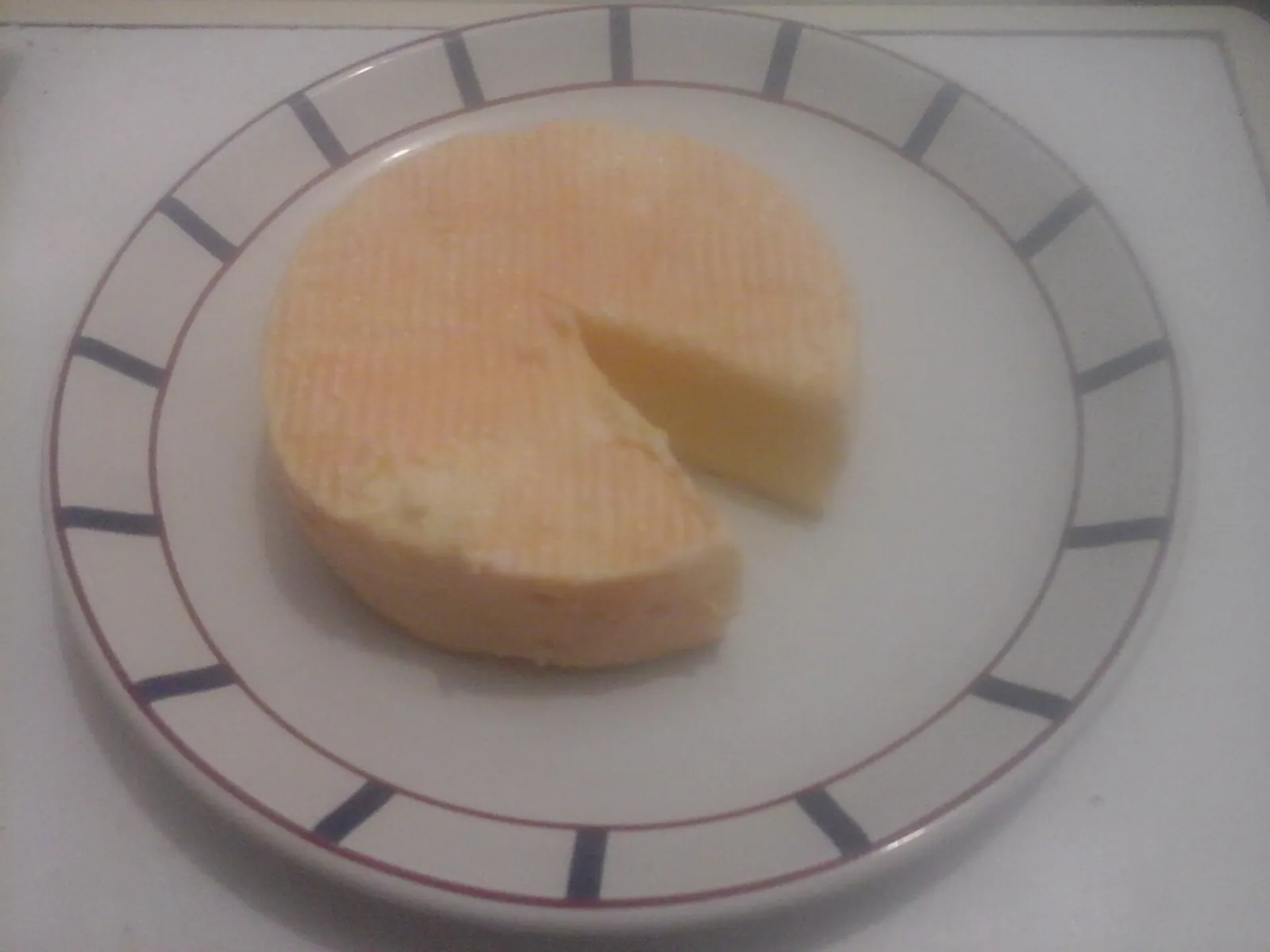
Neither is a copy of the other, though one grew out of the other.
The short test is the smell. Open the package and if it smells like milk and butter, it is the American style. If it fills the kitchen, it is French. The sections below cover how each is made, how they taste and which one a recipe wants.
Muenster vs Munster at a glance
Here is Muenster vs Munster at a glance.
| Detail | American Muenster | French Munster |
|---|---|---|
| Home | Wisconsin and the US | Vosges mountains, Alsace and Lorraine |
| Milk | Pasteurized cow's milk | Cow's milk from four named breeds |
| Rind | Thin orange rind, colored with annatto | Sticky orange-pink rind from repeated washing |
| Smell | Faint, milky | Powerful, animal and lactic |
| Texture | Semi-soft, smooth, sliceable | Soft, creamy or chalky when young |
| Flavor | Mild, buttery, slightly nutty | Less forceful than the smell suggests |
| Protected name | None; US standard 21 CFR 133.160 | AOP since 1996 |
| Best use | Melting and sandwiches | Cheese board, regional dishes |
Where Muenster and Munster come from
Muenster and Munster come from the same French monastery tradition. Dairy Farmers of Wisconsin says American Muenster was developed by Wisconsin cheesemakers in the 1800s, when French immigrants tried to imitate the Munster of their homeland. French Munster was made by Benedictine monks in the Vosges, and its protected name covers both Munster in Alsace and Géromé, the Lorraine side, which the French agriculture ministry calls "a cheese with dual nationality."
So the American cheese did not stay a copy. It lost the washed rind and the smell, and kept the name.
What American Muenster is
American Muenster is a semi-soft, pasteurized cow's milk cheese with a creamy white interior and a thin orange rind. Dairy Farmers of Wisconsin describes a mild, slightly nutty, buttery flavor that gains complexity with age, and says it is not made with washed-rind methods. The orange comes from annatto, a plant dye, so the color is cosmetic.
The FDA writes the American version into 21 CFR 133.160: at least 50 percent milk fat in the solids and at most 46 percent moisture. That moisture ceiling is why it is soft and melts well. The same standard allows two spellings, "muenster cheese" or "munster cheese," so a US package that says Munster may be the mild cheese, not the French one.
What French Munster is
French Munster is a soft, washed-rind cow's milk cheese with a protected name, meaning only cheese from the Vosges area, made to a written specification, can use it. The EU specification amendment limits the milk to cows of the Vosges, Simmental, Prim'Holstein or Montbéliarde breeds and sets cellar conditions at 90 percent humidity and 10 to 16°C (50 to 61°F). The French ministry's Munster-Géromé page lists seven departments in the area: Bas-Rhin, Haut-Rhin, Haute-Saône, Meurthe-et-Moselle, Moselle, Territoire de Belfort and Vosges.
The rind is washed during ripening, which feeds the bacteria behind the sticky orange-pink rind and the smell. The guide to rind types explains the process, and the best stinky cheeses ranks Munster among its peers.
How Muenster vs Munster compare in flavor and smell
Muenster vs Munster is mostly a contrast of smell, because the flavor gap is smaller than the smell gap. French Munster has a powerful, "animalic and lactic" aroma, according to the French dairy trade body, yet it is described as medium in strength and relatively mild on the palate. The ministry puts it as less forceful than appearances suggest. American Muenster has no such drama: it tastes of butter and mild nuts, with a faint tang.
Texture follows the same split. French Munster is soft, with a cream-colored paste that can be chalky when young and creamy when ripe, and an orangey-pink rind. American Muenster is firm enough to slice thin and stack on a deli board.
How to use Muenster and Munster
Use American Muenster for melting and sandwiches, and French Munster as a cheese to be served. American Muenster works in grilled cheese, on burgers, in tuna melts and mac and cheese. It melts smoothly and quietly; the best melting cheeses ranking shows how it stacks up.
French Munster is traditionally served with cumin seeds, boiled potatoes and Alsace wine, and appears in quiches, omelettes and pies, according to the French dairy trade body. Serve it ripe at room temperature, with dark bread and a glass of Riesling or Gewürztraminer. For the broader Munster profile, see the cheese directory.
Muenster and Munster substitutes
The best Muenster and Munster substitutes depend on which one the recipe means. For American Muenster, use Monterey Jack, mild Colby-Jack or Havarti: Dairy Farmers of Wisconsin lists Muenster among the cheeses Colby-Jack can replace. For French Munster, move to other washed-rind cheeses such as Limburger, which smells similar, or Taleggio for a gentler version. Neither swap is exact, since the French cheese has a depth that mild cheeses lack. The substitute finder has more.
What most Muenster vs Munster advice gets wrong
Most Muenster vs Munster advice gets one thing wrong: it treats the spelling as the difference.
Spelling does not tell you which cheese
The spelling does not tell you which cheese is in the package, because US law allows both Muenster and Munster for the American cheese. Look at the rind and the origin line instead. A thin, bright orange, dry edge and a Wisconsin or other US maker means the mild cheese. A damp, orange-pink, sticky rind and "Product of France" means the French one.
The smell is stronger than the taste
The smell of French Munster is stronger than its taste, so a cheese that scares you at the door can be gentler than expected on the tongue. Eat the paste before judging, and cut a wedge when it is ripe and soft, not chalky in the center.
Questions about Muenster vs Munster
These are the questions about Muenster vs Munster that come up most.
Are Muenster and Munster the same cheese?
Muenster and Munster are not the same cheese, although they share a history. American Muenster is mild, pasteurized and made without a washed rind, while French Munster is a protected washed-rind cheese with a strong smell.
Why does French Munster smell so strong?
French Munster smells strong because its rind is washed during ripening in a damp cellar, which feeds the bacteria that give it a sticky rind and a powerful aroma.
Is American Muenster strong or spicy?
American Muenster is not strong or spicy, and tastes mild, buttery and slightly nutty. It is a friendly melting cheese.
Is Muenster a good melting cheese?
Muenster is a good melting cheese, because the US standard lets it hold up to 46 percent moisture, and it melts smoothly in sandwiches and casseroles.
What is Munster-Géromé?
Munster-Géromé is the full protected name for French Munster, covering both the Alsace (Munster) and Lorraine (Géromé) sides of the Vosges. Munster has held an AOP since 1996.
Choosing between Muenster and Munster
Choosing between Muenster and Munster starts with the dish: pick American Muenster for sandwiches and melts, and French Munster for a board or a regional meal. To try the French one, buy a small round that is ripe but not weeping, and eat it with potatoes and a little cumin.
Sources
- 21 CFR 133.160, Muenster and munster cheese, Code of Federal Regulations (Cornell Legal Information Institute)
- Muenster Cheese, Dairy Farmers of Wisconsin
- Commission Implementing Regulation (EU) 2021/140, amendments to the specification for Munster/Munster-Géromé (PDO), European Commission, via Lexaris
- Le Munster-géromé AOP, French Ministry of Agriculture
- Munster, Dairy Products from France (French dairy interprofession)