
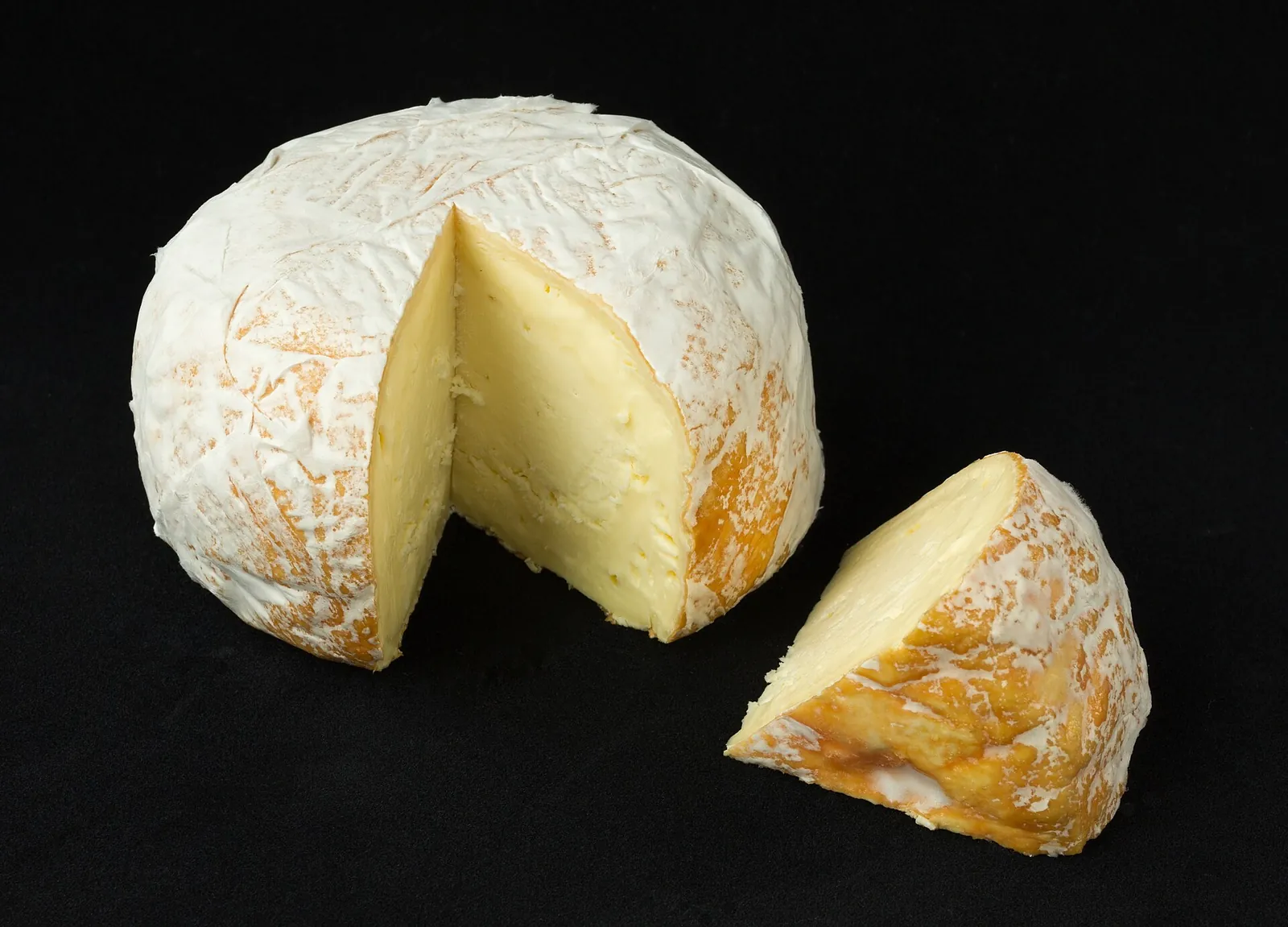
You can usually eat the first two, treat the third as optional, and never eat the others.
The rind is the cheese's skin, and it tells you how the cheese was made before you taste it. White and velvety, orange and sticky, or gray and dry, each look points to a different treatment during aging.
Cheese rind types at a glance
This cheese rind types at a glance table compares each type by how it forms, what it looks like and whether to eat it.
| Rind type | How it forms | Looks like | Examples | Eat it? |
|---|---|---|---|---|
| Bloomy | White mold sprayed on or added to the surface | Soft, white, velvety | Brie, Camembert | Yes |
| Washed | Surface washed with brine or alcohol, encouraging B. linens | Orange to red, sticky | Limburger, Taleggio, Époisses | Usually, if you like it |
| Natural | Surface dries and ages in air | Dry, gray or brown, firm | Cheddar, Parmesan, tommes | Optional; often tough or bitter |
| Waxed | Wax dip after or during aging | Smooth, colored, hard | Edam balls, Babybel | No |
| Cloth | Cloth wrap, often with lard | Rough, tan, fabric weave | Clothbound cheddar | No |
| Rindless | Wrapped in film, no crust | None | Many blocks and loaves | Not applicable |
Bloomy rinds
Bloomy rinds are the soft white skins on cheeses like Brie and Camembert. Wisconsin Cheese says they form when edible mold spores such as Penicillium candidum or camemberti are sprayed on the outside, and calls them almost always worth eating, with a woodsy, mushroomy taste.
Codex defines a mold-ripened cheese as one ripened mainly by mold growth throughout the interior or on the surface. The mold works inward as the cheese ripens, which is why a whole Brie goes from firm and chalky in the center to creamy near the rind. If a bloomy cheese smells of ammonia, it has overripened; the rind itself is not the problem. Spots of unexpected colored mold are a different matter, covered in white mold on cheese.
Washed rinds
Washed rinds come from washing the surface repeatedly during aging. Wisconsin Cheese describes salty brine or alcohol washes that encourage molds and bacteria like B. linens to grow, giving a reddish or orange color, and says the rinds may be quite salty and likely to be stinky. Limburger and brick are its examples; Taleggio and Époisses are the ones most shoppers know.
The smell is stronger than the taste. A washed-rind cheese often tastes savory and meaty, and the rind carries much of that flavor, so eat a small piece with paste before deciding to trim it. The smelliest are ranked in the best stinky cheeses.
Natural rinds
Natural rinds are what a cheese grows when its surface is simply left to dry and age in air. Wisconsin Cheese says they develop over time on varieties like cheddar and Parmesan, and that they are technically edible but will likely taste bitter and not be pleasant to chew.
That is useful honesty. A thin rind on a young tomme or a Gouda is fine; a thick Parmesan rind is not a snack, but it is excellent in a pot of soup or beans, as covered in what to do with cheese rinds. A mottled gray natural rind with a dusting of mold is normal on a tomme such as Tomme de Savoie.
Waxed, cloth and rindless cheeses
Waxed, cloth and rindless cheeses are not rinds in the strict sense. Wisconsin Cheese notes that protective wrappings such as wax, paper and bark are not natural rinds. Wax sealed over a cheese keeps moisture in and mold out, and you peel it off: Babybel and the traditional red Edam ball are the familiar cases. Neither Dutch specification for Edam or Gouda requires wax at all, as the Gouda vs Edam comparison shows.
Clothbound cheddar is wrapped in cloth, usually rubbed with fat, and a natural rind forms under it; trim the cloth, as with Cabot Clothbound. Rindless cheese is ripened in plastic film or cut from a larger block, so there is no crust to worry about. It is the common supermarket form and is typically milder, because the film holds moisture in and slows rind-driven flavor development.
Which cheese rinds can you eat?
Which cheese rinds you can eat depends on the type and your taste. Eat bloomy rinds on Brie and Camembert. Try washed rinds in small bites and trim them if they turn too salty or ammoniated. Taste natural rinds first and skip tough or waxy-feeling ones. Never eat wax, cloth, paper, bark ties or plastic.
A rind is also safe only if the cheese is. Soft, mold-ripened cheeses are a group pregnancy guidance names, and the FDA standard for soft ripened cheese (21 CFR 133.182) requires unpasteurized-milk versions to be cured at 35°F or above for at least 60 days, and that guidance, not the rind, is what matters; see cheese during pregnancy. The longer guide on eating cheese rind covers specific cheeses one by one.
What most cheese rind types advice gets wrong
Most cheese rind types advice reduces to one rule, "if it is a natural rind you can eat it," and misses four things.
Edible is not the same as good. A Parmesan rind is technically edible and unpleasant to chew, which is why cooks simmer it instead.
Orange does not mean spoiled. The color of a washed rind is the point, not a flaw.
Wax color is not a code. A red wax coating does not tell you the cheese is Edam, as the Edam and Gouda specifications do not require wax.
Cheese and rind can be different ages. The rind of a young cheese is soft and the rind of an old one is hard, so judge each wedge by feel.
Questions about cheese rind types
These are quick answers about cheese rind types.
What are the main types of cheese rind?
The main types of cheese rind are bloomy, washed and natural, plus added coverings such as wax and cloth: bloomy rinds are white and mold-formed, washed rinds are orange and brine-treated, and natural rinds are dry and aged.
Can you eat the rind on Brie?
You can eat the rind on Brie, as bloomy rinds are almost always worth eating and add a mushroomy flavor.
Can you eat the wax on cheese?
You cannot eat the wax on cheese: it is a protective coating, not a rind, so peel it off before eating.
Is a washed rind safe to eat?
A washed rind is edible, though it can be salty and strong, so taste a small piece and trim it if you do not like it.
Why does washed-rind cheese smell so strong?
Washed-rind cheese smells strong because the brine or alcohol washes encourage bacteria like B. linens on the surface, and they produce pungent compounds, although the paste inside often tastes milder than the smell.
Choosing by cheese rind types
Choosing by cheese rind types is a good way to shop: a white rind promises a soft, creamy cheese, an orange one a pungent, savory cheese, and a dry gray one a firmer, aged cheese. A board with one of each, such as Brie, Taleggio and an aged cheddar, shows the three side by side. For firmness rather than rind, see soft, semi-soft and hard cheese.
Sources
- Cheese Rind Types, Wisconsin Cheese, Dairy Farmers of Wisconsin
- General Standard for Cheese (CXS 283-1978), Codex Alimentarius, FAO and WHO
- 21 CFR 133.182, Soft ripened cheeses, Electronic Code of Federal Regulations