
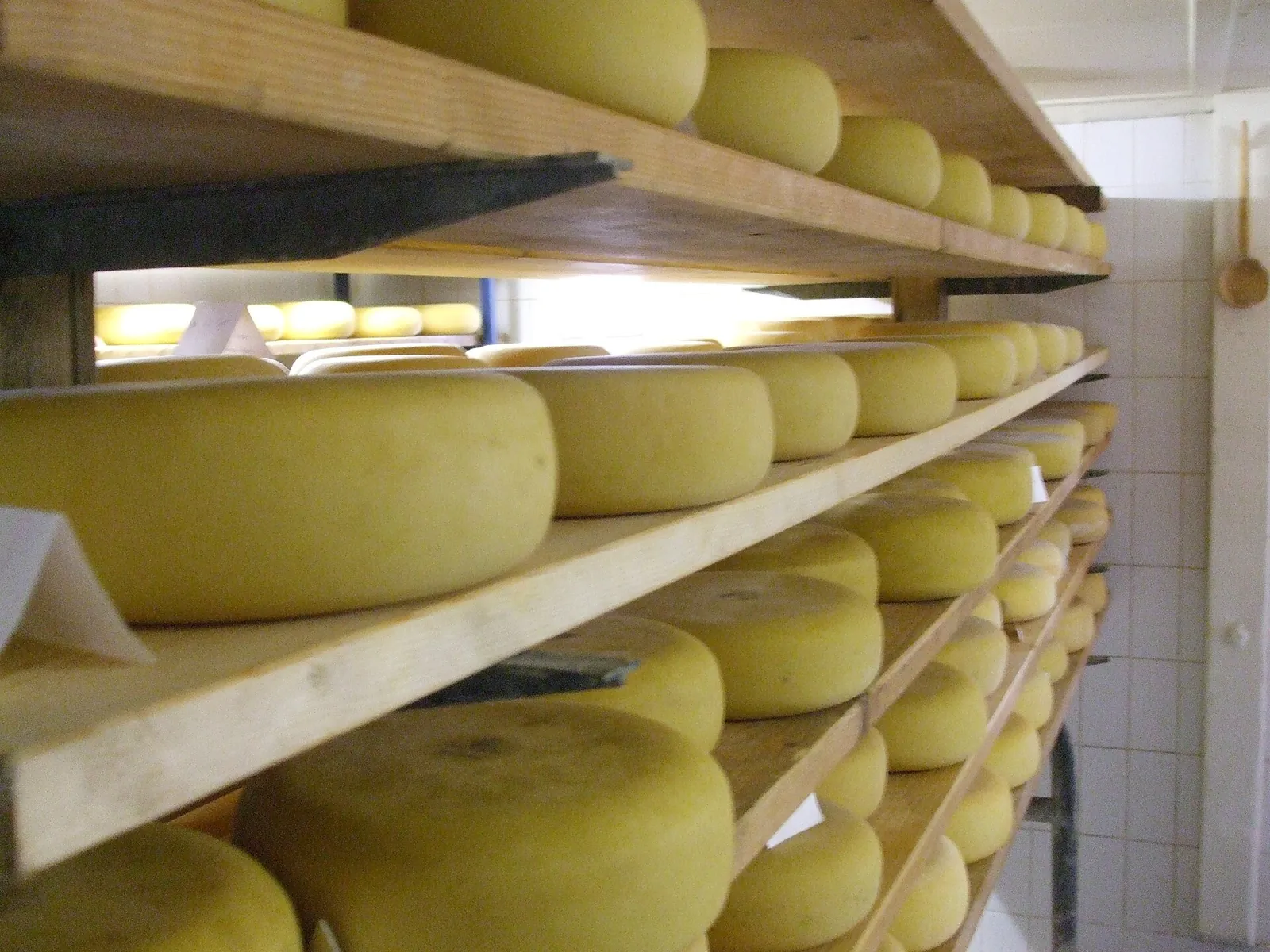
Most cheeses sit somewhere on the line between them, and the label rarely says where. Knowing what aging actually changes tells you how a cheese will taste, melt and keep before you open it.
Fresh vs aged cheese at a glance
This fresh vs aged cheese at a glance table sets the two groups side by side, with water content from USDA's generic entries (grams of water per 100 grams of cheese).
| Fresh cheese | Aged cheese | |
|---|---|---|
| Examples | Cottage cheese (79.8% water), ricotta (73.7%), cream cheese (52.6%), whole-milk mozzarella (50.0%), queso fresco (51.4%) | Cheddar (36.7%), Swiss (37.6%), Gruyère (33.2%), hard Parmesan (30.0%) |
| Time before eating | Days after making | Weeks, months or years |
| Texture | Soft, moist, spreadable or springy | Firm, dense, often crumbly or crystalline |
| Flavor | Milky, clean, lightly tangy | Sharp, nutty, savory, concentrated |
| Melt | Softens or weeps; fresh mozzarella stretches | Melts less smoothly; best grated in small amounts |
| Lactose | Higher | Lower |
| Keeps | Days, then spoils fast | Weeks to months, once cut |
What fresh cheese is, and what counts as aged
What fresh cheese is has a formal answer. The Codex General Standard for Cheese defines unripened cheese, including fresh cheese, as cheese that is ready for consumption shortly after manufacture, and ripened cheese as the opposite: cheese held until chemical and physical changes make it what it is.
Aged is looser. Some standards set a floor: the FDA's Parmesan standard (21 CFR 133.165) requires curing for at least 10 months and no more than 32 percent moisture, while its cheddar standard sets a ceiling of 39 percent moisture and leaves the aging to the maker. That is why "aged cheddar" is a marketing range, not a legal grade. The aged vs young cheddar page covers the labels you will see.
Moisture and texture in fresh vs aged cheese
Moisture and texture in fresh vs aged cheese move together, because water is what keeps a cheese soft. Creamed cottage cheese is about 80 percent water by USDA's figures, whole-milk ricotta about 74, and both are spoonable. Cheddar is about 37, Gruyère about 33 and hard Parmesan about 30, and those are the cheeses that slice, shave and snap.
Aging dries a cheese in two ways. Water evaporates through the rind or surface over time, and the cheese's proteins, broken down by enzymes, tighten into a denser paste. Long-aged cheeses can also develop crunchy crystals, which come from that protein breakdown, not from added salt or sugar. If you want the sorting by firmness itself, soft, semi-soft and hard cheese lays out the classes.
Flavor and lactose in fresh vs aged cheese
Flavor and lactose in fresh vs aged cheese both follow the same process: time converts what the milk brought into something else. A fresh cheese tastes like cultured milk, clean and a little tangy. As a cheese ages, enzymes and bacteria split proteins and fats into smaller flavor compounds, and the water that leaves concentrates them, so the same milk ends up sharp, nutty or caramel.
Lactose goes the other way. Most of it leaves in the whey, and the cheese culture turns much of the rest into lactic acid, so less is left the longer a cheese ripens. The National Institute of Diabetes and Digestive and Kidney Diseases suggests lactose-sensitive people try hard cheeses such as cheddar or Swiss, which are lower in lactose than most dairy. Fresh cheeses made from curds that keep their whey, like cottage cheese and ricotta, are the ones to be careful with. Two longer guides cover the details: lactose in cheese and cheese for the lactose intolerant.
Melting and cooking with fresh vs aged cheese
Melting and cooking with fresh vs aged cheese is mostly about water and protein structure. A cheese in the middle of the age range melts best: young cheddar, Monterey Jack and Gouda go smooth because their protein network is relaxed and still holds some water. Aged cheeses turn grainy or oily when heated hard, so grate them over the top or stir in a small handful at the end.
Fresh cheeses behave differently again. Fresh mozzarella melts and stretches but releases water, which is why pizza makers pat it dry. Ricotta and cottage cheese soften without flowing and are used for filling and baking, not for sauce. The melting cheese ranking puts numbers to which ones work.
Shelf life and safety of fresh vs aged cheese
Shelf life and safety of fresh vs aged cheese are the same story told as risk. Water, mild salt and no ripening time give bacteria room to grow in a fresh cheese, so it should be kept cold, eaten by the date on the package and not left out for hours. A hard aged cheese has less water to work with and keeps longer, and when a spot of surface mold appears, the usual advice for hard cheeses is to cut it away generously, which does not apply to soft or fresh cheeses.
Raw-milk rules show the difference clearly. In the US, the FDA's standard for soft ripened cheese (21 CFR 133.182) says that if the milk is not pasteurized, the cheese must be cured at no less than 35°F for no less than 60 days. A fresh cheese cannot take that route because it is not aged, so fresh cheeses on US shelves are made from pasteurized milk. Soft and fresh cheeses are also the group most often named in pregnancy guidance, which belongs to the FDA and your doctor; the pregnancy page points to the current advice.
What most fresh vs aged cheese advice gets wrong
Most fresh vs aged cheese advice repeats three shortcuts: that fresh means soft, that aged means strong, and that age is printed on the label.
Fresh is not always soft. Fresh mozzarella and queso fresco are made to be eaten young, yet their paste is springy or crumbly, and cottage cheese is mostly curd. Texture comes from moisture and curd handling, not age alone.
Aged is not always strong. A cheese can be old and gentle. Strength depends on the milk, the culture and the rind, so an aged Gouda is sweet and a young washed-rind cheese can already smell loud.
Age is rarely on the label. Words like "sharp", "extra sharp" and "vintage" have no fixed meaning in a standard, and a "10-year" claim comes from the maker. Check the date and the producer, not the adjective.
Also, wet does not mean unaged: ricotta is wetter than almost anything, yet Brie at about 48 percent water is a ripened cheese that needs weeks.
Questions about fresh vs aged cheese
These are quick answers to the most common questions about fresh vs aged cheese.
What is the difference between fresh and aged cheese?
The difference between fresh and aged cheese is mainly time: fresh cheese is eaten shortly after it is made and stays moist, mild and perishable, while aged cheese is ripened for weeks or years and becomes drier, sharper and longer-keeping.
Why does aged cheese taste stronger than fresh cheese?
Aged cheese tastes stronger than fresh cheese because enzymes and bacteria break proteins and fats into smaller flavor compounds, and evaporating water concentrates them.
Does aged cheese have less lactose than fresh cheese?
Aged cheese generally has less lactose than fresh cheese, because lactose drains with the whey and ripening cultures consume what remains. NIDDK names cheddar and Swiss as lower-lactose choices.
Is fresh or aged cheese better for melting?
Fresh or aged cheese melts best only in the middle of the range: young and semi-soft cheeses such as young cheddar or Monterey Jack melt smoothest, fresh mozzarella melts and stretches, and long-aged cheese melts poorly.
Is fresh cheese safe if it is made from raw milk?
Fresh cheese made from raw milk is not a standard US product, since the 60-day aging route for unpasteurized cheese needs a cheese that is actually aged. See raw-milk cheese for the rules.
Choosing fresh vs aged cheese
Choosing fresh vs aged cheese comes down to the job. Pick fresh for spreading, filling and salads, and buy only what you will finish this week. Pick aged for a board, for grating and for a bold bite, and wrap the leftovers properly using the guidance on storing soft vs hard cheese. To feel the difference, taste a fresh ricotta, a young cheddar and a Parmigiano-Reggiano on one plate, in that order.
Sources
- General Standard for Cheese (CXS 283-1978), Codex Alimentarius, FAO and WHO
- 21 CFR 133.165, Parmesan cheese, 133.113, Cheddar cheese and 133.182, Soft ripened cheeses, Electronic Code of Federal Regulations
- USDA FoodData Central (SR Legacy), water content per 100 g: cottage cheese (172179), ricotta (170851), cream cheese (173418), mozzarella (170845), queso fresco (172223), cheddar (173414), Swiss (171251), Gruyère (171242), Parmesan (170848), Brie (172177)
- Eating, Diet, and Nutrition for Lactose Intolerance, National Institute of Diabetes and Digestive and Kidney Diseases