
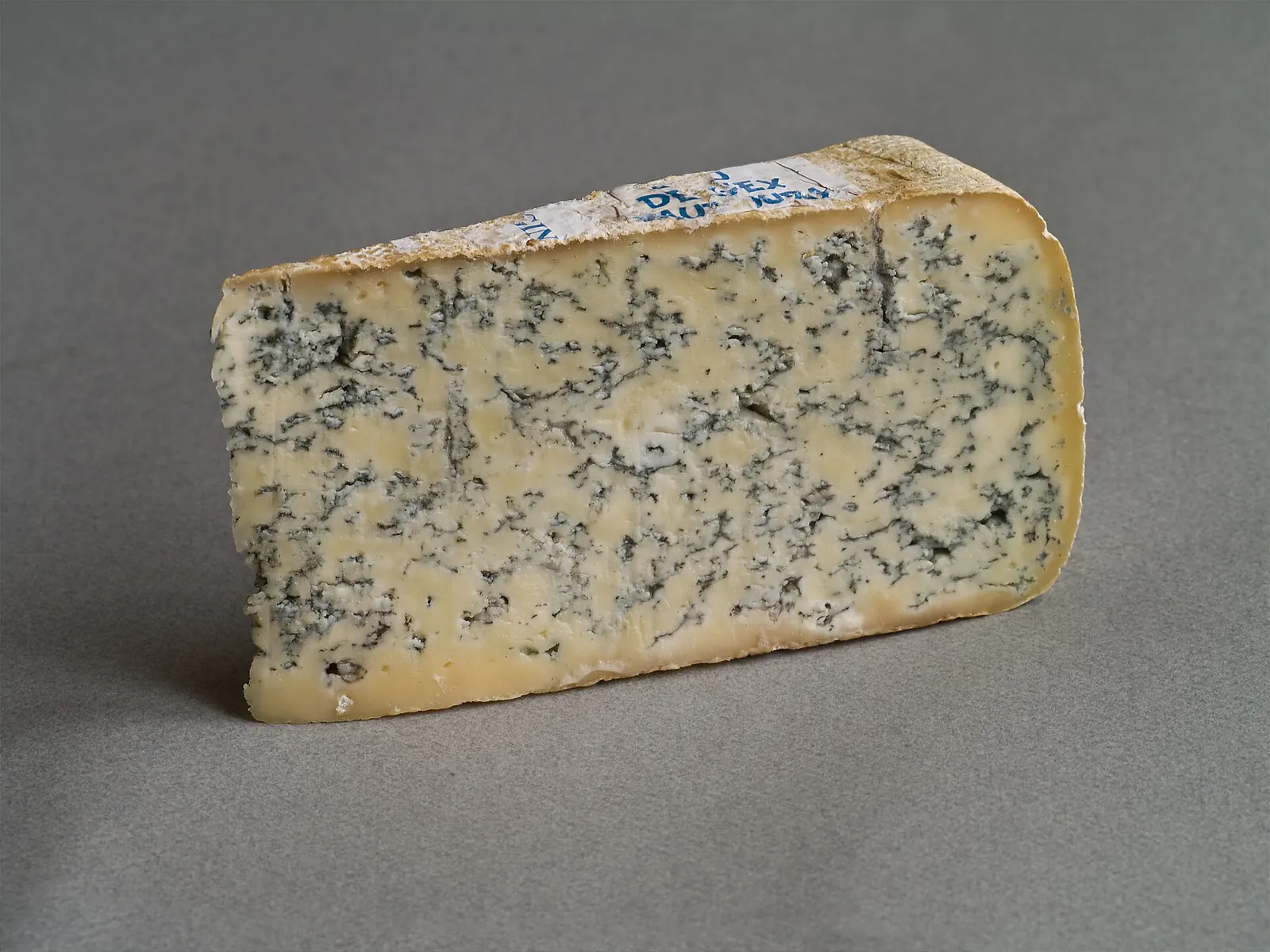
So every Gorgonzola and every Roquefort is a blue cheese, but a package marked only "blue cheese" is neither. The words Gorgonzola and Roquefort are legal names with rules about milk, place and age, and the plain term is not.
Blue cheese vs Gorgonzola vs Roquefort at a glance
This blue cheese vs Gorgonzola vs Roquefort table sets the generic category beside the two named cheeses, using their protected-name rules, the US standard and USDA data.
| Blue cheese (generic) | Gorgonzola | Roquefort | |
|---|---|---|---|
| What it is | Any cheese with Penicillium roqueforti veins | Italian blue, PDO | French blue, PDO |
| Milk | Cow, sheep or goat | Pasteurized whole cow's milk | Raw whole sheep's milk |
| Where | Worldwide | Lombardy and Piedmont, Italy | Southern France, aged in Roquefort-sur-Soulzon |
| Minimum age | 60 days (US standard) | 50 days (dolce), 80 days (piccante) | 90 days |
| Style | Varies | Soft and mild, or firm and sharp | Moist, crumbly, intense |
| Fat per ounce (USDA) | 8.1 g | Not in the USDA table | 8.7 g |
| Sodium per ounce (USDA) | 325 mg | About 180 mg (consortium figure) | 513 mg |
What blue cheese means
What blue cheese means is set out in the US federal standard: a cheese containing bluish-green mold throughout, at least 50 percent milkfat in the solids, no more than 46 percent moisture and at least 60 days old, according to 21 CFR 133.106. The standard names no country and no animal, so cow, sheep and goat blues all qualify.
The mold is Penicillium roqueforti, and it needs air. Makers pierce the wheel so the blue grows along the channels, which is why blues are crumbly or open in texture. The blue cheese guide covers the veins and the other famous blues such as Stilton and Danablu in depth. Because the category is so wide, a generic blue can be mild and creamy or sharp and salty, and the label rarely says which.
Gorgonzola: the Italian blue
Gorgonzola is the Italian blue, made only in a defined area of Lombardy and Piedmont from pasteurized whole cow's milk. It comes in two styles. Dolce is soft and mild enough to spread and is sold from 50 days of age, while piccante is firmer, crumblier and sharper and needs at least 80 days.
Most of what you find in the US is dolce. Gorgonzola is also one of the less salty blues: the consortium puts it at about 640 mg of sodium per 100 g, roughly 180 mg per ounce. The Gorgonzola page explains the foil label, the two styles and the American gorgonzola standard.
Roquefort: the French sheep's milk blue
Roquefort is the French blue, made only from raw whole sheep's milk and aged at least 90 days, beginning in the natural caves of Roquefort-sur-Soulzon. It carried the first appellation of origin for a French cheese in 1925 and became an EU PDO in 1996.
Sheep's milk is richer and more aromatic than cow's milk, and Roquefort is salted dry, so the result is moist, crumbly and bold. USDA lists generic Roquefort at 512.9 mg of sodium per ounce and 8.7 g of fat, against 324.9 mg and 8.1 g for generic blue cheese. Its mold is also different in lineage: a 2020 genomic study found Penicillium roqueforti was domesticated twice, with Roquefort using an older line. See the Roquefort page for the rules and for how to cook with it.
Which to buy: blue cheese, Gorgonzola or Roquefort
Which to buy among blue cheese, Gorgonzola and Roquefort depends on the dish and your tolerance for salt:
- Cream sauce, risotto, pizza: Gorgonzola dolce, which melts smoothly.
- Salad with pears and walnuts: Roquefort or Gorgonzola piccante, crumbled.
- A first blue: Gorgonzola dolce, the mildest of the named cheeses.
- Steak sauce: Roquefort melted into cream, tasted before any salt goes in.
- Dressing and wings: a generic crumbled blue, which costs less and does the job.
- A board: one named blue with honey or fruit, as the blue cheese pairing guide suggests.
What most blue cheese vs Gorgonzola vs Roquefort advice gets wrong
Most blue cheese vs Gorgonzola vs Roquefort advice makes three shortcuts: that all blues taste alike, that Gorgonzola is simply the mild one, and that Roquefort is just a French name for blue.
All blues are not alike. In a French study of cheeses made to Roquefort specifications, strains from the Roquefort mold population produced more of the compounds typical of blue cheese than strains from other populations, so the mold itself shapes flavor.
Gorgonzola is not always mild. Piccante is firmer and sharper, and the foil must say so. Dolce is the style that earned the mild reputation.
Roquefort is not a style. Only a cheese from raw sheep's milk, ripened in the Roquefort caves and meeting the PDO rules, can carry the name, and the US standard for Roquefort defines it as a sheep's milk blue. A cow's milk blue labeled Roquefort would be mislabeled.
Questions about blue cheese vs Gorgonzola vs Roquefort
These are quick answers to common questions about blue cheese vs Gorgonzola vs Roquefort.
Are Gorgonzola and Roquefort both blue cheeses?
Gorgonzola and Roquefort are both blue cheeses, since each is ripened with Penicillium roqueforti. Gorgonzola is Italian cow's milk, and Roquefort is French sheep's milk.
What is the difference between Gorgonzola and Roquefort?
The difference between Gorgonzola and Roquefort is milk, country and salt: Gorgonzola is pasteurized cow's milk from northern Italy and is usually milder, while Roquefort is raw sheep's milk from France and is saltier and more intense.
Is blue cheese the same as Gorgonzola?
Blue cheese is not the same as Gorgonzola, because blue cheese is the whole category and Gorgonzola is one protected Italian member of it.
Which is saltier, Gorgonzola or Roquefort?
Roquefort is saltier than Gorgonzola, at about 513 mg of sodium per ounce in USDA data against roughly 180 mg for Gorgonzola from the consortium's figure.
Can you substitute Gorgonzola for Roquefort?
You can substitute Gorgonzola for Roquefort in sauces, dressings and salads, using a little more of it, since it is milder and less salty. Taste before you add salt, and see the substitute finder for other matches.
Choosing between blue cheese, Gorgonzola and Roquefort
Choosing between blue cheese, Gorgonzola and Roquefort is easiest by tasting: buy a small wedge of Gorgonzola dolce and one of Roquefort, and eat them plain with a pear. If the first is enough blue for you, cook with it. If you want more, step up to Roquefort, or try the English alternative in the Stilton guide.
Sources
- 21 CFR 133.106, Blue cheese, Legal Information Institute, Cornell Law School
- USDA FoodData Central (SR Legacy): Cheese, blue (172175) and Cheese, roquefort (171250)
- Roquefort history and rules: First PDO in history, Confédération Générale des Producteurs de Lait de Brebis et des Industriels de Roquefort
- Independent domestication events in the blue-cheese fungus Penicillium roqueforti (Dumas et al., 2020) and Strong effect of Penicillium roqueforti populations on volatile and metabolic compounds (Caron et al., 2021), via PubMed