
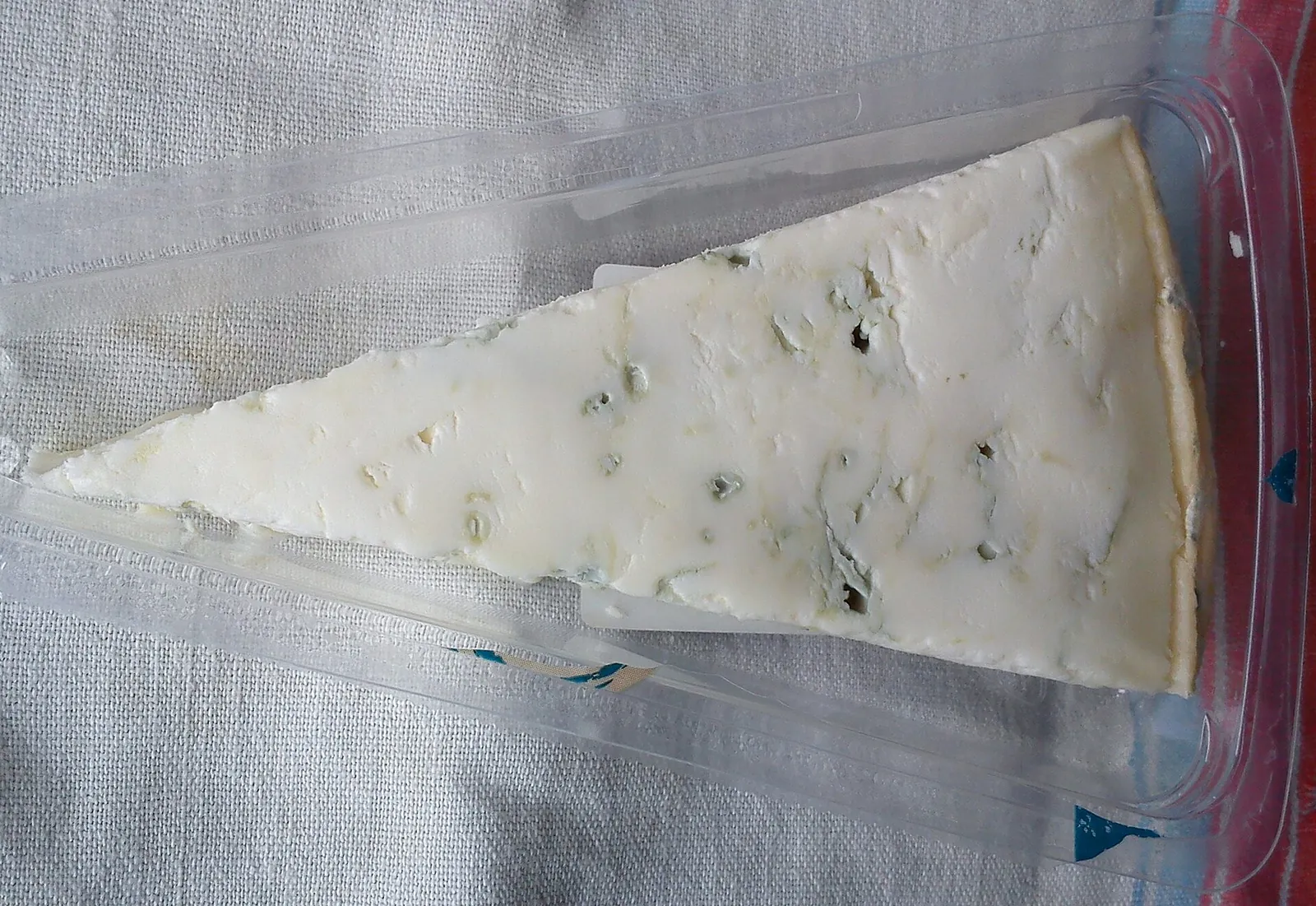
Gorgonzola dolce is soft enough to spread and only slightly spicy. Gorgonzola piccante is firmer and crumblier, with a stronger flavor and a paste the Gorgonzola consortium calls "more herbaceous."
Both styles start from pasteurized whole cow's milk and the same blue mold, Penicillium roqueforti. The difference is mostly time: the mold keeps breaking down fat and protein into the compounds that make blue cheese smell like blue cheese, and the rules let a dolce be sold at 50 days while a piccante needs at least 80.
Gorgonzola at a glance
Here is Gorgonzola at a glance, from the rules of its protected designation of origin (PDO).
| Gorgonzola dolce | Gorgonzola piccante | |
|---|---|---|
| Milk | Pasteurized whole cow's milk | Pasteurized whole cow's milk |
| Made in | 15 provinces of Lombardy and Piedmont, plus towns around Casale Monferrato | Same area |
| Aging | 50 to 150 days | 80 to 270 days (small wheel: 60 to 200) |
| Wheel | 20 to 30 lb (9 to 13.5 kg) | 20 to 30 lb, or a small wheel of 12 to 20 lb (5.5 to 9 kg) |
| Texture | Soft, creamy, spreadable | Firmer, crumbly |
| Flavor | Mild, milky, slightly spicy | Strong, sharp, more herbaceous |
| Rind | Gray or pinkish, not eaten | Gray or pinkish, not eaten |
| Label | "DOP Gorgonzola" on embossed foil | The same, plus the word "piccante" |
| Share of 2020 wheels | About 89 percent | About 11 percent |
Gorgonzola dolce vs piccante
Gorgonzola dolce vs piccante is the first choice at the counter, and the foil settles it: under the EU's single document for Gorgonzola, every piccante wheel and portion must carry the word "piccante" next to "DOP Gorgonzola," so a foil without it holds dolce.
Gorgonzola dolce, the sweet one
Gorgonzola dolce, the sweet Gorgonzola, is the style you are most likely to meet: of the more than 5 million PDO wheels made in 2020, only 11.3 percent were piccante, a 2021 study of Gorgonzola tasters reports. Nothing sweet goes in, and the consortium's nutrition panel lists zero grams of sugar; the sweetness is fresh milk and cream with only a slight bite. In that study, 358 people liked dolce more than piccante, and "creamy," "sweet," "nutty" and "salty" were the notes that won them over.
Gorgonzola piccante, the sharp one
Gorgonzola piccante is the older, sharper style: firm, crumbly and stronger. There is no chili in it; the rules allow only milk, calf rennet and salt, plus cultures and mold, so the bite comes from ripening. Age pushes it further. In the same study, a piccante aged 95 days scored higher than an 80-day one for "ammonia," "moldy," "soapy" and "pungent," and lower for "sweet" and "creamy." Piccante also comes as a small wheel, aged 60 to 200 days.
How Gorgonzola gets its blue veins
Gorgonzola gets its blue veins from Penicillium roqueforti spores added to the milk with lactic cultures, before there is any curd. The mold needs air, so during aging the wheels are pierced again and again (Wisconsin Cheese describes metal rods), and the veins spread along those channels. Some guides name the mold Penicillium glaucum, but the consortium and the US federal standard both say roqueforti. Blue Cheese 101 covers the rest of the blue family.
Why Gorgonzola tastes stronger with age
Gorgonzola tastes stronger with age because the mold never stops working. The consortium's notes on Gorgonzola's aroma lay out the chemistry: the young curd is acidic, and the spreading mold gradually neutralizes it. Proteins break into smaller pieces, and the typical Gorgonzola flavor starts to show after about 40 to 45 days, so even the youngest legal dolce tastes of blue.
Fat matters as much. Enzymes from the mold split milk fat into fatty acids, which become methyl ketones such as heptanone and nonanone, key parts of the cheese's aroma. Both kinds of breakdown run more intensely in Gorgonzola than in most cheeses, the consortium adds, and a piccante has had months longer for both.
Gorgonzola origin and PDO rules
Gorgonzola's origin is a small corner of northern Italy, and its PDO rules keep it there: it may be made only in 15 provinces of Lombardy and Piedmont plus 31 towns around Casale Monferrato. Legend dates it to 879 in the town of Gorgonzola outside Milan; another tradition credits Pasturo in Valsassina, whose natural caves hold 43 to 54°F (6 to 12°C), according to the consortium's history. Italy protected the name in 1955 and the EU in 1996. The consortium counted 5,277,959 wheels in 2024, most made around Novara.
The rules are short. At least half the cows' feed must be grown locally, the only raw materials are whole cow's milk, calf rennet and salt, and each wheel is stamped with its dairy's number, then wrapped in embossed foil (in use since 1975) once it is ready to sell. The guide to PDO labels explains what that seal promises.
Buying Gorgonzola in the US
Buying Gorgonzola in the US means choosing between imported PDO cheese and American gorgonzola. Imported wheels come in embossed aluminum foil printed with "DOP Gorgonzola" and the EU symbol; at the counter, the wheel should show that foil, and pieces precut in the store must keep a scrap of it.
American gorgonzola follows its own federal standard, 21 CFR 133.141: Penicillium roqueforti throughout, at least 90 days of age, no more than 42 percent moisture and at least 50 percent milkfat in the solids. Pasteurized milk is allowed but not required, goat's milk is permitted, and a little blue or green color may be added to cancel the curd's natural yellow. Among Wisconsin versions, BelGioioso's is aged 90 days and crumbly, and Sartori's Dolcina adds cream for an extra-smooth texture, according to Wisconsin Cheese.
Cooking with Gorgonzola
Cooking with Gorgonzola starts with the style: dolce melts into a smooth sauce, while piccante works best crumbled where you want sharp little bursts.
- Cream sauce: the consortium suggests butter or cream. For 1 pound (450 g) of gnocchi or pasta, warm 1/2 cup (120 ml) of heavy cream with a tablespoon of butter, take the pan off the heat and whisk in 4 ounces (115 g) of dolce. Add black pepper and taste before salting.
- Risotto: stir about 3 ounces (85 g) of cubed dolce into four servings at the very end, off the heat. Boiling makes the fat separate.
- Polenta and pizza: spoon dolce over soft polenta, or dot it on pizza for the last minutes of baking.
- Steak and salads: crumble piccante over a hot steak or a bitter-leaf salad with pears and walnuts.
What goes with Gorgonzola
What goes with Gorgonzola is anything sweet, fatty or crunchy that softens its salt: pears, figs, walnuts, warm polenta and honey. Dolce is the classic blue on a board, as the charcuterie cheese guide notes, and a cheese and honey pairing suits both styles. For drinks, Wisconsin Cheese suggests full-bodied reds such as Malbec or Zinfandel, port, a crisp Riesling, or a stout.
How to store Gorgonzola
Store Gorgonzola like the living cheese it is: buy only what you will eat within a few days, the consortium advises, because it keeps ripening, and piccante holds up longer than dolce. Trim the rind, which causes much of the smell, then wrap the piece in aluminum foil or keep it in its tray. Keep the fridge at 40°F (4°C) or below, as the FDA advises, and take the cheese out half an hour before serving. More on wrapping is in how to store cheese.
Gorgonzola vs blue cheese and substitutes
Gorgonzola vs blue cheese is one cheese against a whole family: every Gorgonzola is a blue cheese, but "blue cheese" covers any cheese ripened with blue mold, and Wisconsin Cheese calls gorgonzola typically softer and milder than other blues. For dolce, the easiest substitute is another creamy, mild blue such as Cambozola. For piccante, any firm, crumbly blue works on salads and steak. The blue cheese vs Gorgonzola vs Roquefort comparison covers the rest.
What most Gorgonzola advice gets wrong
Most Gorgonzola advice skips the small details that decide how it tastes on your plate.
Older Gorgonzola is not better Gorgonzola
Older Gorgonzola is not better Gorgonzola for most palates. In the 2021 study, liking dropped where "soapy" and "ammonia" flavors rose, and those notes climbed as piccante aged. The fix: buy dolce for a crowd, buy piccante from a counter that sells a lot of it, and pass on any piece with a sharp ammonia smell.
Gorgonzola is one of the less salty blues
Gorgonzola is one of the less salty blues, a surprise if you expect a salt bomb. The consortium's figure is 1.6 grams of salt per 100 grams, about 640 mg of sodium, while USDA data give 1,146 mg for generic blue cheese and 1,809 mg for Roquefort. Per ounce, that is roughly 180 mg against 325 and 513.
A yellow cut face is not spoilage
A yellow cut face on Gorgonzola is oxidation, not spoilage, according to the consortium's storage and serving advice. An exposed surface forms a dull yellow film; slice off that first layer and the paste underneath shines again. Wrapping cut faces tightly prevents it.
Pasteurized does not settle pregnancy
Pasteurized does not settle the pregnancy question for soft blue cheese. Every PDO Gorgonzola is pasteurized, yet the UK's NHS lists soft blue-veined cheeses, gorgonzola by name, among foods to eat in pregnancy only thoroughly cooked. The FDA advises pregnant women not to eat unpasteurized milk products, and American gorgonzola may be made from raw milk. Ask your doctor, and see cheese during pregnancy.
Questions about Gorgonzola cheese
These questions about Gorgonzola cheese come up most often.
Is Gorgonzola stronger than blue cheese?
Gorgonzola is usually not stronger than other blue cheese: dolce is milder than most blues, though an old piccante can match any of them.
Is Gorgonzola pasteurized?
Gorgonzola with the DOP mark is always pasteurized, because its rules allow only pasteurized whole cow's milk. American gorgonzola may legally use raw milk if aged at least 90 days, so read the label.
Can you eat the rind on Gorgonzola?
The rind on Gorgonzola is not meant to be eaten: the PDO rules describe it as gray or pinkish and non-edible. Cut it away before serving.
What does piccante mean?
Piccante means sharp or spicy in Italian, and on Gorgonzola it marks the longer-aged, stronger style; the consortium's English site translates it as "spicy" and the EU as "strong."
Is Gorgonzola vegetarian?
PDO Gorgonzola is not vegetarian, because calf rennet is one of its three permitted raw materials. The US standard also allows clotting enzymes of plant or microbial origin, so check the label on American gorgonzola.
Is Gorgonzola healthy?
Whether Gorgonzola is healthy depends on how much you eat. By the consortium's figures, an ounce has about 89 calories, 5 grams of protein, 7.7 grams of fat (5.4 saturated), no carbohydrate and 150 mg of calcium.
Your first Gorgonzola
For your first Gorgonzola, buy a small wedge of dolce still in its foil, let it sit out for half an hour, and eat it on bread with a ripe pear and a drizzle of honey. Next time, buy piccante too and taste the two side by side.
Sources
- The Gorgonzola, The origins of Gorgonzola cheese, History, Production area, Conservation and service and The aroma of Gorgonzola PDO, Consorzio per la Tutela del Formaggio Gorgonzola
- Gorgonzola amendment application and single document (2016/C 188/07), Official Journal of the European Union
- 21 CFR 133.141, Gorgonzola cheese, Electronic Code of Federal Regulations
- Relationship between Sensory Attributes, (Dis) Liking and Volatile Organic Composition of Gorgonzola PDO Cheese (Torri and others, 2021), Foods via PubMed
- USDA FoodData Central (SR Legacy): blue cheese and Roquefort, U.S. Department of Agriculture
- The Cheese Lover's Guide to Gorgonzola Cheese, Dairy Farmers of Wisconsin
- Listeria (Listeriosis), U.S. Food and Drug Administration
- Foods to avoid in pregnancy, NHS