
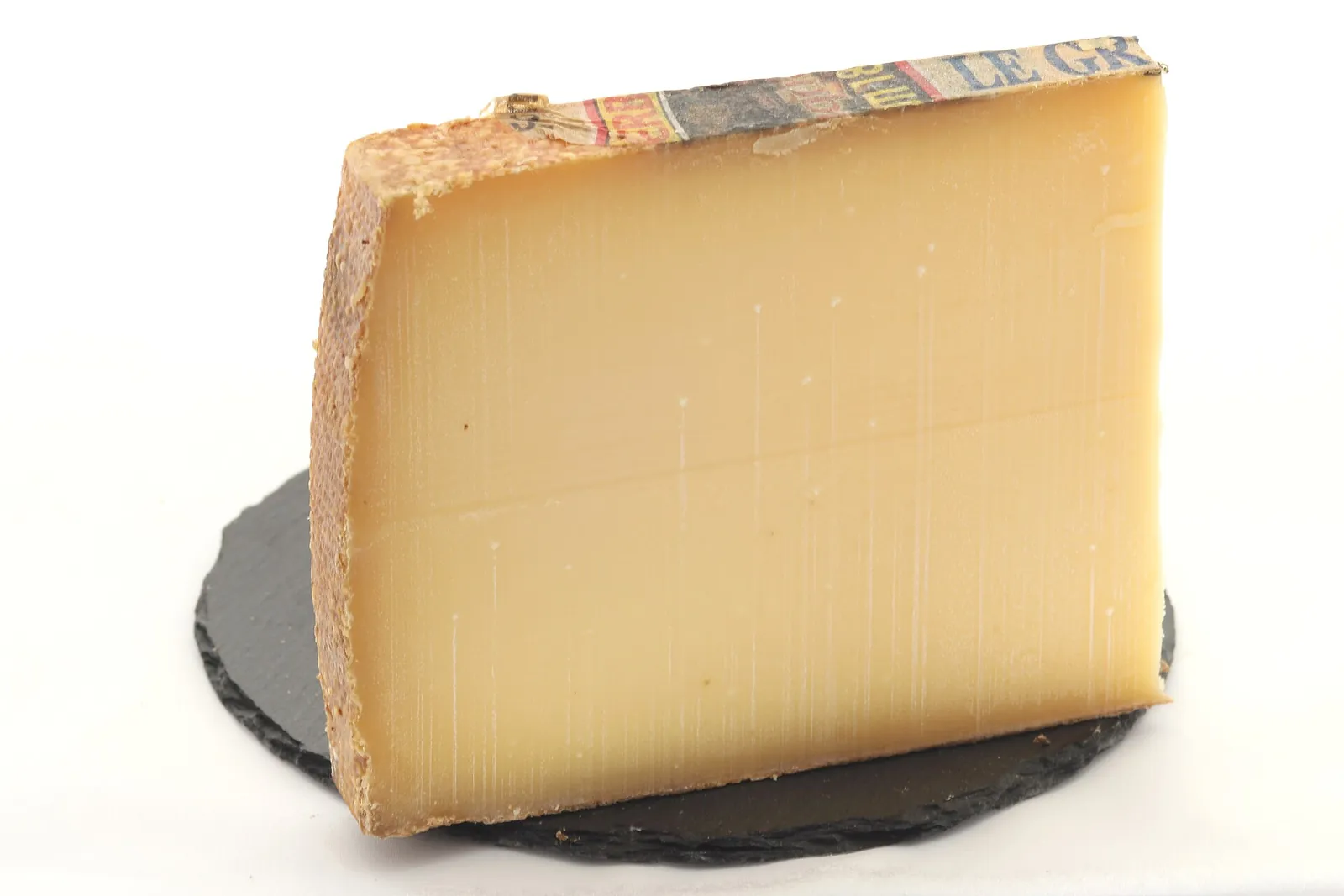
Classic wheels age 6 to 9 months and taste soft and refined; Réserve wheels age more than 10 months and turn full-bodied, fruity and a little crumbly.
The name covers more than one cheese, so the label matters. Le Gruyère AOP is the Swiss original, France makes a separate Gruyère with holes, and in the US the plain word describes a style; the comparison of Swiss, Gruyère and Emmental shows where each fits.
Gruyère cheese at a glance
This Gruyère cheese at a glance table sets the Swiss cheese beside its French namesake, since both carry the name.
| Le Gruyère AOP (Switzerland) | Gruyère PGI (France) | |
|---|---|---|
| Milk | Raw cow's milk, grass and hay, no silage | Raw cow's milk, no silage, local breeds such as Montbéliarde and Abondance |
| Where | Fribourg, Vaud, Neuchâtel, Jura and some communes of Bern | Doubs, Jura, Haute-Saône, Savoie, Haute-Savoie and parts of seven other départements |
| Protected name | AOC since 2001; protected in Europe since December 2011 | EU PGI, registered February 2013 |
| Minimum age | 5 months on sale, graded at 4 months | 120 days |
| Wheel | 55 to 88 lb (25 to 40 kg), 22 to 26 in (55 to 65 cm) across | 21 to 25 in (53 to 63 cm) across, 5 to 6 in (13 to 16 cm) tall |
| Holes | Optional, 4 to 6 mm at most | Required, pea to cherry size |
How Le Gruyère AOP is made
Le Gruyère AOP is made in village dairies from raw milk delivered twice a day by cows fed fresh grass in summer and hay in winter, with no silage, and each wheel takes about 400 liters (106 gallons) of milk. It is named for the Gruyère district of Fribourg, where the Interprofession du Gruyère traces cheesemaking back to 1115.
At the dairy, evening milk left to settle overnight is combined with the morning milk in an open copper vat. Calf rennet sets it in 35 to 40 minutes, the curd is cut into granules the size of wheat grains and heated to 135°F (57°C), and the mass is pressed in molds for about a day. Each wheel then spends 24 hours in 22 percent brine and three months in the dairy's cellar, followed by months more in an affineur's cave at about 59°F (15°C) and 90 percent humidity, where it is turned and brushed with salt water to build its brown, grainy rind.
Experts grade every wheel at four months, and only wheels that pass can be called Le Gruyère AOP and sold from five months. The heel of each wheel is embossed with the name and the dairy's number, and a casein mark records the date.
Gruyère cheese by age: Classic, Réserve and d'Alpage
Gruyère cheese by age comes in two main styles, Classic at 6 to 9 months and Réserve at more than 10, plus a summer-pasture version called d'Alpage. Classic has a soft, refined taste, which makes it the better slicer and melter. Réserve is full-bodied and fruity, firm and slightly crumbly, and some wheels go to 18 or even 24 months.
Le Gruyère d'Alpage AOP is made only between mid-May and mid-October on mountain pastures and pressed in cloth. Its wheels are slightly smaller, about 55 pounds (25 kg), and its flavor follows the pasture flowers and the wheel's age, according to the Gruyère producers.
French Gruyère: the PGI with holes
French Gruyère is a separate cheese protected as a PGI since 2013, and unlike the Swiss one it must have holes. The EU single document describes a raw cow's milk wheel aged at least 120 days, with holes from the size of a pea to the size of a cherry. The milk comes from local breeds such as Abondance, Tarentaise, Montbéliarde, Vosgienne and Simmental française, silage is banned, and cows must graze at least 150 days a year.
Because the two cheeses share a name, the EU made France label its version clearly. The 2013 regulation requires the country of origin to appear beside the name in letters of the same size. A French Gruyère full of holes is following its own rulebook, not imitating the Swiss one.
Melting Gruyère cheese in fondue, gratins and soup
Melting Gruyère cheese works best with Classic wheels, which turn smooth in fondue, gratins and French onion soup. Age matters: in America's Test Kitchen's test of one cheddar at three ages, only the youngest flowed smoothly. Réserve gives more flavor but can turn grainy or greasy in a sauce, so save the oldest wedges for the board.
Fondue is where Gruyère shines. The classic version is half Gruyère and half Vacherin Fribourgeois, or Gruyère with Emmentaler. A 2019 lab study of Gruyère-and-Vacherin fondue found that without starch it separated into rubbery curd, watery liquid and oil, and that too much acid, below a pH of about 4.7, also breaks it. A good starting point is 1 to 2 teaspoons of cornstarch per 8 ounces of grated cheese, and the cheese fondue guide has the full method. For soup, grate Gruyère over the bowl and brown it under a broiler, as in the French onion soup recipe.
How to buy Gruyère cheese in the US
To buy Gruyère cheese in the US, look for the words Le Gruyère AOP and Switzerland, then an age. A whole wheel has the name and the dairy's number embossed on its heel, and a wedge should show the AOP name on the label.
The federal standard in 21 CFR 133.149 names no country: it asks for small holes, at least 45 percent milkfat in the solids, no more than 39 percent moisture and 90 days of age, and the cheese may be pasteurized. American "gruyere" can be a good cheese, but it is not Le Gruyère AOP. Per ounce, USDA lists generic Gruyère at 117 calories, 8.5 grams of protein and 9.2 grams of fat. For a stand-in, Comté is the closest match and Beaufort comes next.
What most Gruyère cheese advice gets wrong
Most Gruyère cheese advice treats the name as one cheese and the milk as a footnote, and both details matter.
Raw milk is part of the definition. Le Gruyère AOP and the French cheese are both made from raw milk. The CDC advises people who are pregnant, adults 65 and older and anyone with a weakened immune system to avoid raw milk cheese unless it is heated to 165°F or until steaming hot, which a bubbling fondue or gratin reaches. See cheese during pregnancy for safer choices.
"Swiss or Gruyère" is not an even swap. American deli Swiss is a milder, holey cheese, while Gruyère is denser, with few holes or none, and has at least five months behind it. A fondue or onion soup made with deli Swiss tastes flat.
Holes do not settle it. Swiss Gruyère may have a few pea-size holes or none, and French Gruyère must have them, so the eyes tell you nothing about quality. The label and the heel mark do.
Questions about Gruyère cheese
These are quick answers to common questions about Gruyère cheese.
What does Gruyère cheese taste like?
Gruyère cheese tastes nutty and creamy at 6 to 9 months, with a soft, refined flavor, and turns fuller, fruitier and more savory after 10 months.
Is Gruyère cheese Swiss or French?
Gruyère cheese is Swiss: Le Gruyère AOP comes from western Switzerland. France makes a separate Gruyère, protected as a PGI since 2013 and labeled with the word France.
Does Gruyère cheese have holes?
Swiss Gruyère cheese may have a few pea-size holes or none, while French Gruyère must have holes the size of a pea to a cherry.
Is Gruyère cheese pasteurized?
Gruyère cheese made as Le Gruyère AOP is never pasteurized, because the rules require raw milk. American-made gruyere may be pasteurized.
What is a good substitute for Gruyère cheese?
The best substitute for Gruyère cheese is Comté, a French mountain cheese with similar melt and nutty depth, followed by Beaufort and cave-aged Emmentaler.
Buying your first Gruyère cheese
For your first Gruyère cheese, buy a Classic wedge marked Le Gruyère AOP and melt half of it into a fondue or onion soup. Let the rest sit out for half an hour, then taste it next to a wedge of Réserve to learn what the extra months do.
Sources
- Interprofession du Gruyère: Characteristics, The production of Gruyère AOP, Our types of Le Gruyère AOP, The history and Protected Designation of Origin (AOP)
- Single document for 'Gruyère' (PGI), Official Journal C 298, 4.11.2010 and Commission Implementing Regulation (EU) No 110/2013, European Union
- Rheology of Swiss Cheese Fondue, Bertsch, Savorani and Fischer, ACS Omega (2019)
- Why Young Cheese Melts Better than Aged Cheese, America's Test Kitchen
- US sources: 21 CFR 133.149, Gruyere cheese, Electronic Code of Federal Regulations; Preventing Listeria Infection, Centers for Disease Control and Prevention; Cheese, gruyere (FDC 171242), USDA FoodData Central