
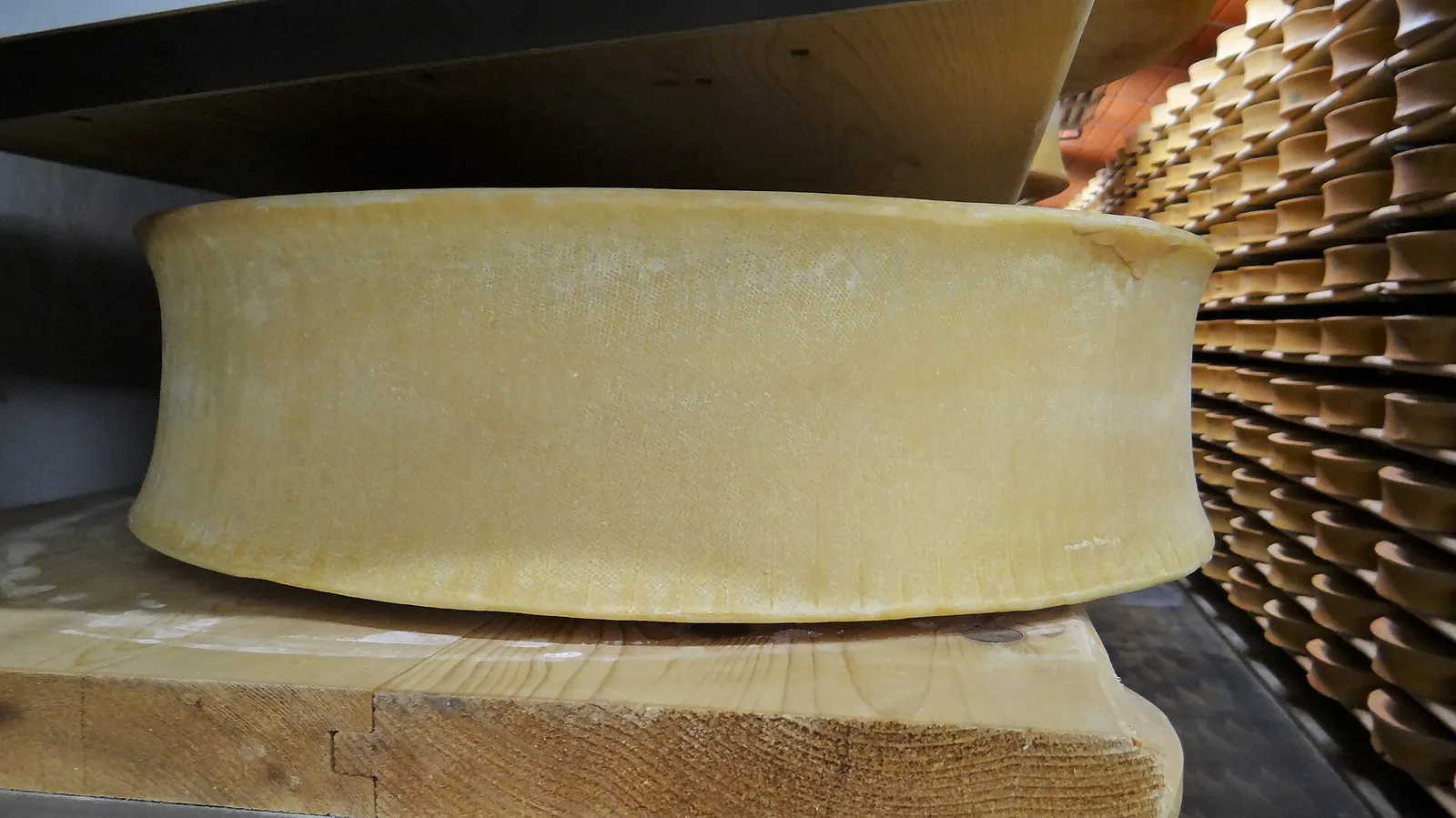
Its wheels are easy to spot, because the rim curves inward like the waist of a drum.
What sets it apart from other Alpine wheels is how little the cows eat that is not grass or hay. Silage is banned, and the best wheels come from summer milk, when the herds climb to pasture. Beaufort sits in the same family as Comté and Gruyère, and the guide to Alpine cheeses shows where it fits.
Beaufort cheese at a glance
Here is Beaufort cheese at a glance, taken from its AOP specification as approved by INAO in June 2024.
| Detail | Beaufort |
|---|---|
| Milk | Raw whole cow's milk, Tarine (Tarentaise) and Abondance cows |
| Made in | The high mountain area of Savoie, plus two sectors of Haute-Savoie |
| Protected name | AOP, with "Été" and "Chalet d'Alpage" as optional labels |
| Wheel | 20 to 70 kg (44 to 154 lb), 35 to 75 cm across, 11 to 16 cm high at the rim |
| Aging | At least 5 months, at 43 to 54°F (6 to 12°C) |
| Paste | Supple and creamy, ivory to pale yellow, fine horizontal splits and a few small holes |
| Rind | Rubbed, clean and solid, yellow to brown |
| Fat | At least 48 percent of the dry matter |
Beaufort cheese AOP rules
Beaufort cheese has been sold under its own name since early last century: a 1929 farm survey notes it sold as Beaufort and no longer just as Gruyère, and a 1945 decree later fixed the name for cooked, pressed cow's milk cheese, according to the AOP rules document. Beaufort cheese must come from raw whole milk of Tarine and Abondance cows in the high mountains of Savoie, and the specification says silage, other fermented feed and beet pulp are forbidden. Dairies make the cheese in a copper vat, and the specification covers how the rind is rubbed and kept clean. The guide to PDO and PGI labels explains what the European seal promises.
One rule helps a shopper directly: pre-packed pieces must show a part of the rind, though the morge, the sticky surface coating, may be removed, and grated cheese cannot be sold as Beaufort. Every genuine wheel also carries an elliptical blue casein plate stamped into the rim.
How Beaufort cheese is made
Beaufort cheese is a cooked, pressed cheese: the maker adds rennet to raw milk at 90 to 95°F (32 to 35°C) in a copper vat, then heats the curd to 127 to 133°F (53 to 56°C) while stirring. That cooking squeezes out whey and is why the paste is dense and supple, not crumbly.
The curd is gathered in a linen cloth and pressed in a wooden ring, the cercle à Beaufort, whose inner bulge gives the wheel its concave rim. Pressing lasts at least 15 hours with turning. The wheel then spends 20 to 24 hours in near-saturated brine at 48 to 54°F (9 to 12°C), and ages for five months or more in the cellar, where regular rubbing builds a rind. Aging in the 6 to 9 month range is what Les Fromages de Savoie calls optimal.
Beaufort Été and Chalet d'Alpage
Beaufort Été and Beaufort Chalet d'Alpage are summer labels, and both are defined by rule, not by marketing. Été is the label for cheese made from June through October, including from alpine milk. Chalet d'Alpage is stricter: made in that window, twice a day by traditional methods, in a chalet above 1,500 meters (about 4,900 feet), with the milk of at most one herd.
Chalet d'Alpage wheels carry a second, red square casein plate beside the blue one, so you can check at the counter. Winter wheels, from hay-fed cows, carry no seasonal label. The specification does not rank the labels by flavor, so treat the usual advice that summer wheels taste more floral as a tasting tip, not a legal guarantee.
Beaufort cheese flavor and texture
Beaufort cheese tastes fruity and floral, with animal and toasted notes underneath, according to its Savoie producers. At five to six months it is supple, sweet and buttery. Given longer, it firms up, picks up toasted-nut depth and leaves a long savory finish. Fine horizontal splits in the paste are normal, not a flaw.
Does Beaufort cheese melt?
Beaufort cheese melts very well, because its curd is cooked and its fat sits at 48 percent or more of the dry matter. Few cheeses go glossy with so little effort, which is why it is a classic for fondue, gratins, tartiflette-style bakes and croque monsieur. Grate it and keep the heat low: boiling splits any aged cheese. See the fondue recipe for ratios.
How to buy Beaufort cheese in the US
Buying Beaufort cheese in the US is easiest at a cheese counter that cuts from the wheel. Ask for a piece with rind, since the rind proves it is real, and ask the age and the season it was made. Raw-milk cheese must meet the FDA's 60-day aging rule, which five months of aging clears, and the raw-milk cheese guide covers the rest.
Beaufort cheese substitutes
The best Beaufort cheese substitutes are its Alpine cousins. Comté aged 12 months or more is the nearest match for taste, and Gruyère works for any melting job, with a nuttier, less floral flavor. Abondance is a lighter Savoie choice for a board. The substitute finder lists more.
What most Beaufort cheese advice gets wrong
Most Beaufort advice leaves out three details that change what ends up in your basket.
Chalet d'Alpage is not simply Été
Beaufort Chalet d'Alpage is not just Été with a nicer name: Été only needs summer production, while Chalet d'Alpage adds the chalet, the 1,500 meter minimum and the single herd. Both can be excellent.
Grated Beaufort is not Beaufort
Grated Beaufort cannot carry the name, so a bag of shredded "Beaufort" is a mislabel. Buy a wedge and grate it yourself.
Do not eat the rind
The rind is not a snack. It is rubbed, brined and cellar-handled, and most people cut it off; keep it for a soup or fondue pot instead.
Questions about Beaufort cheese
These are the questions about Beaufort cheese that come up most.
Why is Beaufort cheese concave?
Beaufort cheese is concave because it is pressed in a wooden ring with a circular bulge inside, which the specification names as the source of the concave rim.
Is Beaufort cheese raw milk?
Beaufort cheese is always raw milk: the specification allows only raw whole cow's milk and sets a five-month minimum for aging.
What is the difference between Beaufort and Gruyère?
Beaufort differs from Gruyère mainly in origin and flavor: Beaufort is French, from Savoie, and tends fruitier and more floral, while Swiss Gruyère is nuttier. Both melt well.
What wine goes with Beaufort cheese?
Beaufort cheese goes with white Savoie wines, Jura whites and Champagne, and a light red also works. Walnuts, dried fruit and crusty bread suit it on the plate, and the pairing guide lists more.
How long does Beaufort cheese keep?
Beaufort cheese keeps for several weeks in the fridge when wrapped in wax or parchment and then loosely in foil. Bring it to room temperature before serving.
Your first Beaufort cheese
For your first Beaufort cheese, buy a small cut with rind from a counter, ask for a summer wheel, let it warm for an hour and eat it with walnuts and a glass of dry Savoie white. Save the rest for a fondue.
Sources
- Cahier des charges de l'appellation d'origine Beaufort (2024), INAO (Institut national de l'origine et de la qualité)
- Document unique de l'AOP Beaufort (2024), INAO
- AOP Beaufort, Les Fromages de Savoie