
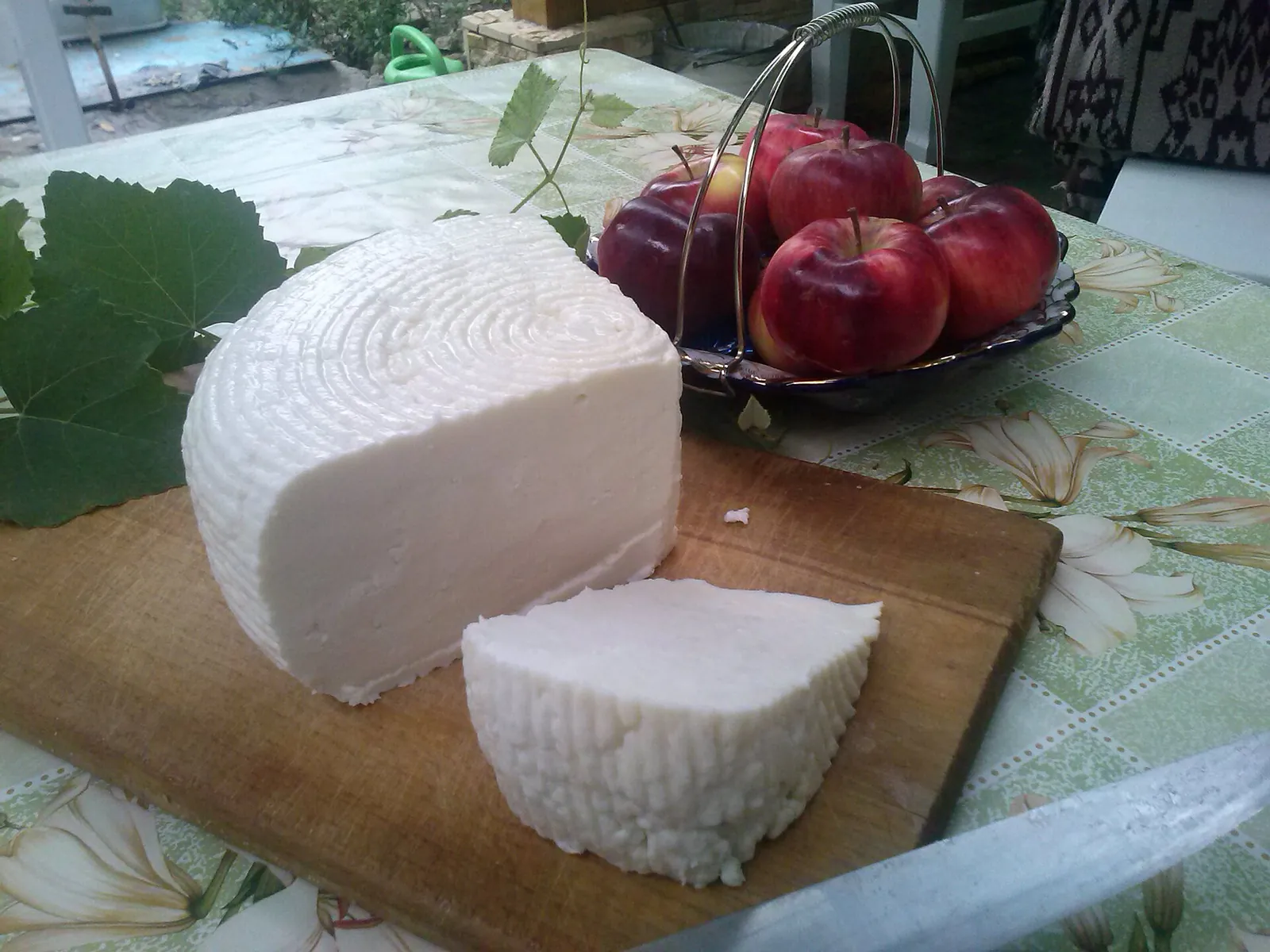
Researchers also call it Circassian cheese, and it is made by heating milk and curdling it with an acid rather than with rennet.
That one fact explains most of what you notice at the stove. Acid-and-heat curd is tightly bound, so a slice of Adyghe softens in a hot pan but keeps its shape, much like paneer. It does not melt into a pool the way sulguni or mozzarella does.
Adyghe cheese at a glance
Here is Adyghe cheese at a glance, with the figures taken from a 2023 study of the traditional method.
| Detail | Adyghe cheese |
|---|---|
| Also called | Circassian cheese |
| Origin | The Adyghe people, North Caucasus, southern Russia |
| Milk | Whole milk |
| Set with | Heat plus acid: sour milk, very sour whey or vinegar |
| Salt in the studied cheeses | About 1.1 to 1.2 percent |
| Dry matter in the studied cheeses | About 42 to 46 percent |
| Texture | Soft, moist, slightly springy |
How Adyghe cheese is made
Adyghe cheese is made by bringing whole milk to nearly boiling and stirring in an acidic liquid, according to a 2023 study in Food Science & Nutrition of Circassian cheese by Hatice Sıçramaz and Ahmet Ayar. The traditional acid is sour milk, very sour whey or vinegar. The curd forms at once, is strained and is salted.
Temperature changes the result. The researchers made batches at 158 and 194 degrees F (70 and 90 C) and found the 90 C curd formed a firmer structure. Some Adyghe cheese is then smoked, and smoking time matters too: six hours of smoke, compared with two and a half, gave a drier cheese with slower protein breakdown and a longer microbial shelf life, at the price of a stronger smoke flavor.
An earlier Turkish study of Sakarya Circassian cheese found that both a higher solids content and smoking made the cheese harder, that smoking extended shelf life, and that the traditional, non-smoked cheese scored highest for overall sensory acceptability. Plain is not the lesser version.
No rennet is involved and nothing ripens, which is why Adyghe is a fresh cheese. If you want to see the same idea at home, farmer's cheese is the closest simple recipe.
What Adyghe cheese tastes like
Adyghe cheese tastes clean, milky and gently tangy, with only light salt. The studied cheeses held about 1.1 to 1.2 percent salt, which is well under what you would find in a feta-style brined cheese, so it reads as mild rather than salty. The body is soft and slightly springy, closer to a firm farmer's cheese than to a crumbly one.
Smoked Adyghe is a different eating experience: a tan skin, a drier bite and a woody, campfire flavor that stands up to bread and pickles. Plain Adyghe is the better choice when you plan to cook with it or want a gentle cheese for breakfast.
How to buy Adyghe cheese in the US
Buying Adyghe cheese in the US is easiest at Russian, Ukrainian and other Eastern European grocers, where it often sits in the refrigerated cheese case in a plastic-wrapped round or wedge. Look for "Adygeisky" or "Adyghe" on the label; some shops sell smoked rounds separately. Prices are modest because it is a simple fresh cheese.
Check the date. A fresh cheese with no brine has little protection, so pick the package with the farthest date, and choose a pasteurized one if you are pregnant or serving someone at higher risk. The CDC says unheated soft cheeses made from raw milk are the concern and that reheating to 165 degrees F or until steaming hot makes them safe; the cheese in pregnancy guide has the details.
How to use Adyghe cheese
Adyghe cheese works three ways: fresh, fried and baked. Fresh, it goes on bread with herbs, cucumbers and tomatoes, or crumbles into salads and breakfast plates. Fried or grilled, slices go golden outside while the center stays soft; a dry non-stick or cast-iron pan over medium heat does it in a couple of minutes per side. Baked, it is a classic filling for pies, pastries and dumplings.
Adyghe also turns up in Caucasus-style bread dishes, and it is a fair stand-in for the stretchy cheese in khachapuri if you accept a softer, less stringy result. Pat slices dry before frying so they brown rather than steam. A little salt at the end is usually all it needs.
Pairings are easy: fresh herbs, honey, jam, tomatoes, flatbread and light white wines. The pairing guide lists wine, beer and fruit matches by cheese.
What most Adyghe cheese advice gets wrong
Most advice on Adyghe cheese treats it as a generic soft cheese, which hides three things that matter.
Adyghe cheese is not a brined cheese
Adyghe cheese is not a brined cheese, even though people lump it with Caucasus and Balkan cheeses. It is salted lightly and sold fresh, unlike Balkan white brined cheeses, which ripen for weeks in salt water. Do not expect feta saltiness, and do not store it for weeks.
Adyghe cheese does not melt on pizza
Adyghe cheese does not melt like mozzarella, because acid-and-heat curd resists melting. On a pizza or in a grilled sandwich it softens and browns but stays in pieces. Use it where a soft, intact chunk is the goal.
Smoked Adyghe keeps differently
Smoked Adyghe keeps longer than plain Adyghe, but not forever: the study found longer smoking extended microbial shelf life, not that it makes the cheese shelf-stable. Treat any Adyghe as a fridge cheese and follow the date.
Adyghe cheese substitutes
Adyghe cheese substitutes depend on what you are doing. For frying, paneer is the closest match, though it is plainer and a little firmer. For salads and fillings, farmer's cheese and queso fresco work, and for a saltier, squeakier fried slice, halloumi is an option if you reduce added salt. The substitute finder lists more.
Questions about Adyghe cheese
These are the questions about Adyghe cheese that come up most.
What is Adyghe cheese?
Adyghe cheese is a soft, mild fresh cheese from the North Caucasus, made by curdling hot milk with acid and draining the curd. It is also called Circassian cheese.
Does Adyghe cheese melt?
Adyghe cheese does not melt into a pool, because acid-and-heat curd holds together. It softens and browns, which is why it fries and grills well.
Is Adyghe cheese the same as feta?
Adyghe cheese is not the same as feta: Adyghe is a fresh, lightly salted cheese set with acid, while feta is a brined sheep or sheep-and-goat cheese. See the feta guide for the difference.
How long does Adyghe cheese last?
Adyghe cheese lasts about a week in the refrigerator once opened, or to the date on the package if sealed. Smoked rounds last somewhat longer; keep cut pieces tightly wrapped.
Is Adyghe cheese the same as Circassian cheese?
Adyghe cheese is the same cheese as Circassian cheese: the two names refer to the traditional acid-and-heat cheese of the Adyghe people, as the Food Science & Nutrition study notes.
Your first Adyghe cheese
For your first Adyghe cheese, buy a small plain round from an Eastern European grocer, fry two slices in a dry pan until golden, and eat them with cucumber and bread. Try the smoked round next to taste how smoke changes it.
Sources
- Coagulation temperature and smoking time determine product quality and shelf life of the acid-heat coagulated Circassian cheese, Sıçramaz and Ayar, Food Science & Nutrition, 2023 (via Europe PMC)
- Effect of Different Processes on Chemical, Textural and Sensory Properties of Sakarya Circassian Cheese, Sert, Ayar and Sıçramaz, 2015, Necmettin Erbakan University repository
- Listeria prevention, Centers for Disease Control and Prevention