
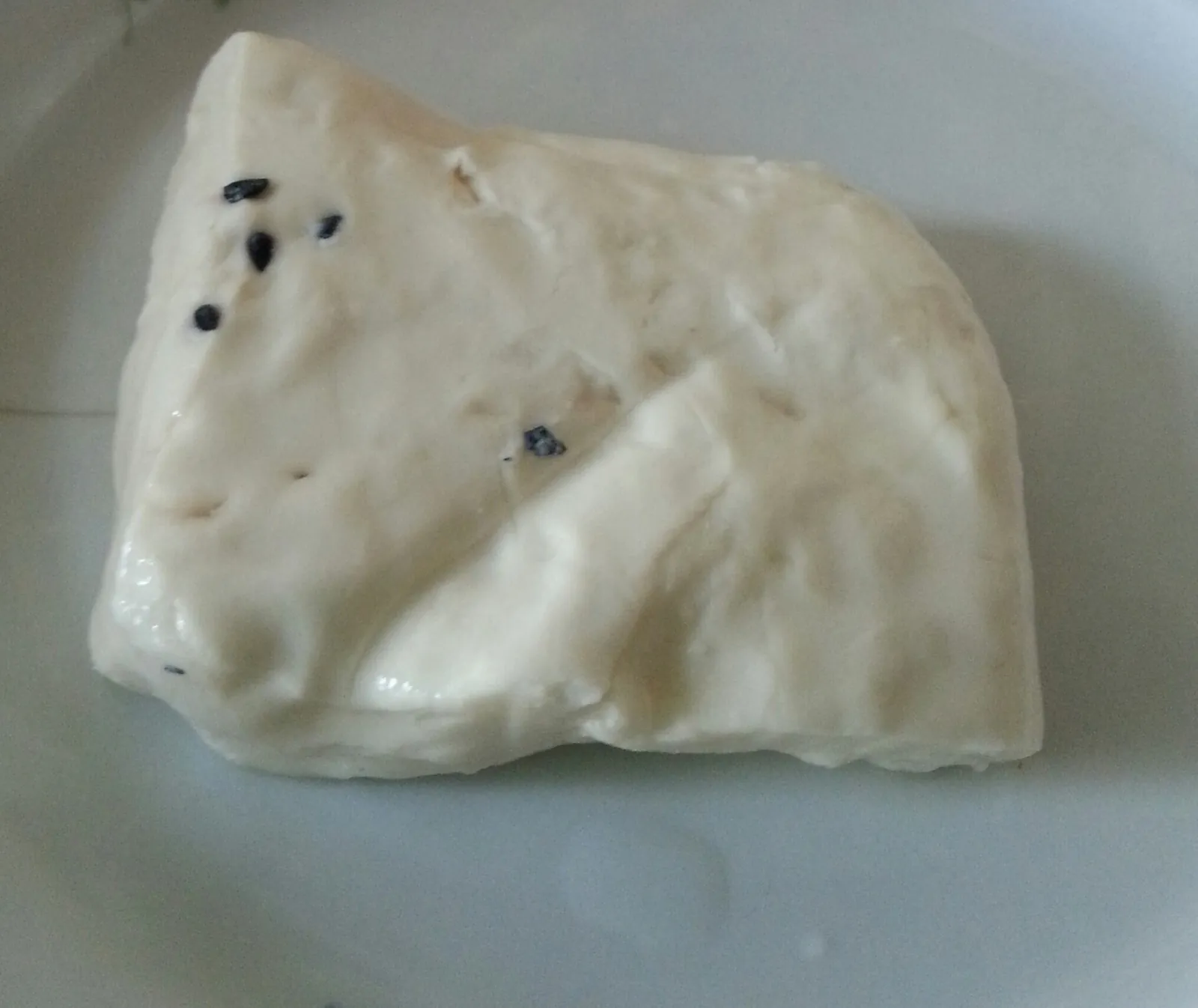
It is the most famous cheese for knafeh, because it stretches when heated.
It is also saltier than most brined cheeses and needs a long soak, which is where most first attempts go wrong. This page covers what is in it, how it is made, and how to get it from the brine to the pastry.
Nabulsi cheese: what it is
Nabulsi cheese is a Palestinian white brined cheese named for Nablus, and it is one of the principal cheeses eaten in Jordan, Wikipedia notes, alongside Akawi. It is a semi-hard cheese with no gas holes, usually sold as a white rectangle, and it turns elastic when heated and brittle when dry.
Traditionally it is made primarily from sheep's milk, with goat's milk as an alternative. A version made from cow's milk or a mixture is called mashmouleh. A Jordanian study of the cheese calls it the dominant white-brined variety in Jordan and neighboring regions, with cow's milk increasingly used for scaled production.
How Nabulsi cheese is made
Nabulsi cheese is made by heating milk, setting it with rennet, pressing and cutting the curd, then boiling the pieces and storing them in brine. The boiling is what separates it from Akawi and feta, and it explains the firm, springy bite. Mahleb and mastic go into the boiling brine, and nigella seeds are mixed into the cheese, per Wikipedia.
A 2023 study in Current Research in Nutrition and Food Science, following a traditional method with adjustments to boiling and piece size, found that yield changes a lot with milk: 26.85 percent from pure sheep's milk against 14.77 percent from pure cow's milk. A 1 to 1 blend of sheep's and cow's milk produced cheese of similar quality to pure sheep's milk. That is one reason commercial Nabulsi is often a blend, and why sheep's milk costs more.
Nabulsi cheese flavor: mahleb, mastic and nigella
Nabulsi cheese flavor starts salty and savory over a milky, slightly rich base, then picks up three aromatics. Mahleb, the ground kernel of a cherry species, adds a faint almond and cherry note. Mastic, a resin from the mastic tree, lends a piney, slightly sweet scent. Nigella seeds add black flecks and a mild, peppery bite.
Not every block carries all three, and some brands skip the spices altogether. Look at the ingredients if the flavor matters to you.
How to desalt Nabulsi cheese
To desalt Nabulsi cheese, cut it into slices or cubes, cover with cold water and refrigerate overnight, changing the water if you can. The cheese is salt-heavy by design: in the 2023 study the salted cheese held 9.69 to 10.16 percent salt and the brine around it 19.76 to 20.87 percent. Researchers soaked samples in water overnight in a refrigerator at 5°C (41°F), and the soak significantly lowered hardness and gumminess while raising cohesiveness.
So desalting does two things: it removes salt and it makes the cheese softer to eat. Taste a piece in the morning. If it is still sharply salty, soak it another few hours in fresh water. Unlike Akawi, Nabulsi usually needs the longer soak.
How to buy Nabulsi cheese in the US
Buying Nabulsi cheese in the US means a Middle Eastern, Palestinian or Arab grocery, where it is sold as blocks in brine or vacuum packs. Look for the black seed flecks. The shop may stock plain and spiced versions side by side.
Choose a pasteurized cheese from a refrigerated case: a 2022 study in the Journal of Food Science notes that white brined cheese has been linked to listeriosis outbreaks worldwide, and pregnant readers should follow FDA and CDC advice on soft cheeses. Keep it in its brine in the fridge. The guide to storing cheese covers wrapping, and the salt in cheesemaking guide explains why a brined cheese keeps so well.
How to use Nabulsi cheese: knafeh and frying
Nabulsi cheese is used two ways: fried in slices until golden, and inside knafeh, the pastry layered with cheese and soaked in syrup. Its stretch under heat is why it dominates the dessert, and the salt left after desalting sharpens the sweetness. Soak it fully for knafeh, then pat it dry so it does not water down the pastry.
On the savory side, serve it with bread, olives and tomatoes, or fold cubes into breads and pastries. It browns well in a dry pan, much like halloumi.
Nabulsi cheese substitutes
The best Nabulsi cheese substitute is Akawi, which is milder and softer but sold in the same stores and used the same way. For knafeh, low-moisture mozzarella gives the pull without the salt. For frying, halloumi is the closest in bite. The wider family is in the guide to Middle Eastern cheeses.
What most Nabulsi cheese advice gets wrong
Most Nabulsi cheese advice says to soak it for "a few hours," which underestimates a cheese brined this heavily.
Nabulsi cheese needs more than a quick rinse
Nabulsi cheese from the brine can hold roughly a tenth of its weight in salt, based on the figures above, so a quick rinse barely touches the center. Cut thinner or soak longer.
Nabulsi cheese is not the same as Akawi
Nabulsi cheese is not just Akawi with seeds: it is boiled, traditionally sheep's milk and firmer, and it keeps its shape more in the pan.
Questions about Nabulsi cheese
These are the questions about Nabulsi cheese that come up most.
What flavors Nabulsi cheese?
Nabulsi cheese is traditionally flavored with mahleb and mastic in the boiling brine and with nigella seeds mixed in.
Where does Nabulsi cheese come from?
Nabulsi cheese comes from the Palestinian city of Nablus in the West Bank, and it is now eaten widely across the Levant and Jordan.
Is Nabulsi cheese used in knafeh?
Nabulsi cheese is used in knafeh, where it is soaked to remove salt and then melted into the pastry, and its stretch is the reason.
How long should Nabulsi cheese soak?
Soak Nabulsi cheese overnight in the fridge, as the research did at 5°C, and taste before using.
Your first Nabulsi cheese
For your first Nabulsi cheese, buy a small block, cut it into thick slices, soak them overnight, then pat dry and pan-fry until golden. If you plan knafeh, taste a slice of the milder version beside it in the same store.
Sources
- Quality of White-Brined Nabulsi Cheese Made with Different Proportions of Sheep's and Cows' Milk, Abu-Alruz, Current Research in Nutrition and Food Science, 2023
- Nabulsi cheese, Wikipedia
- Chitosan-ZnO nanocomposite coating for inhibition of Listeria monocytogenes on white brined cheese, Olaimat et al., Journal of Food Science, 2022