
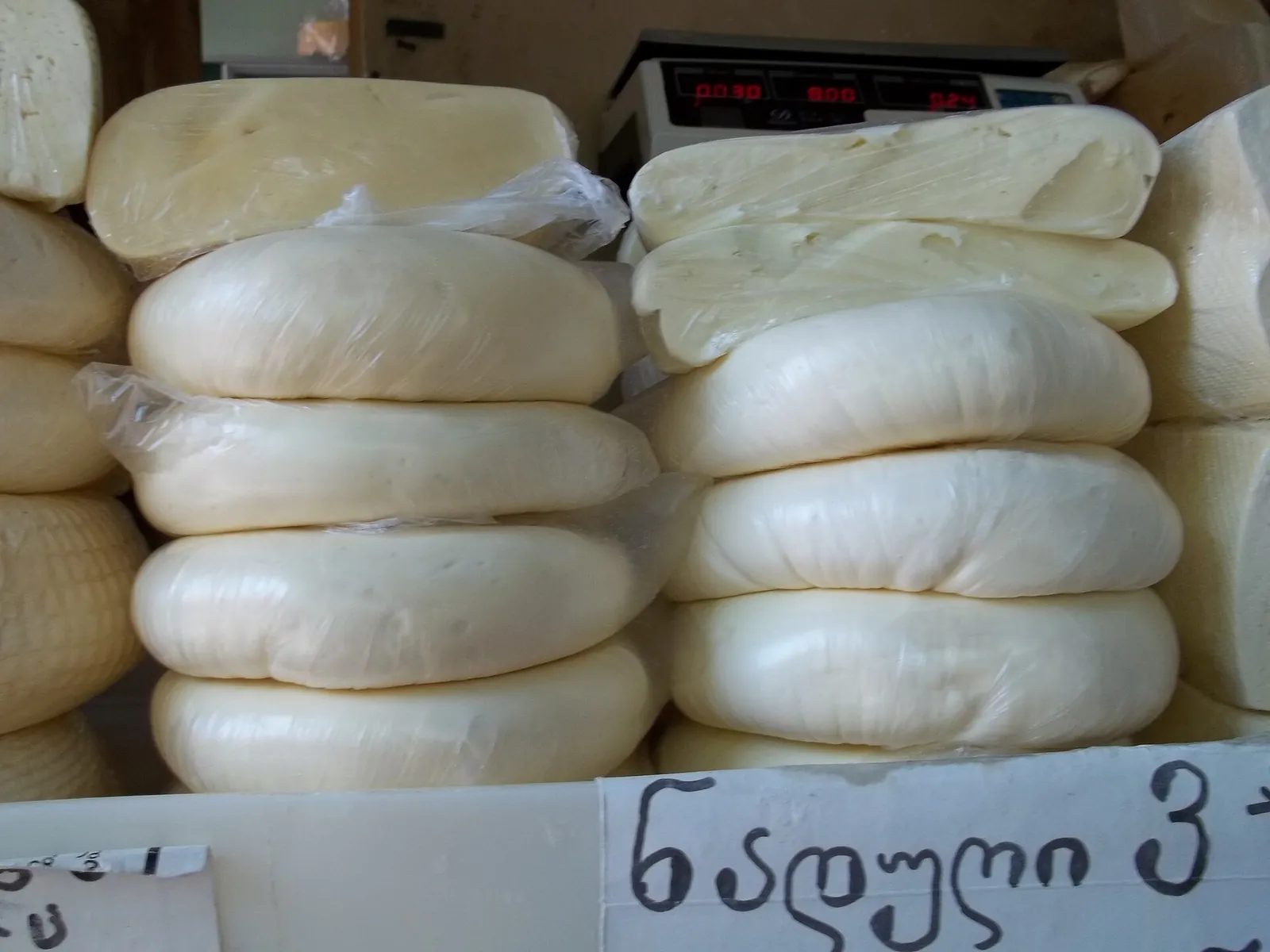
It comes from Samegrelo and Svaneti in western Georgia, and it is the stretchy cheese on Megrelian khachapuri.
Mozzarella is the right comparison, up to a point. Both are soured, then kneaded in very hot water, but sulguni's hot curd is folded over on itself again and again, and the finished cheese goes into strong brine. The folding gives sulguni its layers; the brine gives it its salt.
Suluguni at a glance
Here is suluguni at a glance, with figures from Georgia's official specifications.
| Sulguni (suluguni) | |
|---|---|
| Also called | Megruli sulguni (Megrelian), Svanuri sulguni (Svan); shebolili sulguni when smoked |
| Milk | Cow's, buffalo's or goat's, or a mix; raw or pasteurized |
| Origin | Samegrelo and Svaneti, western Georgia; now made across Georgia |
| Type | Fresh, brined, stretched curd (pasta filata) |
| Shape | Rindless round, 3 to 12 inches (7 to 30 cm) across, about 1/2 to 5 lb (0.25 to 2.2 kg) |
| Texture | Dense and elastic, in layers that peel apart; no holes |
| Flavor | Clean, milky and moderately salty; smoked is saltier |
| Ready to eat | 24 hours after salting; also sold dried, aged or smoked |
| Megrelian rules | 50% water or less, at least 45% fat in dry matter, 1 to 5% salt |
| Protected name | Georgian geographical indication since 2012; protected in the EU since 2016 |
What suluguni is, and where it comes from
Suluguni comes from western Georgia, where the national tourism agency, which counts about 60 Georgian cheeses, credits Mingrelians and Svans with making it first. Georgia's specification for Sulguni dates its earliest written mention to Sulkhan-Saba Orbeliani's 17th-century Georgian dictionary, which describes a stretched, kneaded flat cheese. Local names once varied: selegini in Samegrelo, gvajilla in Upper Imereti, Racha and Lechkhumi, and "double-kneaded" in Guria. By the 1890s it was shipped overseas from the port of Poti, and in the 1980s Soviet factories made it in almost every Georgian region, while its name traveled across the Soviet bloc.
Sulguni or suluguni?
Sulguni or suluguni: both spellings name the same cheese. Georgia's specification gives Sulguni as the English form and Сулгуни in Cyrillic, while the older suluguni appears in the dictionary entry it cites and on most US labels. There is no separate English name.
How sulguni is made
Sulguni is made in four stages under Georgia's rules, and the souring step decides when the curd is ready to stretch.
- Set the curd. Animal or microbial rennet sets milk warmed to 90 to 102°F (32 to 39°C), and the curd is cut to the size of a hazelnut or walnut.
- Sour it. After the whey drains, the curd rests for 2 to 24 hours, at least 5 for Sulguni Classic, until small, even holes appear through it and before it turns too acid.
- Stretch and fold. Thin slices go into very hot but not boiling water, 167 to 176°F (75 to 80°C) in the Megrelian rules, and are stirred into a stretchy paste, then kneaded and folded at least four times and shaped.
- Salt. The cheese is cooled, then dry-salted or soaked for 6 to 24 hours in brine of 14 to 22 percent salt. It may be sold 24 hours after salting begins.
The rules ask for a juicy fresh cheese, with liquid dripping between the layers when a round is cut in half. Sulguni Classic is the strictest version: raw whole milk from the morning or evening milking, no starter culture, kneaded by hand. Producers may also dry, age or smoke sulguni, or knead in Georgian herbs, adjika, honey, wine, chacha or nuts.
Sulguni's protected status in Georgia and the EU
Sulguni's protected status is unusually broad, because Georgia registered the plain name and not only regional versions. On January 24, 2012, Sakpatenti, Georgia's National Intellectual Property Center, registered three geographical indications:
- Sulguni: the whole of Georgia, from Georgian milk.
- Megrelian Sulguni: seven municipalities of Samegrelo, including Zugdidi, Senaki and Martvili, under the Megrelian specification.
- Svanetian Sulguni: Mestia and Lentekhi in the mountains of Svaneti, made in large, irregular wheels from cow's or goat's milk, per its own specification.
In April 2025, Georgia's state registry added an appellation of origin, Askhi Mountain Sulguni. Georgian labels must follow the name with "Protected Geographical Indication" and add Fresh, Dried, Aged or Smoked. Abroad, the EU has protected Sulguni, Megruli Sulguni and Svanuri Sulguni since a November 2016 decision under its Association Agreement with Georgia. US shops, outside both systems, also sell American-made, "Georgian-style" suluguni.
Sulguni in khachapuri
Sulguni in khachapuri is a regional signature, not a universal one. Georgia's tourism agency describes Megrelian khachapuri by its two cheeses, fresh, squeaky chkinti and sulguni. Samegrelo cooks grated the sulguni with eggs over the top, layered it inside or laid it on in strips. The holiday version, ghandami, wears a cross of braided sulguni. Imeretian khachapuri, the most widespread kind, uses crumbly, unstretched Imeretian cheese instead. Georgia granted the khachapuri tradition intangible cultural heritage status in January 2019.
At home, a blend copies the Georgian pairing: a good starting point is 2 parts grated sulguni or low-moisture mozzarella to 1 part crumbled feta or farmer's cheese. The khachapuri recipe covers the dough and the bake.
Smoked sulguni
Smoked sulguni, shebolili in Georgian, cooks differently from fresh, because smoking dries the cheese and concentrates its salt. Under the Sulguni specification it is smoked over non-coniferous wood such as pear, apple, alder, beech or quince, hot for 1 to 12 hours or cold for 3 days to a week, and it turns golden-brown outside and yellowish within. The Megrelian rules cap smoked sulguni at 40 percent water, against 50 for fresh, and set its salt at 3 to 5 percent. The Samegrelo farmhouse method is slower: cheeses hang from a high beam, with smoke blown at them from a distance, for at least two months. Slice it for a board, grill it, or melt it where you want smoke; the best smoked cheeses offer more to compare.
How to eat sulguni
The way to eat sulguni at its best is young, either cold with bread and herbs or hot, where it melts into long strings like mozzarella. Fry thick slices in a dry nonstick pan until browned, thread cubes on skewers for the grill, tear it over hot cornmeal porridge, or melt it into omelets and toasted flatbreads. On a meze table, set fresh sulguni beside tomatoes, cucumbers, green herbs and bread, with a dry Georgian white or a cold lager.
Buying and storing suluguni in the US
Buying suluguni in the US is easiest at Georgian, Russian and Eastern European grocers and online, usually under the spelling suluguni. Expect fresh rounds in brine or vacuum packs, smoked rounds, and strings or braids, shapes the Georgian rules also allow; US makers sell "Georgian-style" suluguni too, including hickory-smoked cheese. A fresh round should feel springy and look moist between its layers. Sulguni can be made from raw milk, as Sulguni Classic must be, so if you are pregnant or at higher risk, choose one labeled pasteurized or cook it until steaming hot, as the CDC advises.
At home, keep fresh sulguni cold, in its brine or tightly wrapped, and use it within a few days of opening; smoked sulguni keeps longer. If a piece tastes too salty, soak slices in cold water or milk for an hour before cooking.
Sulguni substitutes
The best sulguni substitute is low-moisture mozzarella with a little extra salt, since both are stretched-curd cheeses that melt into strings.
- **Low-moisture mozzarella** matches the melt; add a crumble of feta for salt and tang.
- **Oaxaca cheese**, Mexico's stretched cheese, pulls into strings and peels in strands.
- **Kashkaval** is stretched the same way but aged, so it suits frying more than khachapuri.
- Scamorza or smoked mozzarella stands in for smoked sulguni.
What most sulguni advice gets wrong
Most sulguni advice stops at "Georgian mozzarella," and that shortcut hides its salt, its short life and the differences between rounds.
It is saltier than mozzarella, by design. Megrelian rules allow 1 to 5 percent salt, while whole-milk mozzarella has 486 mg of sodium per 100 g in USDA data, about 1.2 percent salt. When mozzarella stands in, salt the filling or add feta.
It is meant to be eaten young. Fresh sulguni can be sold one day after salting begins, and the rules want it juicy enough to drip between the layers. A dry, crumbly "fresh" round is past its best.
"Sulguni" covers several cheeses. The rules set minimums by milk: at least 30 percent fat in the dry matter for cow's milk sulguni, 40 for cow and buffalo or cow and goat blends, and 45 for buffalo's milk or smoked sulguni. Buffalo's milk sulguni is also whiter, white to ivory against ivory to light yellow for cow's, so the milk on the label tells you how rich a round will be.
Questions about suluguni cheese
These questions about suluguni cheese are the ones shoppers ask most.
What is suluguni cheese similar to?
Suluguni cheese is similar to mozzarella and Mexican Oaxaca cheese, all stretched-curd cheeses that melt into strings. It is closest in method to Balkan kashkaval, which is stretched the same way and then aged.
What is suluguni cheese in the USA?
In the USA, suluguni cheese is sold under that name at Georgian, Russian and Eastern European grocers, including US-made Georgian-style versions. Low-moisture mozzarella is the supermarket stand-in.
What does suluguni cheese taste like?
Suluguni cheese tastes clean, milky and creamy, moderately salty, with the light tang of a cultured dairy product. Smoked suluguni adds smoke and a little more salt.
Is sulguni cheese like mozzarella?
Sulguni cheese is like mozzarella in method and melt, and fresh Megrelian sulguni holds up to 50 percent water, about the same as whole-milk mozzarella. It differs in its folded layers, its brining and up to four times the salt.
Is suluguni cheese healthy?
Suluguni cheese is a fresh cheese with up to 5 percent salt, so count it toward the day's sodium. USDA has no entry for it; check the nutrition panel on the pack.
Trying suluguni for the first time
For a first try of suluguni, buy one fresh and one smoked round from a Georgian or Russian grocer, peel a layer from each and taste them cold. Then melt the fresh one over a Megrelian-style khachapuri.
Sources
- Specification of the Protected Geographical Indication Sulguni (registration no. 10), Sakpatenti, National Intellectual Property Center of Georgia
- Geographical indication: Megrelian Sulguni Cheese (registration no. 9), Sakpatenti, National Intellectual Property Center of Georgia
- Geographical indication: Svanetian Sulguni Cheese (registration no. 11), Sakpatenti, National Intellectual Property Center of Georgia
- State registry of appellations of origin and geographical indications, Sakpatenti, National Intellectual Property Center of Georgia
- Decision No 1/2016 of the EU-Georgia Geographical Indications Sub-Committee (OJ L 335, 9.12.2016), Official Journal of the European Union
- Get a taste of khachapuri, Georgian National Tourism Administration
- Types of Georgian Cheese, Georgian National Tourism Administration
- Order No. 02/3 of 2019 granting intangible cultural heritage status to the khachapuri tradition in Georgia, FAOLEX via UNEP Law and Environment Assistance Platform