
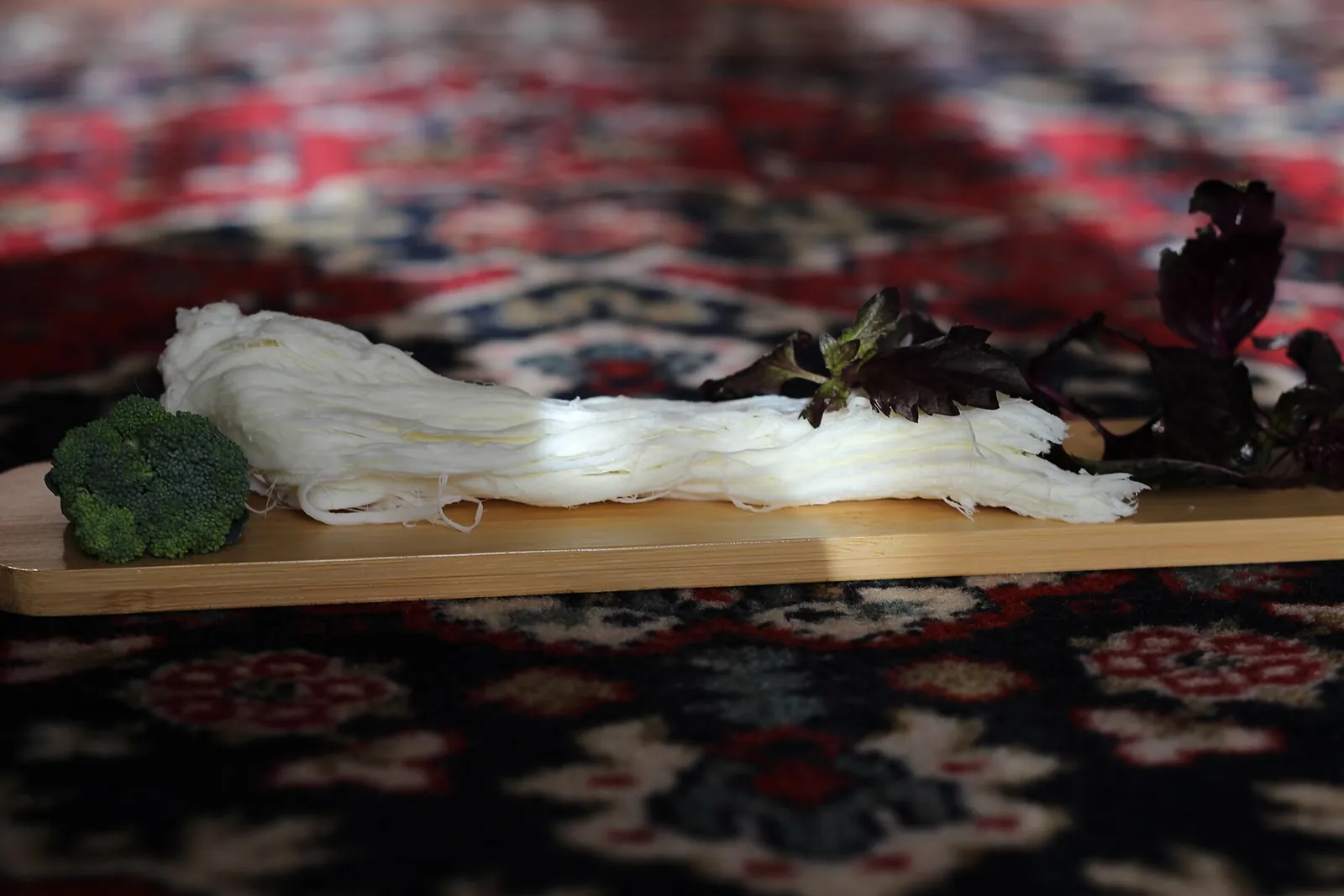
You buy it as a braid, unwind it and peel it into strands to eat by hand.
What sets it apart from supermarket string cheese is how much salt and smoke it carries. Chechil is made to be eaten in small pulls alongside a drink, not packed into a lunchbox.
Chechil cheese at a glance
Here is chechil cheese at a glance, drawing on an Armenian ethnographic study and a US cheese reference.
| Detail | Chechil cheese |
|---|---|
| Origin | Armenia (made in some regions, not all) |
| Traditional milk | Mainly skimmed cow's milk; sheep's milk ranked higher, buffalo lower |
| Traditional method | Soured milk, curd worked by hand into strands |
| US versions | Pasteurized cow's milk, curd heated and stretched, often smoked |
| Shape | Braid or rope |
| Texture | Firm and smooth, peels into threads |
| Flavor | Very salty, smoky when smoked |
| Protected name | None |
What chechil cheese is
Chechil cheese is a string cheese, defined by its threads and its braid. A 2025 study of Armenian chechil cheese-making skills by ethnographer Hasmik Harutyunyan of Yerevan State University says it is made mainly from skimmed cow's milk, although by prestige the order ran sheep's milk first, cow's milk second and buffalo's milk third. The same study notes that chechil is popular in some Armenian regions, not all, and that even neighboring villages know it by different names and make it slightly differently.
It also has a place in custom. The study records that a braid of chechil, like white hair, was once sent to a bride as a holiday gift so that her hair would grow long and she and her husband would grow old together.
How chechil cheese is made
Chechil cheese is made from curd that has been worked into strands, and the Armenian study describes it starting from soured milk. Some cooks speed the souring with salt or vinegar, and sometimes the milk sours on its own without a starter. The curd mass is worked into strands by hand, with fingers by some cooks and sticks by others.
For keeping it, the study says chechil is stored in a barrel of brine or pressed and buried, often with spices and other dairy products added.
The version sold in the US follows the pasta filata path. Culture magazine's cheese library describes a US chechil made from pasteurized cow's milk, in which curd blocks are heated and shaped into braided strings, in a method similar to mozzarella, and the braids are then smoked. Pasta filata means stretched curd: the Cheese Science site says curd is heated, usually to about 130 to 160 degrees F (55 to 70 C), and stretching aligns the protein into strands. That alignment is the string you peel.
The braid itself is as much custom as technique, so treat any claim that it exists purely for brining or smoking as unproven.
What chechil cheese tastes like
Chechil cheese tastes very salty, with a clean milky base, and when smoked it picks up strong smoke notes. Culture's entry for the US version describes it as firm and smooth, very salty and carrying hickory smoke, with strings that separate into small threads when you unbraid and peel it.
Expect a chewier bite than mozzarella string cheese and far more salt. Unsmoked braids are milder and taste more of the cheese; smoked braids are the ones with a bar-snack personality.
How to eat chechil cheese
Chechil cheese is best eaten as a snack, pulled apart by hand. Unbraid it, tear off a few strands and eat them with beer; Culture's entry suggests a Pilsner such as Pilsner Urquell to match the smoke and salt. A crisp lager cuts the salt, and the beer and cheese guide covers other matches.
On a meze or snack plate, set strands next to tomatoes, cucumbers, herbs and flatbread, which give the salt something fresh to land on. A few strands can also go into a salad as a chewy, smoky accent. The pairing guide lists wines and fruit by cheese.
Strands are not a melting cheese. Dropped on a hot pizza they soften and brown at the tips, but chechil is not chosen for stretch the way mozzarella is.
How to buy chechil cheese in the US
Buying chechil cheese in the US is easiest at Eastern European and Russian grocers, where braids sit in the cheese case, and online from specialty sellers. The Culture entry lists a New York maker whose braid weighs about half a pound. Look for plain or smoked on the label, a braid that is firm rather than dry and cracked, and a pasteurized milk line.
Pasteurized matters if you are pregnant. The CDC lists string cheese and mozzarella made with pasteurized milk among the safer choices, and the pregnancy cheese guide has the full picture.
What most chechil advice gets wrong
Most chechil advice flattens a few differences that change how you shop and cook.
Chechil cheese is not the same as sulguni
Chechil cheese is not the same as sulguni, although both are stretched-curd cheeses of the Caucasus region and sometimes sold in similar braids or strings. Sulguni is a Georgian cheese with protected status and is usually a layered round; chechil is the Armenian braid, saltier and chewier. Check the label rather than the shape.
Chechil cheese is not always smoked
Chechil cheese is not always smoked, and the Armenian study describes brine or pressed storage rather than smoking. The smoked braid you find in the US is one style, so ask for plain if you want a milder salty cheese for cooking.
Chechil cheese is very salty
Chechil cheese is very salty, so do not season around it. If a strand is too salty, soak it in cold water or milk for a few minutes before using it in a salad.
Chechil cheese substitutes
Chechil cheese substitutes are easy to find, though none match the braid. Smoked string cheese or smoked mozzarella gives the strands and smoke with less salt, and smoked sulguni comes closest in character. For the salty chew of unsmoked chechil, halloumi torn or cut into thin strips is a workable stand-in, and smoked oscypek shaved thin brings the smoke. The substitute finder lists more.
Questions about chechil cheese
These are the questions about chechil cheese that come up most.
What is chechil cheese?
Chechil cheese is an Armenian braided string cheese, firm and salty, that peels into thin threads and is often smoked.
Why is chechil cheese braided?
Chechil cheese is braided because the strands are worked into a braid by hand; the Armenian study records the braid as a gift for brides. The sources do not say it is braided only to help brining or smoking.
Is chechil cheese like string cheese?
Chechil cheese is like string cheese in that it peels into strands, but it is saltier, chewier and often smoked, and it is sold as a braid.
What does chechil cheese taste like?
Chechil cheese tastes very salty and milky, with a strong hickory-style smoke in smoked versions.
How do you store chechil cheese?
Chechil cheese should stay refrigerated and well wrapped. Traditional chechil is kept in brine, so if yours came in brine, keep it there and use it within a week or two.
Your first chechil cheese
For your first chechil cheese, buy one smoked braid at an Eastern European grocer, chill it, unbraid it, and eat the strands with a cold pilsner and a tomato.
Sources
- Traditional Skills in Chechil Cheese-Making and Preservation Among Armenians, Hasmik Harutyunyan, History and Culture, Yerevan State University, 2025
- Chechil Cheese, culture: the word on cheese
- Pasta Filata, Cheese Science
- Listeria prevention, Centers for Disease Control and Prevention