
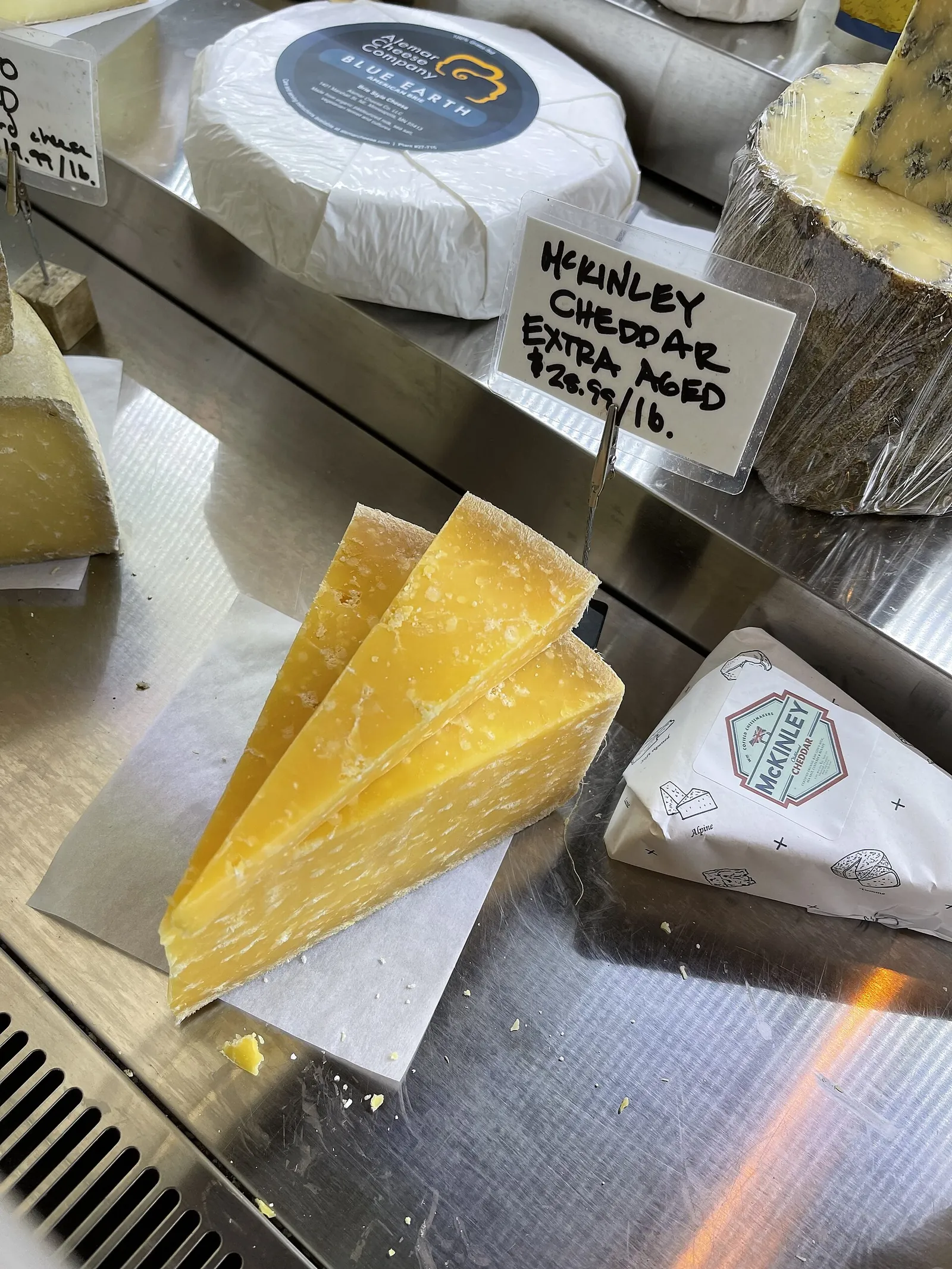
Young cheddar is roughly two to six months old depending on whose ladder you use, a sharp is around nine months, an extra sharp runs a year or more, and the oldest blocks age for years.
Age works through the cheese's proteins. As cheddar ages they are cut into smaller pieces, which loosens the cheese at first, and then they bond into a tighter network that needs more heat to melt. Flavor, texture and crystals follow the same slow clock.
Aged vs young cheddar at a glance
Here is aged vs young cheddar at a glance, using one major US maker's minimum ages as the yardstick.
| Label | Typical age | How it tastes | How it feels | Best for |
|---|---|---|---|---|
| Mild and medium | About 2 to 6 months (Tillamook's medium: at least 60 days; Dairy Farmers of Wisconsin's mild: 3 to 6) | Milky and buttery, with a mild tang | Smooth and springy | Sandwiches, grilled cheese, kids' mac |
| Sharp | About 9 months (Tillamook: over 9 months) | Bold, tangy and savory | Firmer and drier, still creamy | Sauces, burgers, everyday snacking |
| Extra sharp | 15 months and up (Tillamook: 15 to 24 months) | Deeper and nuttier, with an umami finish | Crumbly, sometimes with white crystals | Grating, boards, blending into sauces |
| Vintage and reserve | 2 to 6 years (Tillamook's longest) | Intense and savory | Hard and crystalline | Boards, shaving, finishing |
What age does to cheddar
Age does three things to cheddar at once: it deepens flavor, changes texture and, past a few months, grows crystals.
How aging changes cheddar flavor
Aging changes cheddar flavor by making it sharper and more savory, and Tillamook says plainly that the longer its cheddars age, the sharper and more flavorful they become. Its medium is milky and buttery with some acid brightness, its nine-month sharp is bold, dry and still creamy, and its extra sharp adds funky, nutty depth with an umami finish.
How aging changes cheddar texture
Aging changes cheddar texture from smooth and springy to firm, dry and crumbly. A nine-month sharp is already dry, and past a year or two the cheese tends to break into crumbles instead of slicing cleanly.
Crystals in aged cheddar
Crystals in aged cheddar are usually calcium lactate, a mineral salt, and they are not mold. John Lucey of the University of Wisconsin's Center for Dairy Research, writing in Dairy Foods, calls calcium lactate the most common crystal in aged cheddar, appearing as white dots inside the cheese or white specks and lines on the outside, usually three to four months in, and says it does not directly affect flavor. Tillamook says its extra sharp may contain them as a direct result of aging.
The crystals people prize in aged Parmigiano-Reggiano and aged Gouda are a different compound. A study of crystals in several cheeses found tyrosine, an amino acid, in those two, while the cheddar it tested held calcium lactate. The same paper notes that the US cheddar industry often treats visible crystals as a defect, while traditional and artisan cheeses treat them as part of their character. If a white spot looks fuzzy or colored instead of hard and dry, see crystallized vs spoiled cheese.
How aged and young cheddar melt
Aged and young cheddar melt differently, and the gap is wider than most recipes admit. America's Test Kitchen baked slices of one brand's cheddar, aged 3, 16 and 24 months, on inverted metal cups in a 175°F oven. The 3-month cheddar melted smoothly, the 16-month cheddar clumped, and the 24-month cheddar broke into two large pieces and never melted. The test's explanation is protein structure: as the cheese ages its proteins first loosen, then bond into a tighter network that takes more heat to melt and pushes out fat.
In a sauce, that puts the sweet spot at young to sharp, up to about a year. Older cheddar still belongs in the pot as a flavor booster, blended with a younger melter or stabilized as the science of a smooth cheese sauce explains, and the best cheeses for mac and cheese shows the blends. Shredding the block yourself also helps, and the guide to shredding cheese for the best melt has the details.
Which cheddar to buy for each job
Which cheddar to buy for each job depends on what you are making, and a few rules of thumb cover most cases.
| Job | Buy | Why |
|---|---|---|
| Grilled cheese, burgers, quesadillas | Medium to sharp | Melts evenly and stays creamy |
| Mac and cheese, cheese sauce | Sharp, about 6 to 12 months | Strong flavor with a reliable melt; blend older cheddar with a younger melter |
| Chili, soup, baked potatoes | Extra sharp, grated | Big flavor from a small handful |
| Cheese board and snacking | Extra sharp or older, cut in chunks | Crumbly and crystalline, rewarding to eat slowly |
| Kids and mild dishes | Mild or medium | Gentle and creamy |
If you keep only one cheddar at home, make it a sharp block around 9 months old: it melts, grates and snacks well. For more on picking a block, see what to look for in a good cheddar, and remember that color is no clue to age, as the cheddar origin and flavor guide explains for annatto.
What most aged vs young cheddar advice gets wrong
Most aged vs young cheddar advice gets one thing wrong: it treats age as a simple ladder of quality.
Sharp, medium and mild are not legal terms
Sharp, medium and mild are not legal terms, and the federal standard for cheddar defines no age words at all. Brands draw their own lines: Tillamook's medium is aged at least 60 days, its sharp 9 months and its extra sharp 15 months, while Dairy Farmers of Wisconsin's cheddar guide runs mild at 3 to 6 months, sharp at 9 to 12 and extra sharp at 1 to 2 years. The only age rule in the standard is the 60-day minimum for cheddar made from raw milk, so when a package gives a number of months, trust it over the word.
The age on the label is a minimum
The age on a cheddar label is a minimum, not a precise measurement, because Tillamook states its ages as minimums and says its cheddar keeps aging after you bring it home. A block labeled 9 months can be older, and its flavor keeps shifting slowly in your fridge.
Older cheddar is not always better
Older cheddar is not always better, because the age that makes a wedge a joy on a board is wasted in a sauce. Heat and other ingredients flatten the fine notes of a vintage block, so melt a medium or sharp cheddar and save the older cheese for eating cold.
Questions about aged vs young cheddar
These are the questions about aged vs young cheddar that come up most.
How long is cheddar aged?
Cheddar is aged from about 60 days to several years, depending on the label. Tillamook's medium is aged at least 60 days, its sharp 9 months, its extra sharp 15 months and its longest-aged cheddars 2 to 6 years.
Are the white crystals in aged cheddar mold?
The white crystals in aged cheddar are not mold. They are usually calcium lactate, a mineral salt that can show up after three to four months of aging, and they do not directly affect flavor.
Does aged cheddar have less lactose?
Aged cheddar has little lactose to begin with, and so does young cheddar: the NIDDK lists cheddar among hard cheeses that are lower in lactose than other dairy foods, and USDA data show about 0.1 gram of sugars per ounce. NIDDK also says many people could have 12 grams of lactose, about the amount in a cup of milk, with no or mild symptoms, and the lactose in cheese guide ranks cheeses.
Which melts better, aged or young cheddar?
Young cheddar melts better than aged cheddar. In America's Test Kitchen's oven test, the 3-month cheddar melted smoothly and the 24-month cheddar never melted.
Is clothbound cheddar the same as aged cheddar?
Clothbound cheddar is a wrapping style, not an age: the wheel is coated in fat, wrapped in cloth and aged for different lengths. Cabot Clothbound Cheddar, for example, is aged 9 to 14 months, according to its maker.
Why does aged cheddar cost more?
Aged cheddar costs more because the maker pays to store and tie up cheese for months or years before it can be sold.
Choosing aged vs young cheddar
Choosing aged vs young cheddar gets easy once you match the age to the job. Buy a sharp block around 9 months for cooking, add a small wedge of extra sharp for the board, and read the number of months on the package when the maker gives it.
Sources
- How long do you age your cheddar cheeses? What makes them sharp?, Tillamook
- Tillamook cheddar sharpness story, Tillamook
- Why young cheese melts better than aged cheese, America's Test Kitchen
- How to avoid crystals in cheese, John A. Lucey, Dairy Foods
- Crystal fingerprinting: elucidating the crystals of Cheddar, Parmigiano-Reggiano, Gouda, and soft washed-rind cheeses using powder x-ray diffractometry, Dairy Science & Technology, 2015 (via PubMed Central)
- Eating, Diet, & Nutrition for Lactose Intolerance, National Institute of Diabetes and Digestive and Kidney Diseases
- 21 CFR 133.113, Cheddar cheese, Legal Information Institute, Cornell Law School
- Cheese, cheddar (FDC 173414), USDA FoodData Central, SR Legacy
- Extra sharp cheddar cheese, Dairy Farmers of Wisconsin