
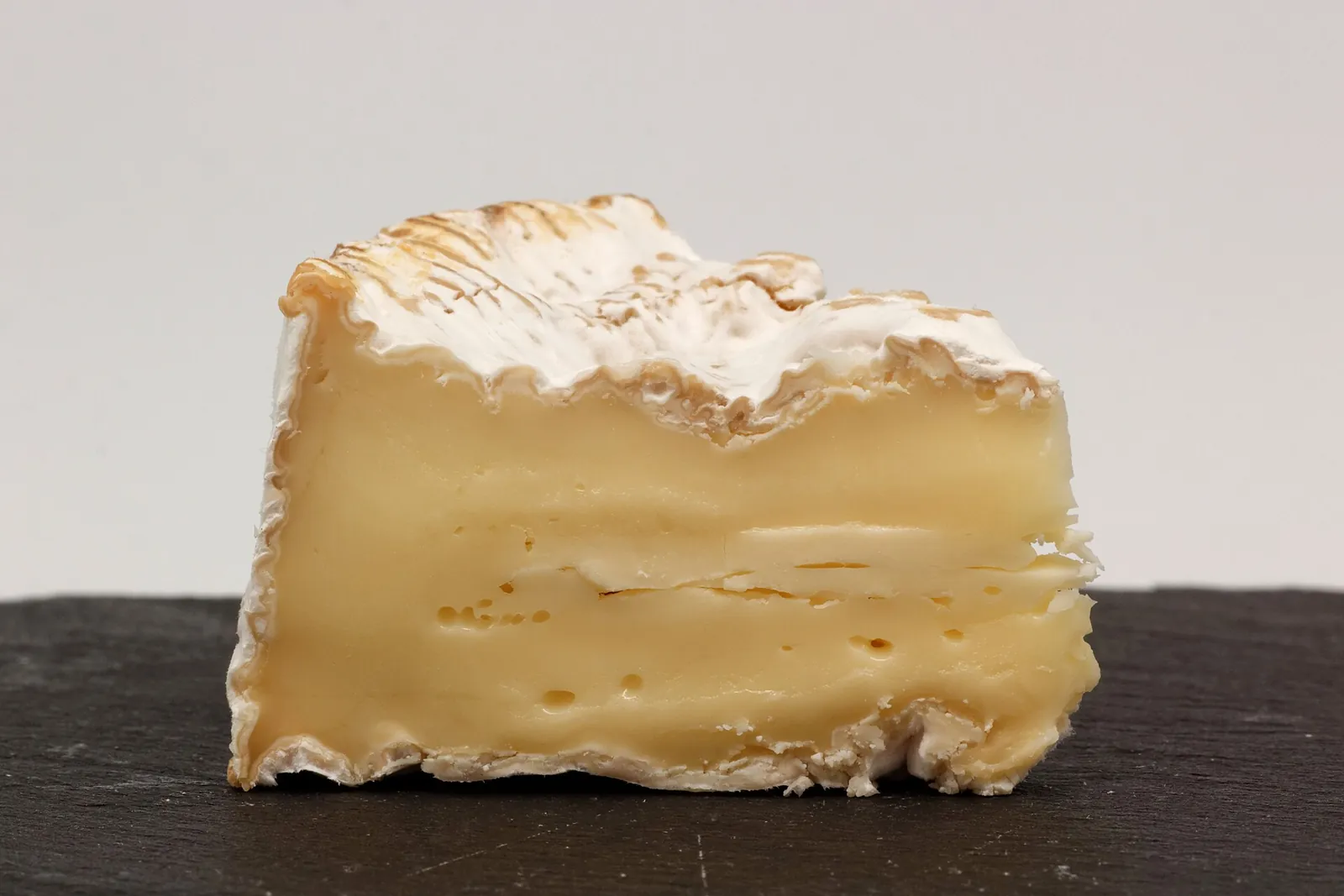
The word is free for anyone to use, so one camembert can be a raw-milk Camembert de Normandie and the next a pasteurized factory round.
The white rind does the work. Mold on the surface softens the paste from the outside in, so a young round is firm and milky and a ripe one is soft and fruity, which makes ripeness as important as the label.
Camembert at a glance
This camembert at a glance table sets the protected original beside the camembert most shoppers actually buy.
| Everyday camembert | Camembert de Normandie | |
|---|---|---|
| Milk | Usually pasteurized in the US | Raw cow's milk only, never heated above 104°F (40°C) |
| Made in | Anywhere | Normandy: the Orne, Calvados and Manche, plus a western strip of the Eure |
| Herd | Varies by maker | At least half pure Normande cows, grazing 6 months or more a year |
| Molding | Varies by maker | Ladled in 5 or more passes, 40 minutes or more apart; drains 18 hours or more |
| Size | Varies by maker | 4.1 to 4.3 in (10.5 to 11 cm) across, at least 8.8 oz (250 g) |
| Reaches customers | Varies by maker | Day 22 after renneting or later |
| Taste | Varies by maker | Lightly salted; milky and mild, then fruity |
| Name | "Camembert" is generic | Protected: PDO (AOP in France) |
What is camembert cheese?
Camembert cheese is a soft-ripened cow's milk cheese named for the village of Camembert in Normandy's Orne department, about 19 miles (30 km) south of Lisieux. Its thin rind is a white felt of Penicillium candidum mold that can pick up red patches from bacteria as the cheese ages, and the paste runs from ivory to pale yellow, according to the official specification.
The legend credits Marie Harel, who is said to have perfected the cheese in 1791 with help from a priest she was hiding during the Revolution, but the specification itself calls that story unconfirmed. What it documents is the trade: from 1855 the Paris to Lisieux railway cut the trip to the Pays d'Auge from three days to under six hours.
Camembert de Normandie, the protected original
Camembert de Normandie is the only camembert with a protected name, earning the French appellation in 1983 and EU protected designation of origin status on June 21, 1996, according to the eAmbrosia register. The PDO and PGI guide explains what such a label promises.
Camembert de Normandie milk and herds
Camembert de Normandie milk must be raw, never heated above 104°F (40°C), and at least half of each farm's dairy cows must be pure Normande, a breed whose protein-rich milk sets into a firm curd. The cows graze at least six months a year, with at least 0.33 hectare (0.8 acre) of grass for each one milked, and the milk is partly skimmed, to 28 to 29 grams of fat per liter, because Norman milk is too rich to use whole.
How Camembert de Normandie is ladled
Camembert de Normandie is ladled into its molds in at least five passes, each at least 40 minutes after the last, and the curd then drains on its own for at least 18 hours. The EU summary of the rules credits that slow, layered shaping for the paste's pliability and creaminess.
Camembert in the US
Camembert in the US is mostly pasteurized, because the FDA standard for soft ripened cheeses requires a cheese made from unpasteurized milk to be cured at 35°F or warmer for at least 60 days. A raw-milk round on an American counter is therefore at least 60 days old, against the three weeks or so of a Camembert de Normandie leaving a French dairy. Ask the cheesemonger how old it is.
How to tell when camembert is ripe
Ripe camembert gives evenly when you press it gently through the wrapper, with no hard, chalky core. The specification describes a paste that is smooth and supple once it is ripe to the core.
The center lags behind the rind. In an Oregon State University study of five camembert-style recipes, the rind's pH reached neutral by day 10 while the paste took 35 to 50 days, so a young round can be soft at the edge and chalky in the middle. A rind that has browned, turned sticky or smells sharply of ammonia is past its best; browning is classed as a defect in mold-ripened cheese, and it showed up in all five recipes. How to choose a ripe brie or camembert has a shopping checklist.
Treat the date as a deadline, not a ripeness guide.
How to eat camembert
Camembert is best eaten at room temperature, so take it out of the fridge 30 to 60 minutes ahead and cut wedges from the center to the edge, giving everyone rind and paste together. Serve baguette, tart apples, pears or cornichons alongside, with dry cider, sparkling wine or a light red; the pairing guide has more matches.
How to bake camembert
Baked camembert takes 12 to 15 minutes at 350°F (175°C): unwrap the round completely, set it back in its wooden box with the lid off or in a small ovenproof dish, and bake until the top puffs and the center wobbles. Score the top and push in garlic slivers and rosemary, or finish with honey, fig jam or chopped nuts; the toppings in baked brie ideas work just as well.
Bake a younger, firmer round for this. Heat does the ripening's job, while a fully ripe round can run out of its rind. Set the box on a baking sheet either way.
How to store camembert
Store camembert in the refrigerator, in its paper or in parchment set loosely in a container, and finish an opened round within about a week. In the FDA and Health Canada risk assessment for soft-ripened cheese, which modeled a pasteurized Camembert-style cheese, Listeria growth during storage at home was the main risk factor, because the bacterium can grow at refrigerator temperatures. The FDA advises keeping the refrigerator at or below 40°F (4°C).
People who are pregnant, 65 or older, or have a weakened immune system should skip raw-milk cheese unless it is heated to 165°F (74°C) or until steaming hot, the CDC advises. See cheese during pregnancy for other cheeses.
Camembert mistakes that cost you flavor
The most common camembert mistake is trusting the box, which says less than it seems to.
Reading "hand-ladled" as a rule. The PDO fixes the ladling but not who does it. The specification allows automated molding heads as well as hand ladles and calls only manual molding in static molds on a draining table the "traditional technique." Hand-ladling is something a producer adds, not something the AOP logo promises.
Trusting "Normandy" or "French." INAO, the French agency that oversees appellations, says the name camembert has become generic in France and worldwide. Only Camembert de Normandie guarantees the raw milk, the Norman herds and the molding, and INAO tells shoppers to look for the red and yellow AOP logo.
Expecting every round to run. In the Oregon State study, a stabilized-curd camembert moved only 4 mm (about 1/6 inch) when cut after 50 days, against 27 mm (about 1 inch) for a lactic-curd one. A round that stays firm to its date may simply be built to keep.
Questions about camembert cheese
These are the questions about camembert cheese that come up most.
Is camembert the same as brie?
Camembert is not the same as brie, though both are soft cow's milk cheeses with white mold rinds. Camembert is the small round from Normandy, and the full brie vs camembert comparison shows how size, rules and flavor differ.
What does camembert taste like?
Camembert tastes lightly salted, milky and mild when young and more distinct and fruity as it ripens, according to the rules for Camembert de Normandie.
Can you eat the rind on camembert?
You can eat the rind on camembert; it is the white mold coat that ripened the cheese. Trim it only if it has turned brown, sticky or bitter, and see which rinds you can eat for other cheeses.
Why does camembert come in a wooden box?
Camembert comes in a wooden box because a Le Havre exporter introduced it around 1890 to ship the cheese better. The rules for Camembert de Normandie now require a whole round in an individual wooden box.
How many calories are in camembert?
Camembert has about 85 calories in a 1-ounce (28 g) serving, with 6.9 g of fat, 5.6 g of protein and about 239 mg of sodium, according to USDA FoodData Central.
Buying your first camembert
For your first camembert, buy a pasteurized round that gives gently when pressed, let it warm for 45 minutes and eat it with a baguette and apple slices. Bake the second one, and if you find a raw-milk round marked Camembert de Normandie with the AOP logo, taste the two side by side.
Sources
- Cahier des charges de l'appellation d'origine protégée Camembert de Normandie, INAO (Institut national de l'origine et de la qualité)
- Camembert de Normandie, product sheet, INAO
- Camembert de Normandie, PDO-FR-0112, European Commission eAmbrosia register
- 21 CFR 133.182, Soft ripened cheeses, Electronic Code of Federal Regulations
- Influence of cheese-making recipes on the composition and characteristics of Camembert-type cheese (Batty, Waite-Cusic and Meunier-Goddik, 2019), Journal of Dairy Science via PubMed
- Quantitative Assessment of the Risk of Listeriosis from Soft-Ripened Cheese Consumption in the United States and Canada: Interpretive Summary (2015), FDA and Health Canada
- Preventing Listeria Infection, Centers for Disease Control and Prevention
- Are You Storing Food Safely?, U.S. Food and Drug Administration
- Cheese, camembert (FDC 172178), USDA FoodData Central, SR Legacy