
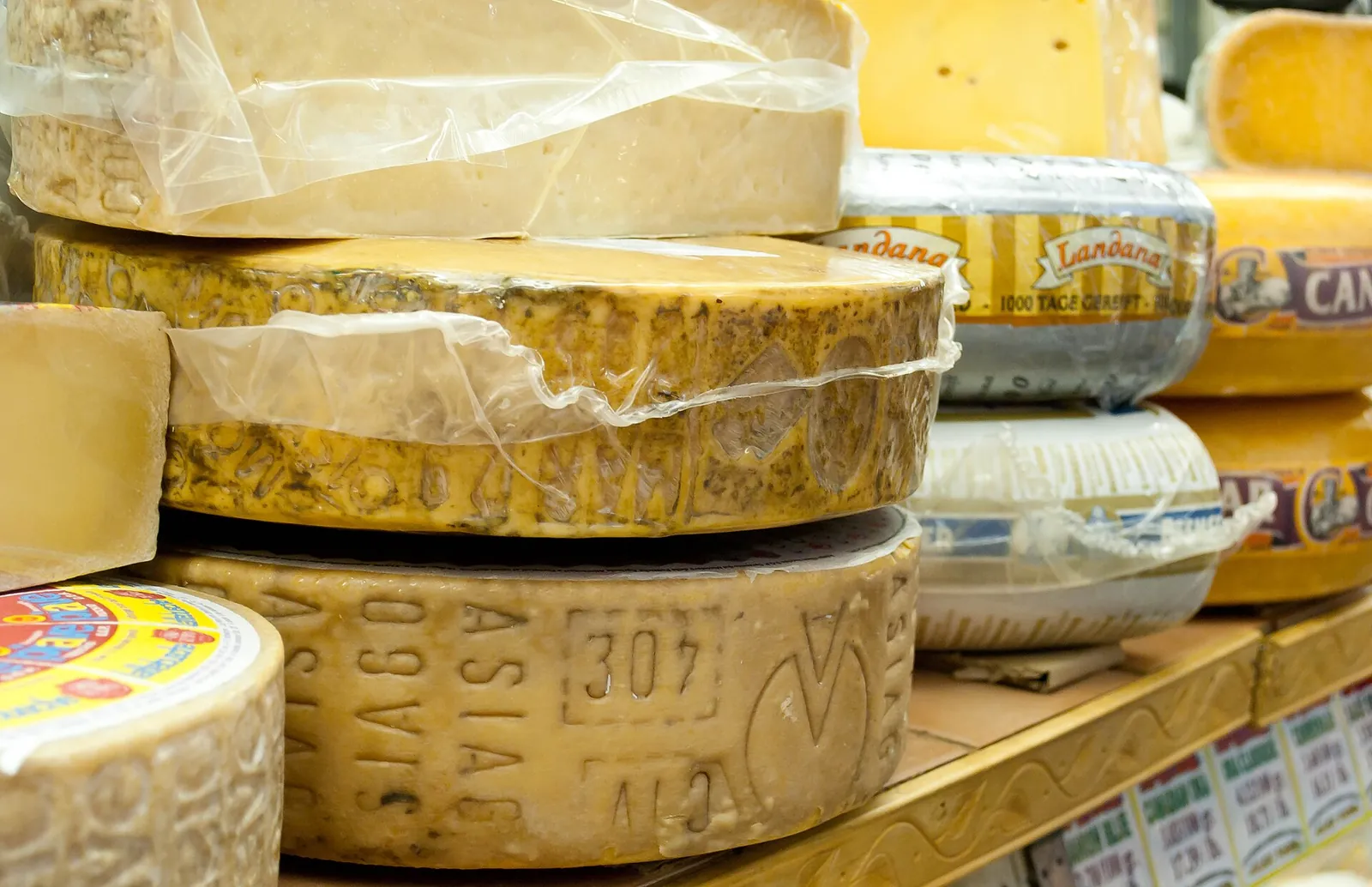
PDO is the tightest link to a place, PGI is looser, and TSG protects a method with no place at all.
The labels are legal tools, not taste ratings. A seal tells you the product meets its written rules; whether you like the result is up to you.
What PDO, PGI and TSG mean
PDO, PGI and TSG are the three product schemes in EU law, and the European Commission's explainer sets out each one.
| Seal | Stands for | The rule | Region needed |
|---|---|---|---|
| PDO | Protected Designation of Origin | Every part of production, processing and preparation takes place in the specific region | Yes, for all stages |
| PGI | Protected Geographical Indication | At least one of the stages of production, processing or preparation takes place in the region | Yes, for one stage |
| TSG | Traditional Specialty Guaranteed | Highlights traditional aspects, such as how the product is made or its composition | No |
The Commission adds that its mandatory logo applies to food and agricultural products carrying PDO, PGI or TSG. In other languages the same seals appear as AOP in French and DOP in Italian and Spanish, and they mean the same thing.
What a PDO cheese promises
A PDO cheese promises that the whole process happened in the named region, following a published specification. The Commission's rule is that every part of production, processing and preparation takes place there. For cheese, the specification typically fixes the milk, the area, the method and the minimum age.
Parmigiano-Reggiano is the clearest example: raw cow's milk, made only in a defined part of Italy and aged at least 12 months. Roquefort is another, with its aging in the Combalou caves. Feta is a third, reserved for Greek cheese made from sheep's milk, or sheep's milk with up to 30 percent goat's milk.
What a PGI cheese promises
A PGI cheese promises less than a PDO cheese does, because only one stage of production has to happen in the region. The Commission describes PGI as covering products whose quality or reputation is essentially linked to geographic origin, though production may be less localized than PDO.
Yorkshire Wensleydale is the example on this site. Its protection and what it requires are covered on the Wensleydale page. A PGI is a real guarantee of origin, just a looser one than PDO.
What a TSG label promises
A TSG label promises a traditional method or composition, not an origin. The Commission describes it as highlighting the traditional aspects, such as the way a product is made or its composition, without being linked to a specific geographical area. Its example is Gueuze beer, which can be produced anywhere. Of the three, TSG is the one you will meet least on cheese.
UK PDO, PGI and TSG after Brexit
UK PDO, PGI and TSG schemes run in parallel with the EU ones, and the split depends on where the product is sold. GOV.UK says the UK GI schemes protect registered names when they are sold in Great Britain (England, Scotland and Wales), while the EU schemes protect registered names sold in Northern Ireland and the EU. The GOV.UK guidance names the same three designations, UK PDO, PGI and TSG, and was first published on December 31, 2020.
For a shopper, the practical point is that British cheeses such as Stilton and Wensleydale may carry UK or EU marks depending on the register and the market. The United Kingdom page covers British cheeses. This page does not list which cheeses sit on which register, because the GOV.UK page only points to the registers.
How the US treats PDO and PGI names
The US treats geographical names as trademarks, not through a PDO-style system. A Congressional Research Service report says GIs are generally treated as a subset of trademarks, collective or certification marks under the existing trademark regime, and that the US does not protect a geographic term considered generic.
The US Patent and Trademark Office says protection comes through certification marks indicating regional origin, collective marks, or trademarks. A certification mark requires a certifier that controls the term and sets standards for others to use it.
The practical result is that the US and EU disagree about names. The CRS report names parmesan, feta and provolone as contested terms, and says many US food makers see them as common names. That is why a US "feta" can be made from cow's milk, while the EU reserves feta for the Greek PDO cheese. The reverse is also true: a US shelf can hold a genuine PDO import beside a domestic cheese using the same word.
How to read a cheese label
To read a cheese label for protected status, look for the seal, the full protected name and the country of origin. A wedge sold as Parmigiano-Reggiano with the EU PDO mark follows its specification. Wording like "Italian-style" or "parmesan" does not carry that promise in the US. The guide to buying Parmigiano-Reggiano shows the rind marks to check, and the guide to spotting authentic feta does the same for feta.
What most PDO and PGI cheese advice gets wrong
Advice on PDO and PGI cheese often says a seal means better cheese, and that is not what the schemes promise. The Commission describes them as protecting origin and method, not grading quality.
The other common mistake is assuming the seal travels. A name protected in the EU is not automatically protected in the US, where the same word can be a common name or a trademark depending on the case. A PDO seal on the package is the reliable signal, not the word alone.
Questions about PDO and PGI cheese
These questions about PDO and PGI cheese cover the labels most shoppers meet.
What does PDO mean on cheese?
PDO on cheese means Protected Designation of Origin: every part of production, processing and preparation takes place in the specific region.
What is the difference between PDO and PGI?
The difference between PDO and PGI is that PDO needs every stage in the region while PGI needs at least one.
What is TSG on a food label?
TSG on a food label means Traditional Specialty Guaranteed, which protects a traditional method or composition without tying it to a geographic area.
Are AOP and DOP the same as PDO?
AOP and DOP are the French and Italian or Spanish forms of PDO, and they carry the same meaning.
Does the US recognize PDO cheese names?
The US recognizes protected names only through its trademark system, and it does not protect a geographic term it considers generic.
Using PDO and PGI labels when you shop
When you shop with PDO and PGI labels in mind, pick the seal for cheeses where origin matters to you, such as Parmigiano-Reggiano or Roquefort, and judge unprotected cheeses by the maker, milk and age. For a next step, compare a PDO Parmigiano-Reggiano with a domestic parmesan and see what the label says.
Sources
- Geographical indications and quality schemes explained, European Commission
- Protected geographical food and drink names: UK GI schemes, GOV.UK
- Geographical Indications (GIs) in U.S. Food and Agricultural Trade, Congressional Research Service
- Geographical indications, United States Patent and Trademark Office