
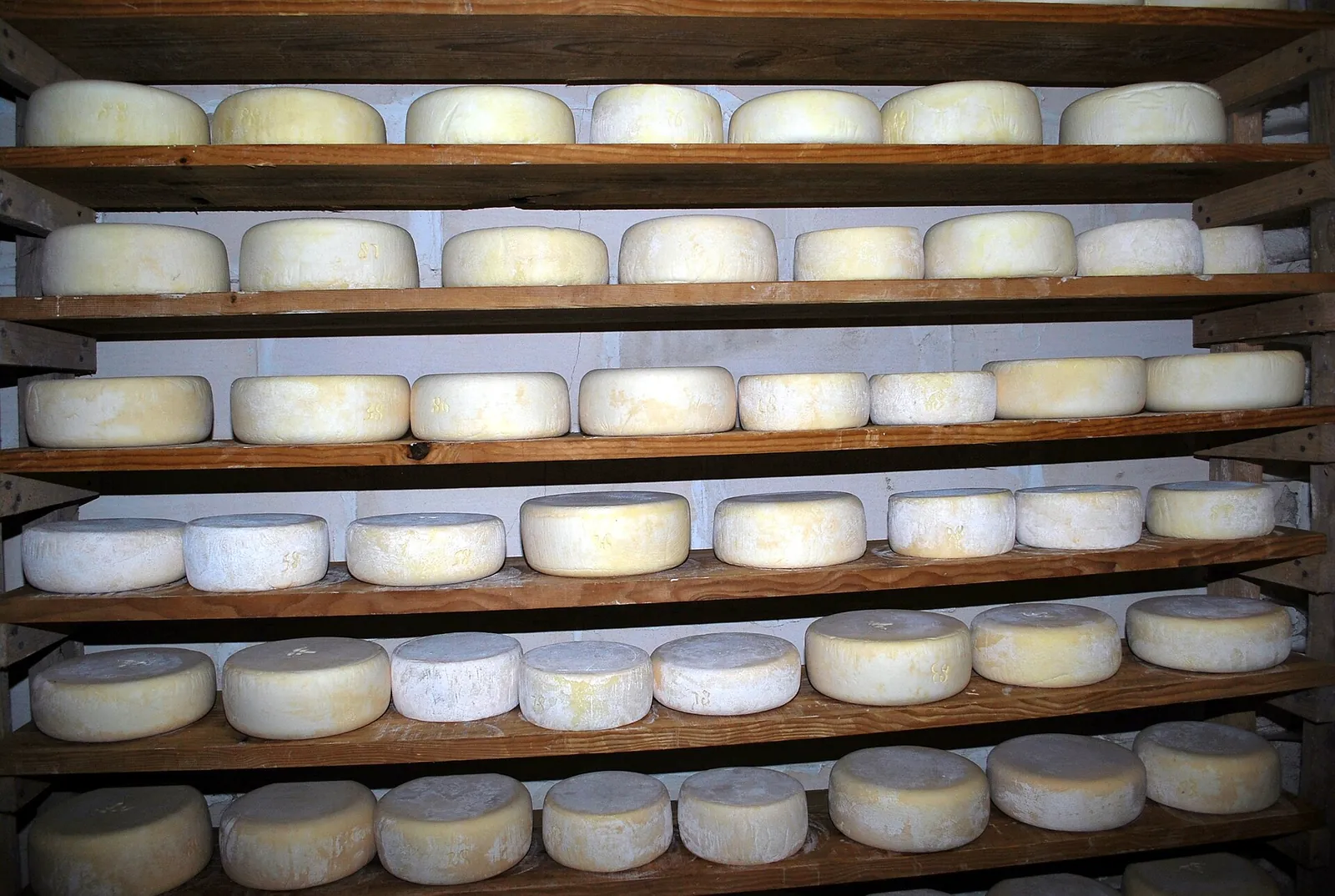
They taste alike in spirit: nutty, buttery, a little sharp, built to be sliced thin and eaten with something sweet.
The border runs through the Pyrenees, but the sheep, the pastures and the shepherds' methods carry across it. That is why one wedge of Idiazabal and one of Ossau-Iraty can feel like cousins even though they have different laws, different breeds and different national rules. For the wider Spanish picture, see Spanish cheeses.
Basque cheeses at a glance
This table of Basque cheeses sets the two protected names side by side, using the facts on the linked cheese pages.
| Cheese | Side of the border | Milk | Aging | Notes |
|---|---|---|---|---|
| Idiazabal | Spain: Basque Country, part of Navarre | Raw sheep, Latxa and Carranzana | At least 60 days | Hard, smoked or plain |
| Ossau-Iraty | France: Basque Country and Béarn | Sheep, Manech or Basco-béarnaise | At least 80 days (smaller wheels), 120 (larger) | Smooth, ivory paste |
Idiazabal, the Spanish Basque cheese
Idiazabal is the Spanish Basque cheese, made from raw milk of Latxa and Carranzana sheep. The milk must be unpasteurized sheep's milk with a minimum of 6 percent fat, and the wheels weigh about 2 to 4 pounds (0.9 to 1.8 kg). The rind is hard, dark and waxy, and it is not eaten.
Smoking is optional for Idiazabal and happens after aging, over beech or alder wood, and the label words tell you which version you have. The smoke sits on the rind, so a smoked wheel tastes drier and more aromatic but is not a different cheese. Aged past a few months, it gets firm, dry and sharp.
Ossau-Iraty, the French Basque cheese
Ossau-Iraty is the French Basque cheese, a pressed, uncooked sheep's milk cheese from the Basque Country and Béarn. Three breeds are allowed for Ossau-Iraty: Manech tête rousse, Manech tête noire and Basco-béarnaise. The AOC dates from 1980, and the aging minimum is 80 days for 2 to 3 kg wheels and 120 days for 4 to 7 kg wheels.
The paste is smooth, creamy and firm, from white to cream, with a yellow-orange to gray rind. It is gentler than Idiazabal, with a slight hazelnut note, and it is the easier cheese to give to someone who does not like sharp flavors. For the country context, see France. It is one of only three French sheep's milk cheeses with AOC status, so the name carries weight at the counter.
The Spanish side is just as tightly defined. Idiazabal is a protected cheese shared by the Basque Country and Navarre, one of 26 Spanish cheeses with PDO status. In practice that means a wheel from outside the zone cannot use the name, and a buyer who wants the real thing should look for the numbered label and the words Denominación de Origen Idiazábal.
Other Basque cheeses
Other Basque cheeses include many farm wheels that carry no protected name, sold simply as Pyrenean or Basque sheep's milk tommes. They follow the same recipe: raw or lightly heated sheep's milk, pressed and aged for a few months. The tomme de brebis page covers that style and what to expect.
If you are buying one without a protected name, ask the age, the milk and the maker. A wheel with no origin information may not be Basque at all.
How to serve Basque cheeses
How to serve Basque cheeses follows the old custom: a thin wedge, a sweet partner and a drink from the region. Black cherry jam is the standard match for Ossau-Iraty, traditionally made with cherries from Itxassou, and quince paste or honey suits Idiazabal. Add crusty bread, almonds and cured ham. Cider is the traditional Basque drink and suits both, and the cider and cheese guide explains why.
Allow about 2 ounces a person as an appetizer. Take the cheese out of the fridge 30 to 60 minutes ahead, or the fat will be too firm to taste.
What most Basque cheeses advice gets wrong
What most Basque cheeses advice gets wrong is treating the two sides as one cheese. Idiazabal and Ossau-Iraty share a milk and a mountain, but they have separate protected names, separate breeds and separate aging rules, and they taste different: Ossau-Iraty is smoother, Idiazabal sharper and often smoky.
The second mistake is assuming the smoke is flavoring added to every Idiazabal. Smoking is optional and applied to the rind after aging, so a plain wheel exists, and the label should say which you have. The third is skipping the raw-milk rule: raw-milk cheese must age at least 60 days to be sold in the US, which both of these cheeses clear before they reach a US shelf. The raw-milk cheese page covers it, including advice for pregnancy.
Questions about Basque cheeses
These questions about Basque cheeses cover the usual confusion.
What milk are Basque cheeses made from?
Basque cheeses are made mostly from sheep's milk, from breeds such as Latxa and Carranzana in Spain and Manech in France.
What is the most famous of the Basque cheeses?
The most famous of the Basque cheeses are Idiazabal and Ossau-Iraty, one from each side of the border.
Is Idiazabal always smoked?
Idiazabal is not always smoked, because smoking is optional and done after aging, so check the label.
What goes with Basque cheeses?
What goes with Basque cheeses is sweet and simple: black cherry jam, quince paste or honey, bread, almonds and cider.
Can you buy Basque cheeses in the US?
You can buy Basque cheeses in the US at cheese counters and specialty shops, and both protected wheels meet the 60-day raw-milk aging rule.
Try Basque cheeses
To try Basque cheeses, buy a wedge of Ossau-Iraty and a wedge of Idiazabal, plain or smoked, and taste them side by side with cherry jam. See the Spain country page for the rest of the Spanish range.
Sources
- Idiazabal cheese, Wikipedia
- Ossau-Iraty, Wikipedia
- List of Spanish cheeses, Wikipedia
- 21 CFR Part 133: Cheeses and Related Cheese Products, Electronic Code of Federal Regulations