
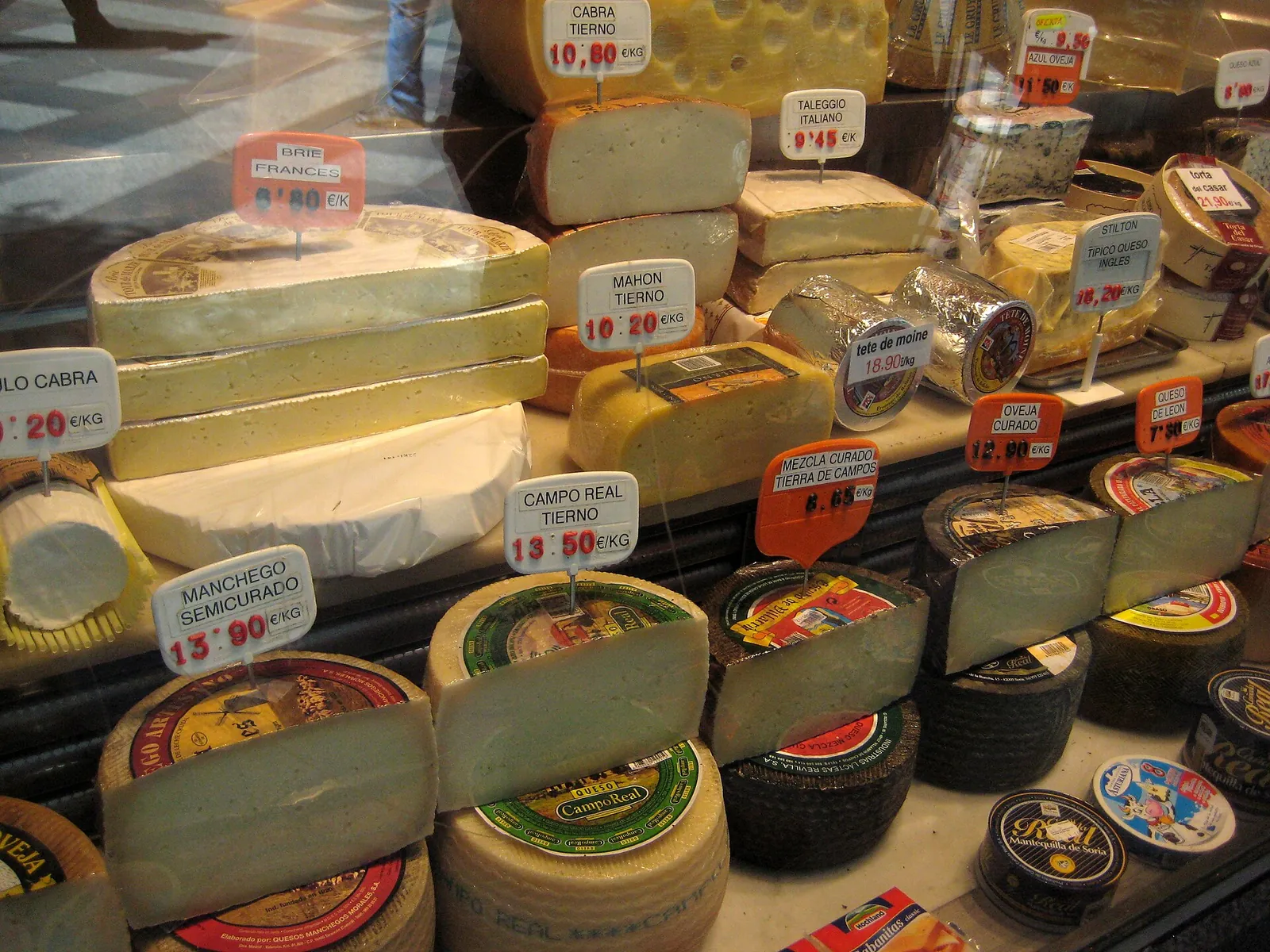
If you want one cheese to start with, buy Manchego. If you want to see how wide the range is, add a blue, a soft cow's milk cheese and a spoonable thistle-set sheep's cheese.
Spain has 26 cheeses classified as protected designation of origin (DOP in Spanish), and 3 more with protected geographical indication status. A protected name fixes the place, the milk and usually the minimum aging, which makes the label more useful than the brand. The PDO and PGI guide explains the seals.
Spanish cheeses at a glance
This table of Spanish cheeses lists the main names, with the milk and region for each.
| Cheese | Milk | Region | Texture | Try it with |
|---|---|---|---|---|
| Manchego | Sheep | La Mancha | Firm, pressed | Quince paste, olives |
| Cabrales | Cow, or a mix with sheep and goat | Asturias | Creamy blue | Honey, dry cider |
| Mahón-Menorca | Cow | Menorca | Semi-soft to hard | Almonds, figs |
| Idiazabal | Sheep | Basque Country, Navarre | Hard, often smoked | Cider, bread |
| Tetilla | Cow | Galicia | Soft, creamy | Fruit, toast |
| Zamorano | Sheep | Zamora, Castile and León | Hard, sharp | Red wine |
| Torta del Casar | Sheep | Extremadura | Spoonable when ripe | Bread |
Spanish sheep's milk cheeses
Spanish sheep's milk cheeses are the center of the cheese board, and the best known is Manchego, a PDO cheese made from Manchega sheep in La Mancha. It is sold at several ages, from young and mild to cured and sharp, and the real one carries a woven rind pattern and a numbered label.
Zamorano is the less famous cousin, made in the province of Zamora from Churra and Castellana ewes and ripened at least 100 days. It runs sharper and saltier than a young Manchego, which makes it a good swap when you want more bite.
Torta del Casar, from Extremadura, is the odd one out. It is a sheep's milk cheese set with a coagulant from the cardoon thistle, aged at least 60 days, and it takes the milk of about 20 sheep to make a 2.2 pound (1 kg) wheel. It is traditionally eaten by cutting off the top and scooping out the creamy inside, and the thistle gives a faint bitterness. Buy it in season and keep it cold. It has no page of its own here yet.
Spanish blue and cow's milk cheeses
Spanish blue and cow's milk cheeses make up the north and the islands. Cabrales is the powerful blue of Asturias, made from raw cow's milk or a blend with sheep's and goat's milk and ripened at least two months in mountain caves. Use a small piece: it is salty and sharp, and a thin wedge goes a long way against sweet quince paste or honey.
Mahón comes from Menorca and is made from cow's milk, pressed into a square block with rounded corners and an orange-brown rind. Young Mahón is mild and milky, and cured Mahón is sharp and nutty. It is a cow's milk cheese, not a sheep's milk one, which surprises people who assume all Spanish cheese is sheep.
Tetilla is the gentle one, a soft cow's milk cheese from Galicia shaped like a cone and ripened only about a week. It melts well and suits people who find the aged cheeses too strong.
Spanish goat cheeses
Spanish goat cheeses are less common in US shops, but the protected names include Murcia al Vino, a PDO goat's cheese from Murcia made from pasteurized milk, and Majorero, a PDO goat's cheese from the Canary Islands. Garrotxa from Catalonia is another name to look for. These are worth asking for at a cheese counter when you want something outside the Manchego lane.
How to buy Spanish cheeses in the US
How to buy Spanish cheeses in the US starts with the label: look for the protected name, the region and the age word. Manchego, Mahón, Tetilla and Cabrales are the easiest to find. Raw-milk cheese must age at least 60 days to be sold in the US, so a cheese ripened for a week, such as Tetilla, arrives made from pasteurized milk. The raw-milk cheese page explains the rule and the pregnancy advice.
For a first purchase, buy a 6 to 8 ounce wedge of Manchego aged about six months, a small piece of Cabrales and one soft cheese. That is enough for four people as an appetizer at about 2 ounces each.
What Spanish cheese labels get wrong
What Spanish cheese labels get wrong, for buyers, is the word "Manchego" on its own: it is a protected name, and only cheese from Manchega sheep in La Mancha may use it. A sheep's milk cheese sold as "Manchego style" may come from elsewhere. The same goes for "Mahón-style" and "Idiazabal-style" wedges. If the protected name and the seal are missing, treat it as a different cheese and judge it on taste and price.
Smoke is the other trap. Idiazabal wheels weigh about 2 to 4 pounds (0.9 to 1.8 kg) and are sold smoked and unsmoked, and the smoke sits on the rind, so ask which one you are getting. The Idiazabal page and the Basque cheeses guide cover it. For the wider picture, see the Spain country page.
How to serve Spanish cheeses
How to serve Spanish cheeses is simple: take them out of the fridge 30 to 60 minutes before eating, cut thin wedges, and add something sweet, salty and crunchy. Quince paste (membrillo), marcona almonds, olives and cured ham are the standard partners, and dry sherry, cider or a Tempranillo red suit most of the board. Put the blue and the smoked cheese last, because they will overpower a mild Tetilla.
Questions about Spanish cheeses
These questions about Spanish cheeses come up most often at the counter.
What is the most famous of the Spanish cheeses?
The most famous of the Spanish cheeses is Manchego, the firm sheep's milk cheese from La Mancha, which has a protected name.
Are Spanish cheeses made from sheep's milk?
Many Spanish cheeses are made from sheep's milk, including Manchego, Zamorano, Idiazabal and Torta del Casar, but Mahón and Tetilla are cow's milk cheeses and Cabrales can use cow's milk or a blend.
Which Spanish cheese is a blue?
The Spanish cheese that is a blue is Cabrales from Asturias, ripened in natural mountain caves for at least two months, with Valdeón from Castile and León as another PDO blue.
Is Manchego safe during pregnancy?
Manchego safety in pregnancy depends on whether the wheel is pasteurized or raw, so check the label and follow FDA guidance for your situation.
What do you eat with Spanish cheeses?
What you eat with Spanish cheeses is usually quince paste, almonds, olives and cured ham, with sherry, cider or red wine.
Start with Spanish cheeses
To start with Spanish cheeses, build one board: Manchego for the center, Cabrales for the bold bite and Tetilla for the soft side, with quince paste and almonds. Then move on to a smoked Idiazabal or a Torta del Casar when you want to go further.
Sources
- List of Spanish cheeses, Wikipedia
- Torta del Casar, Wikipedia
- Idiazabal cheese, Wikipedia
- 21 CFR Part 133: Cheeses and Related Cheese Products, Electronic Code of Federal Regulations