
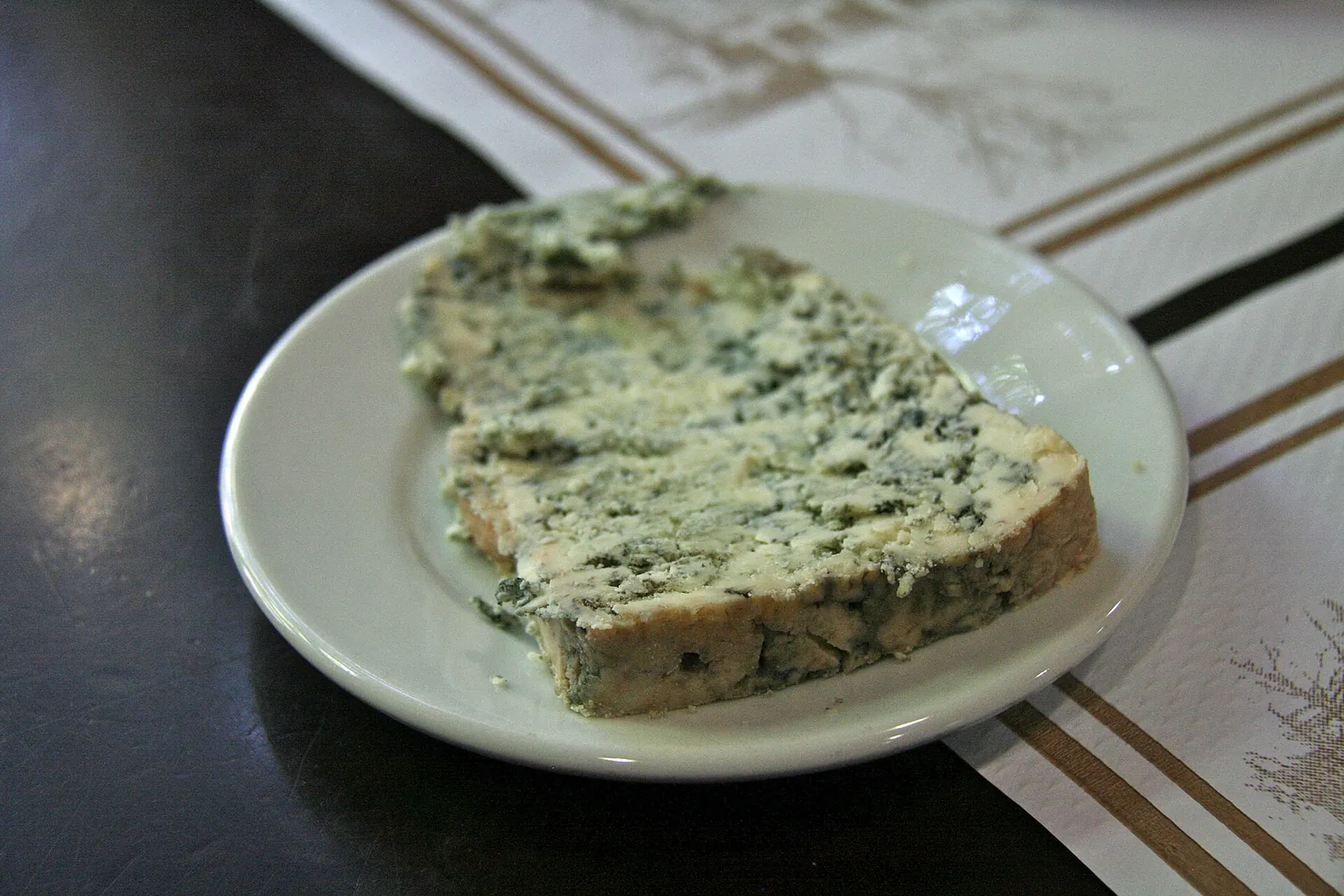
It is creamy, salty and sharp, and it has the reputation of being one of the strongest blues you can buy.
Two things explain the strength: the milk and the cave. Raw milk keeps a wide range of flavors, and cave air does the ripening, so the cheese ends up stronger when sheep's or goat's milk goes into the vat.
Cabrales cheese at a glance
Here is Cabrales cheese at a glance, taken from the protected-name file and the regulatory council.
| Detail | Cabrales |
|---|---|
| Milk | Raw whole cow's milk, or a mix of two or three milks (cow, sheep, goat) |
| Made in | Cabrales council and three villages of Peñamellera Alta, Asturias, Spain |
| Protected name | DOP (Denominación de Origen Protegida) "Cabrales" |
| Ripening | At least two months from the day the curd is made, mostly in caves |
| Shape | Cylinder, 7 to 15 cm (about 3 to 6 in) tall, soft thin rind |
| Fat | At least 45 percent of dry matter |
| Texture | Creamy, compact paste with no eyes, white with blue-green veins |
| Flavor | Slightly spicy, stronger when sheep's or goat's milk is used |
Where Cabrales cheese is made
Cabrales cheese can be made only in a small zone in the Picos de Europa mountains. The protected-name file names the villages: 18 in the council of Cabrales (including Bulnes, Sotres, Tielve and Arenas) and three in the neighboring council of Peñamellera Alta. Milk comes only from registered herds in that zone, the cheese is made in registered artisan dairies there, and ripening finishes in registered caves.
The Cabrales regulatory council certifies the milk and cheese; its site describes the cheese as made from raw cow's milk or a mix of two or three milks: cow, sheep and goat. See the PDO and PGI guide for what the label promises.
How Cabrales cheese is made and aged
Cabrales cheese is made from whole raw milk, with no preservative, set into a curd and drained into cylinders. The file requires at least two months of ripening counted from the day the curd is made, mostly in a cave. Producers often keep it longer; the most expensive cheeses page notes that an auction-winning wheel was aged about 9 to 10 months.
The caves are natural limestone caverns. Wikipedia's Cabrales entry reports humidity of about 90 percent and a temperature of 7 to 13 °C (45 to 55 °F). That cool, damp air lets blue mold develop along the paste and softens the rind into the thin, greasy, gray-brown to orange skin the file describes. The mechanism is the same as in other blues: mold needs air channels, salt and humidity, as Blue Cheese 101 explains.
What Cabrales cheese tastes like
Cabrales cheese is creamy and dense, with a compact paste, no holes and blue-green veins running through white. The file calls the flavor slightly spicy, and more marked when sheep's or goat's milk is blended with cow's milk. In practice it tastes salty, sharp and long, with a pungent smell.
Compared with Roquefort, which is sheep's milk only, Cabrales leans on cow's milk and often shows a softer, buttery center with fierce edges. Compared with Gorgonzola, it is far saltier and less sweet.
How to buy Cabrales cheese in the US
Buying Cabrales cheese in the US usually means a foil-wrapped wedge from a cheese shop or a good grocery cheese counter. The file allows the cheese to be sold whole, in halves or in portions, always packaged so the origin is clear, and Wikipedia reports that the official version is wrapped in dark-green foil with the registered Cabrales stamp.
Look for that stamp and the word Cabrales; "Spanish blue" or "Asturian blue" is another cheese. Ask for a cut with moist, evenly veined paste and a clean smell, not an ammonia sharpness. Raw milk is allowed in the US only under FDA aging rules; the raw-milk cheese guide covers it, and the pregnancy cheese guide covers who should skip it. Buy a small piece, about 1 to 2 ounces per person on a board.
How to serve and cook with Cabrales cheese
Serve Cabrales cheese at room temperature with something sweet to calm the salt. Quince paste (membrillo), honey, figs and walnuts work, and a little goes a long way spread on toast or crackers.
In the kitchen, melt a spoonful into a warm cream or cider sauce off the heat and pour it over steak, or mash it into a sauce for roasted pears. Crumble it into salads with apple and toasted nuts. Because it is strong, use about half the amount you would use of a milder blue.
For drinks, Asturian sidra (cider) is the local match, and sweet wines such as Pedro Ximénez sherry and port also work; the blue cheese pairing guide has more, and the port and blue cheese guide explains why sweetness helps. Manchego is the milder Spanish partner on the same board.
Cabrales cheese substitutes
Cabrales cheese substitutes should be salty, sharp blues. Roquefort is the closest for strength, though it is sheep's milk and more tangy. Piquant Gorgonzola is creamier and a little milder, and Danablu is a cheaper, saltier option for sauces. For a mild fallback, use a Stilton and add a pinch of salt.
What most Cabrales cheese advice gets wrong
Most Cabrales cheese advice repeats a few ideas that are only half true.
Cabrales cheese does not need a cave to be called Cabrales
Cabrales cheese must be ripened in caves, but the file says the ripening is "mostly" in a cave, not entirely, and it gives the minimum as two months. A cheese sold young is still Cabrales, so ask the age if strength matters.
Cabrales cheese is not always raw cow's milk
Cabrales cheese can be cow's milk alone or a blend with sheep and goat, and the blends taste stronger. Wikipedia and the council describe this; the rules allow all of it.
Cabrales cheese is not meant to be eaten in large pieces
Cabrales cheese is meant to be used in small amounts, and its salt is the reason. A thin slice with quince paste does more than a thick wedge.
Questions about Cabrales cheese
These are the questions about Cabrales cheese that come up most.
Is Cabrales cheese the strongest blue?
Cabrales cheese is among the strongest blues, with a salty, slightly spicy flavor that grows with sheep's or goat's milk in the blend.
What milk is Cabrales cheese made from?
Cabrales cheese is made from raw whole cow's milk, or a mix of cow, sheep and goat milk, from registered herds in the Cabrales zone.
How long is Cabrales cheese aged?
Cabrales cheese is aged at least two months from the day the curd is made, mostly in a natural cave, though many producers keep it longer.
Is Cabrales cheese safe to eat?
Cabrales cheese is a raw-milk blue, so people who are pregnant or immunocompromised should follow CDC and FDA guidance on raw-milk cheese.
Where do you buy Cabrales cheese in the US?
Cabrales cheese is sold in the US at specialty cheese shops and some grocers as foil-wrapped wedges stamped with the Cabrales mark.
What is a substitute for Cabrales cheese?
A substitute for Cabrales cheese is Roquefort, piquant Gorgonzola or Danablu, which share its salt and sharpness.
Your first Cabrales cheese
For your first Cabrales cheese, buy a 2 ounce wedge, serve it with quince paste and a dry cider, and taste a small bite first. If it is too strong, melt it into a steak sauce.
Sources
- Expediente de la Denominación de Origen Protegida "Cabrales", Gobierno del Principado de Asturias
- Consejo Regulador D.O.P. Cabrales, Cabrales regulatory council
- Cabrales cheese, Wikipedia