
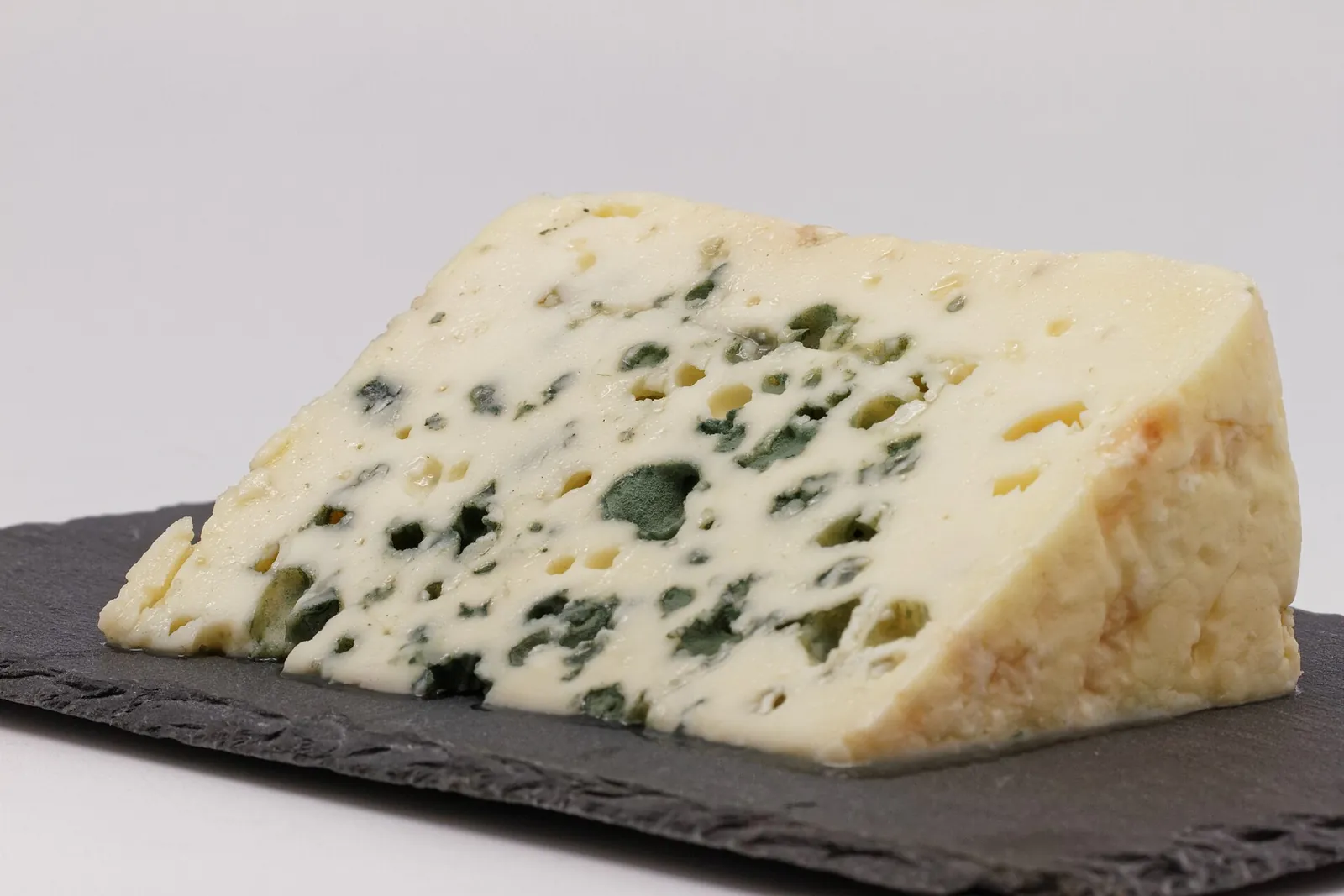
The caves are the secret ingredient. Cool, humid air blows through cracks in the Combalou cliff called fleurines, and the blue-green mold that veins the cheese, Penicillium roqueforti, thrives in that draft. Age the same recipe anywhere else and, under the rules, it cannot be called Roquefort.
Roquefort at a glance
This Roquefort at a glance table summarizes what the protected name requires.
| Roquefort | |
|---|---|
| Milk | Raw, whole sheep's milk from Lacaune ewes, no treatment beyond filtering |
| Made in | Aveyron and parts of Aude, Lozère, Gard, Hérault and Tarn; aged only in Roquefort-sur-Soulzon |
| Mold | Penicillium roqueforti, from traditional strains isolated in the Roquefort caves |
| Aging | At least 90 days from making, with at least 2 weeks bare in the caves before wrapping |
| Paste | Creamy and well bound, evenly veined blue-green |
| Size | 7.5 to 7.9 in (19 to 20 cm) across, 3.3 to 4.5 in (8.5 to 11.5 cm) tall, 5.5 to 6.6 lb (2.5 to 3 kg) |
| Fat | At least 52 g per 100 g of dry matter |
| Sodium (USDA) | 1,809 mg per 100 g, about 513 mg per ounce |
| Protected name | French appellation 1925, the first for a cheese; EU PDO 1996 |
What is Roquefort cheese?
Roquefort cheese is a creamy, crumbly sheep's milk blue whose paste the specification describes as evenly veined green-blue, with a very particular bouquet and a fine, pronounced flavor. The name is old: the specification cites a mention in the cartulary of the abbey of Conques in 1070, and a 1666 court judgment that gave the villagers of Roquefort the exclusive right to age the cheese.
The first legal protection came early, too. A 1925 law made Roquefort the first French cheese with an appellation of origin, according to the confederation of producers, and the EU added its protected designation of origin in 1996.
How Roquefort is made
Roquefort is made in two places, the farms and dairies across a wide area of southern France and the caves of one village.
Roquefort milk and sheep
Roquefort milk comes from Lacaune ewes, a dairy breed, and must be used raw and whole, with no treatment other than filtering out debris. The ewes graze daily whenever grass is available, and at least three-quarters of their feed must come from the production area. The specification says the breed, the feed and the raw milk shape the milk's fatty acids, which carry the aromas that the mold later reveals.
Roquefort caves and mold
The mold is added to the milk or curd as a powder or culture made from traditional strains isolated in the Roquefort caves. The confederation says the strain is traditionally multiplied on rye bread: a baked loaf is inoculated, the fungus invades the crumb, and the crumb is crushed and sieved. A 2020 study in Molecular Ecology found that the Roquefort mold is a separate lineage, domesticated independently of the one used in nearly every other blue cheese, with slower growth in cheese and more spore production on bread. Blue Cheese 101 explains how the veins form.
The curd drains without pressing, which leaves small openings in the paste, and the cheese is pierced with needles to let in the air the mold needs. It then sits bare on the cave shelves for at least two weeks, until the confederation's master ripener judges it ready for wrapping in foil that slows the mold. Aging continues under that wrapper for at least 90 days from the day the cheese was made.
Roquefort taste and texture
Roquefort taste starts sweet and frank and finishes with a fine, pronounced bitterness, and the texture is soft and melting, the confederation's tasting notes say. Each of the seven makers keeps its own mold strains, so the veins run from dark green to pale blue-green and the paste from more to less creamy.
Roquefort is also one of the saltiest cheeses in the USDA's data, at about 513 mg of sodium per ounce, against about 185 mg for cheddar. The specification calls for dry salting, and the cheese's FDA standard caps moisture at 45 percent.
Roquefort in the US
Roquefort is sold in the US because it clears the FDA's age rule: the federal standard for Roquefort cheese requires it to be at least 60 days old, and the French rules require at least 90. That standard defines the cheese as a sheep's milk blue, so a cow's milk blue cannot carry the name. The confederation lists the United States, with Germany and Belgium, among its first export markets.
On the label, look for the name Roquefort with the EU protected-origin symbol and the red sheep mark, both required by the specification.
How to serve Roquefort
Serve Roquefort at room temperature: take it out at least an hour ahead, until it reaches about 64°F (18°C), and bring out only what you will serve. The confederation suggests dried fruit and nuts, quince paste, jam, pears, figs, grapes, green apples, and crisp endive, celery or beet, on bread, brioche or gingerbread. The blue cheese pairing guide covers drinks.
Cooking with Roquefort
Cooking with Roquefort works best when the cheese goes in late and the salt goes in last. Crumble it over a pear, endive and walnut salad, melt it into cream for a steak sauce (a good starting point is 2 ounces to 1/2 cup of cream), or beat it into butter or cream cheese for a spread. Taste before you add any salt.
How to store Roquefort
Store Roquefort in the refrigerator's vegetable drawer; the confederation advises cling film so it does not dry out. Blue cheeses also need some air, so the storage container guide is worth a look, and either way keep it wrapped apart from other foods.
Roquefort mistakes that cost you flavor
The most common Roquefort mistake is treating it as any other blue.
Assuming all blues taste alike. In a French study that made cheeses to Roquefort specifications, strains from the Roquefort mold population produced more of the methyl ketones and secondary alcohols typical of blue cheese than strains from the other populations, partly through more efficient breakdown of fat and protein. The mold is part of the flavor.
Salting the dish first. An ounce of Roquefort carries nearly three times the sodium of an ounce of cheddar, so season after the cheese is in.
Cutting it from the side. The confederation advises cutting slices from the heart to the heel, so each guest gets the creamy center and the firmer edge, and saving less-marbled ends for sauces.
Questions about Roquefort cheese
These are the questions about Roquefort cheese that come up most.
Is Roquefort the same as blue cheese?
Roquefort is a blue cheese, but most blue cheese is not Roquefort: the confederation calls it the only PDO blue made from raw sheep's milk. The blue cheese vs Gorgonzola vs Roquefort comparison sets the three side by side.
Can you eat the mold on Roquefort?
You can eat the mold on Roquefort; the blue-green veins are Penicillium roqueforti, which the specification calls for on purpose. A pink, slimy or fuzzy patch on the surface is a different matter, so check the cheese before eating.
Is Roquefort safe during pregnancy?
Roquefort is made from raw milk, and the CDC advises people who are pregnant, 65 or older, or have a weakened immune system to skip raw-milk cheese unless it is heated to 165°F (74°C) or until steaming hot. See cheese during pregnancy for other cheeses.
Why is Roquefort so salty?
Roquefort is salty because the curd is salted dry, and it ends up at about 1,809 mg of sodium per 100 g in USDA data, among the highest of any cheese. A little goes a long way.
What can you substitute for Roquefort?
You can substitute Stilton or another firm, tangy blue for Roquefort in dressings and sauces, using a little less salt. The Substitute Finder lists more options.
Buying your first Roquefort
For your first Roquefort, buy a small wedge with even blue-green marbling and the red sheep mark, let it warm for an hour and taste it plain with a pear and a few walnuts. Cook with it only after you know how salty your wedge is.
Sources
- Cahier des charges de l'appellation d'origine protégée Roquefort (version approved November 2025), INAO (Institut national de l'origine et de la qualité)
- First PDO in history, Natural ripening and Tasting notes, Confédération Générale des Producteurs de Lait de Brebis et des Industriels de Roquefort
- 21 CFR 133.184, Roquefort cheese, sheep's milk blue-mold, and blue-mold cheese from sheep's milk, Electronic Code of Federal Regulations
- Independent domestication events in the blue-cheese fungus Penicillium roqueforti (Dumas et al., 2020), Molecular Ecology via PubMed
- Strong effect of Penicillium roqueforti populations on volatile and metabolic compounds responsible for aromas, flavor and texture in blue cheeses (Caron et al., 2021), International Journal of Food Microbiology via PubMed
- Cheese, roquefort (FDC 171250) and Cheese, cheddar (FDC 173414), USDA FoodData Central, SR Legacy
- Preventing Listeria Infection, Centers for Disease Control and Prevention