
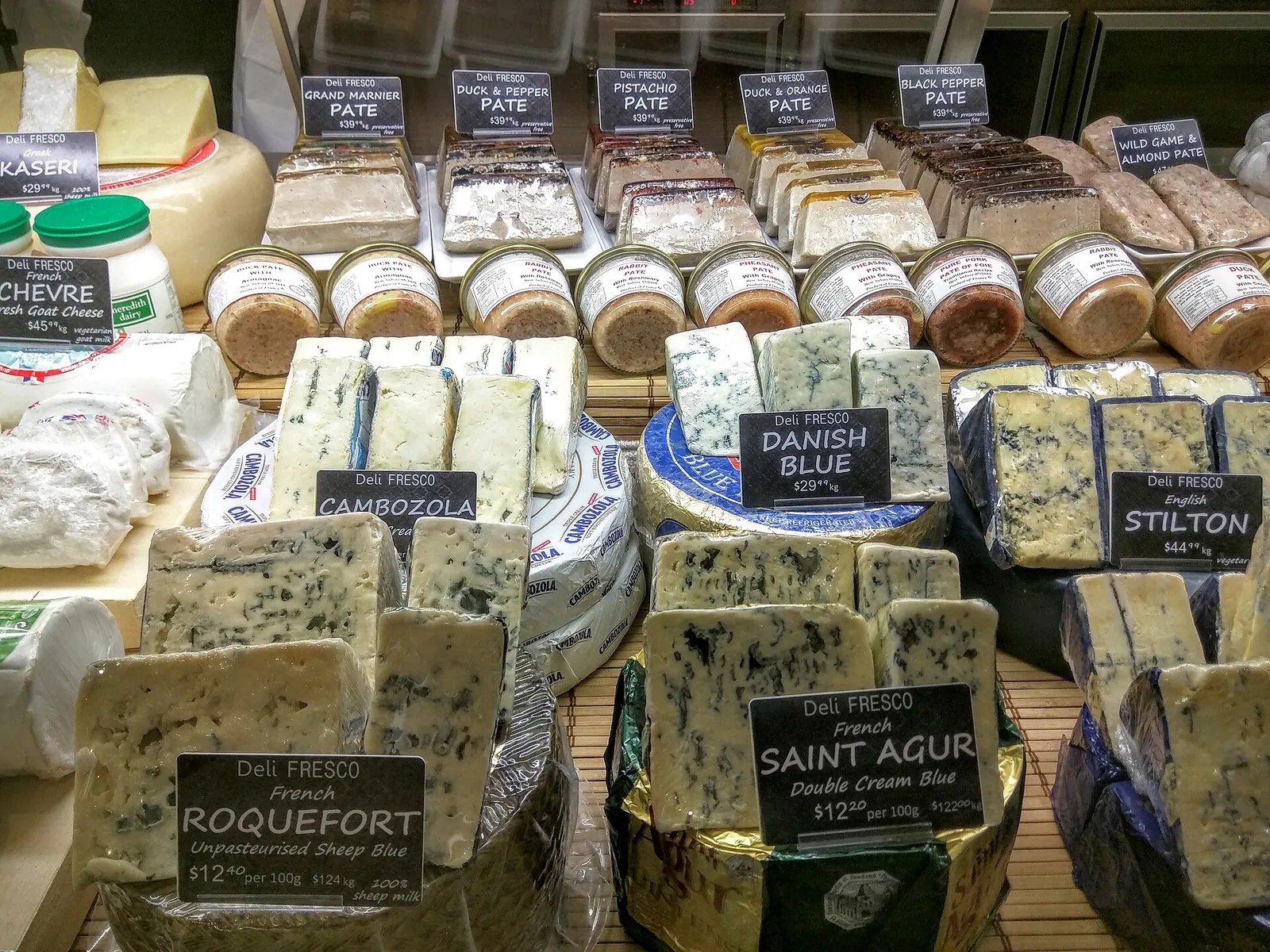
The mold is added on purpose, and USDA says the molds used to make blue cheeses are safe to eat.
The mold breathes air, so the maker has to let air in: needles pierce the wheel, and the blue grows along the channels. That one fact explains the veins, the open crumbly texture and why blue cheese needs different storage from most cheeses.
Blue cheese at a glance
Here is blue cheese at a glance, comparing the four styles most US cheese counters stock.
| Roquefort | Gorgonzola | Stilton | Danablu | |
|---|---|---|---|---|
| Country | France | Italy | England | Denmark |
| Milk | Raw whole sheep's milk | Pasteurized whole cow's milk | Pasteurized cow's milk | Cow's milk |
| Protected name | PDO | PDO | PDO | PGI |
| Aging | At least 90 days | 50 days (dolce) or 80 days (piccante) | Sold from about 6 weeks | Not set out in its register file |
| Profile | Creamy, evenly veined, strong | Soft and mild, or firm and sharp | Crumbly to creamy, clean, slightly sharp | Whiter, creamy, piquant |
How blue cheese is made
Blue cheese is made by adding Penicillium roqueforti spores to the milk or curd, draining the curd without pressing it, salting it, and then piercing the wheel so air reaches the mold. The US federal standard for blue cheese describes the same sequence: spores go in as the curd is placed in forms, the shaped curd is salted with dry salt or brine, then perforated and held at about 50°F (10°C) and 90 to 95 percent humidity until the mold grows. Growth takes weeks to months, says Penn State Extension.
Timing matters. Stilton seals its surface to keep oxygen out, then pierces the wheel at about six weeks, so the mold stays dormant until the needles go in, according to its UK specification. Once the mold grows, its enzymes split milk fat into fatty acids, which become methyl ketones such as heptanone and nonanone, the compounds behind the classic blue aroma, the Gorgonzola consortium explains.
The main types of blue cheese
The main types of blue cheese differ by milk, country and age, and these four cover most of what you will find at a counter.
Roquefort
Roquefort is the French sheep's milk blue: raw whole milk from Lacaune ewes, unpressed curd, dry salting and at least 90 days of ripening, with the cheese cured in the natural caves of Roquefort-sur-Soulzon, its PDO specification says. The Roquefort guide has more.
Gorgonzola
Gorgonzola is Italy's pasteurized cow's milk blue, sold as soft, mild dolce (aged at least 50 days) or firmer, sharper piccante (at least 80 days). The Gorgonzola guide covers both.
Stilton
Stilton is England's pasteurized cow's milk blue, made only in Derbyshire, Leicestershire and Nottinghamshire, and it ranges from crumbly to creamy. See the Stilton guide.
Danablu
Danablu is Denmark's cow's milk blue, protected as a PGI. The Danish producers' history in its register file says cheesemaker Marius Boel began making blue cheese commercially in 1915, and that homogenizing the milk in 1927 made it richer, whiter and more piquant. Read the Danablu guide. All four names were registered by the EU in 1996.
How salty is blue cheese
Blue cheese is among the saltiest cheeses: a 2022 review puts blue-veined cheeses at 3 to 5 percent salt, often applied dry. The salt does real work. It drains whey, shapes texture, and holds back competing microbes, and at least 1 percent salt stimulates the mold's spores to germinate, the Frontiers in Nutrition review reports.
The numbers vary by style. USDA's table gives 325 mg of sodium per ounce for blue cheese and 513 mg for Roquefort, the saltiest of the blues it lists, while the Gorgonzola consortium's figure of 1.6 g of salt per 100 g works out to roughly 180 mg per ounce. Crumble a strong blue sparingly and it goes a long way.
How to store blue cheese
Store blue cheese loosely wrapped, so the mold can breathe, in a lidded box in the fridge. Penn State Extension says that without air flow the mold dies and leaves off colors and flavors, and the Gorgonzola consortium recommends foil or the original tray. Wrap it in cheese paper, wax paper or loose foil, and take it out half an hour before serving.
A dull yellow film on a cut face is oxidation, not spoilage; slice off the first layer. Tight plastic wrap is the real enemy. For safety, see the mold rules below.
Blue cheese pairings
Pair blue cheese with something sweet, fatty or crunchy that softens its salt: pears, figs, honey, walnuts, and sweet or fortified wines such as port, Sauternes or Madeira. Stout, porter and Belgian ales also stand up to the funk. The blue cheese pairing guide lists more, and port and blue cheese explains the classic match.
What most blue cheese advice gets wrong
Most blue cheese advice treats the mold as one thing, and it is not.
Not every blue cheese uses the same mold
Not every blue cheese uses the same mold: a 2020 genomic study found that Penicillium roqueforti was domesticated twice. Roquefort uses an older lineage that grows slowly in cheese, while every other blue cheese worldwide uses a lineage with higher lipolytic activity and salt tolerance, per the Molecular Ecology paper.
Other mold on blue cheese is not the good mold
Other mold on blue cheese is not the good mold. USDA's guide to molds on food says to treat firm blues such as Gorgonzola and Stilton like hard cheese: cut off at least 1 inch around and below any surface mold and rewrap. It says to discard crumbled or sliced cheese with mold, and soft cheeses with mold that is not part of the process.
Questions about blue cheese
These are the questions about blue cheese that come up most.
Is blue cheese made from mold?
Blue cheese is made with mold: Penicillium roqueforti is added on purpose and is safe to eat, according to USDA.
Does blue cheese have penicillin in it?
Blue cheese does not contain penicillin, because the molds used in cheese, including Penicillium roqueforti, are not penicillin producers, an allergy specialist notes. A separate mold allergy is possible, so ask an allergist if you react.
What is the mildest blue cheese?
The mildest blue cheese for most people is Gorgonzola dolce, which is soft, creamy and only slightly spicy; Cambozola is a gentler hybrid.
Is blue cheese vegetarian?
Blue cheese is not always vegetarian, because the rennet differs by style: Stilton's rules allow animal or non-animal rennet, and the US standard allows clotting enzymes of animal, plant or microbial origin. Check the label.
Is blue cheese safe during pregnancy?
Blue cheese made with raw milk is risky during pregnancy: the CDC says people who are pregnant should avoid cheese made with raw milk unless it is heated to 165°F or until steaming hot. Roquefort is always raw-milk, while Stilton and Gorgonzola are pasteurized, so ask your doctor and read the label.
Your first blue cheese
For your first blue cheese, buy a small piece of Gorgonzola dolce, let it warm up for half an hour and eat it with a ripe pear and a drizzle of honey. Then taste a Stilton or Roquefort beside it and notice the salt, and keep the leftovers in paper, not plastic.
Sources
- 21 CFR 133.106, Blue cheese, Electronic Code of Federal Regulations
- Molds on Food: Are They Dangerous?, USDA Food Safety and Inspection Service
- Introduction to Making Cheese, Penn State Extension
- The Aroma of Gorgonzola PDO, The Gorgonzola and Conservation and service, Consorzio per la Tutela del Formaggio Gorgonzola
- Cahier des charges de l'AOP Roquefort (2006), INAO, via the EU eAmbrosia register
- Stilton Cheese product specification, UK Department for Environment, Food and Rural Affairs
- Danablu application file with the producers' history and Commission Regulation (EC) No 1107/96, European Commission
- Independent domestication events in the blue-cheese fungus Penicillium roqueforti, Molecular Ecology
- The Reduction of Salt in Different Cheese Categories, Frontiers in Nutrition
- USDA FoodData Central (SR Legacy): blue cheese and Roquefort, U.S. Department of Agriculture
- Blue cheese allergic reaction, American Academy of Allergy, Asthma and Immunology
- Preventing Listeria Infection, Centers for Disease Control and Prevention