
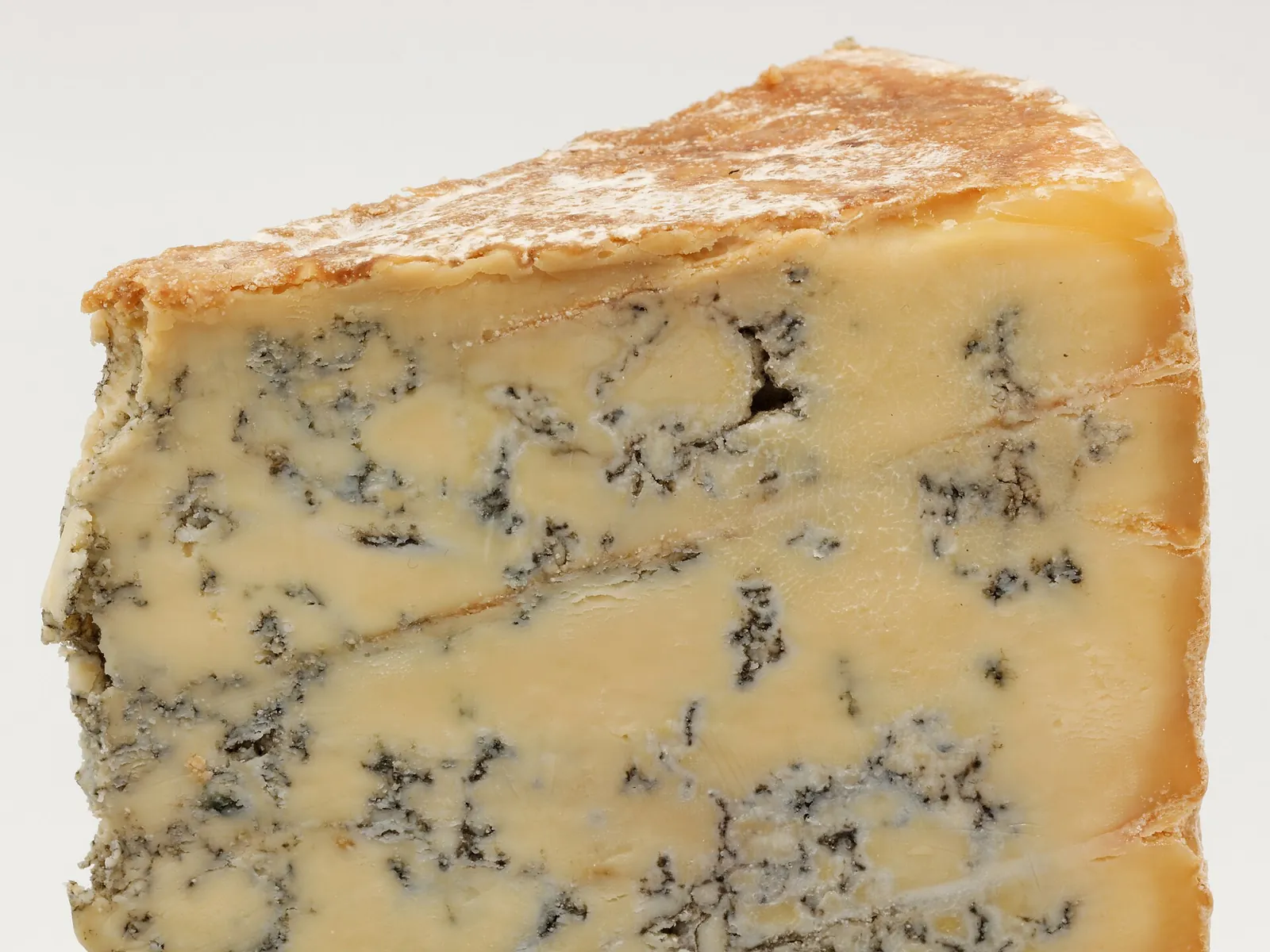
Blue Stilton is the crumbly, tangy blue most people picture; White Stilton has no mold and is ready to eat in about a week.
What defines Stilton is how loosely the curd is handled. It is never pressed, so tiny air gaps stay inside; the maker seals the surface to keep oxygen out, then pierces the wheel at about six weeks so the blue mold can grow along the channels.
Stilton cheese at a glance
Here is Stilton cheese at a glance, taken from its protected-name specification and the EU register.
| Detail | Stilton |
|---|---|
| Milk | Full-cream pasteurized cow's milk, for every variety |
| Made in | Leicestershire, Derbyshire and Nottinghamshire, England |
| Protected name | PDO since June 21, 1996 ("White Stilton cheese / Blue Stilton cheese") |
| Types | White Stilton; Blue Stilton (6 to 12 weeks); Mature Blue (10 to 15 weeks); Vintage Blue (over 15 weeks) |
| Rind | Its own slightly wrinkled crust; the cheese is never pressed |
| Texture | White: flaky or crumbly, moist. Blue: velvety or flaky, open. Mature: soft, creamy. Vintage: drier |
| Flavor | White: fresh, clean, acidic. Blue: clean and subtle, slightly sharp over milk. Mature: mellow, full. Vintage: stronger, more complex |
| Fat | At least 48 percent milk fat in the dry matter |
Where Stilton cheese can be made
Stilton cheese can be made only in Leicestershire, Derbyshire and Nottinghamshire, so the village that gave it its name is out. The name comes from the Bell Inn at Stilton, a coaching stop on the road between London and York where the cheese was first sold to the public; the cheese itself was made around Melton Mowbray in Leicestershire. The village sits in Cambridgeshire, and when a company based there asked to be added to the protected area, Defra refused in 2013 because the applicant did not make Stilton.
The EU registered the name as a protected designation of origin (PDO) on June 21, 1996. The UK specification lets dairies take milk from neighboring counties only when supply runs short, which it ties to the Christmas rush, and the guide to PDO and PGI labels explains what the seal promises.
How Stilton cheese is made
Stilton cheese starts as pasteurized, full-cream milk with a starter culture and rennet; for Blue Stilton, spores of Penicillium roqueforti go into the milk or onto the curd. The next day the curd is cut, milled into walnut-sized pieces, salted and tipped into cylindrical molds. Nothing presses it, and the pieces settle for up to seven days while the molds are turned.
Then each cheese is turned out of its mold and the surface is sealed, which keeps oxygen out of the tiny airways between the curd pieces and the blue mold dormant. White Stilton stops here. Blue Stilton ripens until about six weeks, when stainless-steel needles about the size of skewers pierce the wheel; air reaches the mold, the veins begin, and it may be pierced again later. Loose curd and open airways are why Stilton is flaky rather than dense, and why its blue radiates from the center.
Blue, Mature, Vintage and White Stilton
Blue, Mature and Vintage Blue Stilton are one cheese at different ages, while White Stilton is a separate cheese with no blue mold. Blue Stilton is graded at about six weeks and sold at 6 to 12 weeks, with a white curd, a slightly crumbly body and a slightly sharp flavor over a milky background, the specification says. Mature Blue (10 to 15 weeks) is off-white to yellowish, softer and creamy, with a mellow, full flavor. Vintage Blue (over 15 weeks) is drier, stronger and more complex. The bands overlap because grading goes mostly by flavor and texture, and timing shifts with the season, the size of the wheel and each dairy's methods.
White Stilton is not an unfinished blue. It skips the mold and the piercing, and once wrapped and chilled it is ripe in about seven days, with a fresh, clean, acidic flavor and a flaky or crumbly, moist body.
How to buy Stilton cheese in the US
Buying Stilton cheese in the US starts with the label: only cheese made in the three counties may carry the name, so "Stilton-style" or "English blue" means a different cheese. Look for a creamy white paste with blue-green veining that radiates from the center. The specification asks for a body free of gas holes and chalkiness, so skip a chalky piece.
Ask for a cut from the wheel rather than a wedge that has sat sweating in plastic, and ask which grade it is. Plain Blue Stilton is the best first buy; add a Mature piece next time to taste the softer end.
How to serve Stilton cheese with port
Serve Stilton cheese at room temperature, cut in wedges, with something sweet to drink. Take it out of the fridge about an hour ahead, because cold dulls the flavor, and cut a whole Stilton like a cake, in shallow wedges from the top down.
Port is the classic partner because sweetness and ripe fruit soften the cheese's salt and sharpness: a tawny's nutty notes echo its savory depth, and a ruby leans fruitier. Sauternes works the same way, and pears, walnuts, celery, oatcakes and honey do the job on the plate; the port and blue cheese guide goes deeper. Stilton also melts into cream sauces for steak and into soups; stir it in off the heat so it stays smooth.
How to store Stilton cheese
Store Stilton cheese in wax paper or parchment inside a lidded container in the fridge, and finish a cut wedge within about two weeks for the best flavor. The paper lets it breathe, and the lid keeps its smell off everything else. The storing cheese guide covers wraps in more detail.
What most Stilton advice gets wrong
Most Stilton advice repeats a few habits that cost you flavor or safety.
Vintage Stilton is not simply better
Vintage Stilton is not simply better than Blue Stilton, because the grades describe different flavors rather than a quality ladder. Per the specification, Blue is slightly sharp over milk, Mature is mellow and creamy, and Vintage is drier and more complex. Taste before you pay for age.
Scooping out a Stilton wastes it
Scooping out the center of a Stilton and pouring in port wastes two good things, because hollowing exposes the paste to air and the port drowns the cheese. Cut wedges and pour the port into a glass.
Mold on Stilton is not all the same
Mold on Stilton is not all the same: the blue veins are meant to be there, and USDA says the molds used to make blue cheese are safe to eat. Another mold on the surface is different. USDA's guide to molds on food treats Stilton as a hard cheese: cut off at least 1 inch around and below the spot, keep the knife out of the mold, and rewrap in fresh paper. Moldy crumbled or sliced cheese goes in the trash, because the cutting tool can spread the mold, so crumble only what you will use.
Questions about Stilton cheese
These are the questions about Stilton cheese that come up most.
How is Stilton different from blue cheese?
Stilton is a blue cheese with a protected name: "blue cheese" covers any cheese ripened with blue mold, while Stilton must be made in the three counties from pasteurized cow's milk. Blue Cheese 101 covers the rest of the family.
Is Stilton the same as Roquefort?
Stilton is not the same as Roquefort: Stilton is an English cow's milk cheese made from pasteurized milk, while Roquefort is a French sheep's milk blue.
Why can't Stilton cheese be made in Stilton?
Stilton cheese cannot be made in Stilton because the village is in Cambridgeshire, outside the three counties named in the PDO.
Is Stilton cheese pasteurized?
Stilton cheese is always pasteurized, because the PDO allows only pasteurized cow's milk. That is why raw-milk blues from the same counties, such as Stichelton, are sold under other names, as Slow Food notes.
Is Stilton vegetarian?
Stilton is not vegetarian by default, because the specification allows animal or non-animal rennet. Check the label of the dairy you buy.
Your first Stilton cheese
For your first Stilton cheese, buy a small wedge of Blue Stilton cut to order, let it warm up for an hour and eat it with a pear, a few walnuts and a small glass of tawny port. Taste a Mature piece beside it next time.
Sources
- Stilton Cheese product specification, UK Department for Environment, Food and Rural Affairs (GOV.UK)
- White Stilton cheese / Blue Stilton cheese, PDO-GB-0277: register entry and EU summary sheet, eAmbrosia, European Commission
- Make Stilton in Stilton? No! Defra rejects Stilton PDO amendment, DairyReporter
- Three counties raw milk blue, Slow Food Foundation
- Molds on Food: Are They Dangerous?, USDA Food Safety and Inspection Service