
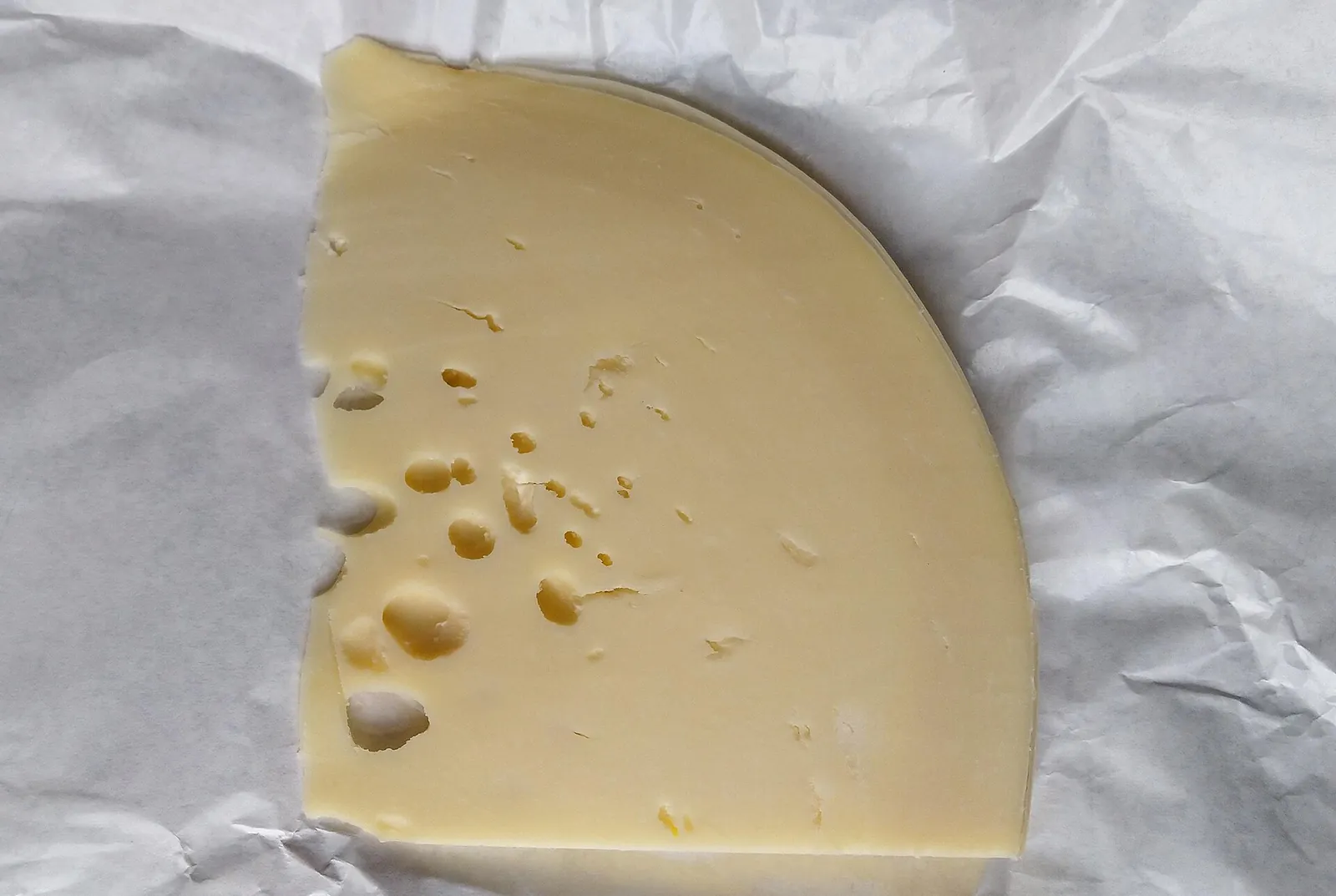
Provolone is the aged cousin of low-moisture mozzarella: the same hot-water stretch, but the curd is salted, hung and aged until it dries to a firmer cheese, with no more than 45 percent moisture against 45 to 52 percent for low-moisture mozzarella. How long it hangs decides the rest: about two to three months for mild dolce, four or more for sharp piccante.
Provolone cheese at a glance
This table summarizes provolone cheese, with the rules from the FDA standard and the EU register and nutrition from USDA.
| Provolone | |
|---|---|
| Milk | Whole cow's milk |
| Origin | Southern Italy; now made in the Po Valley and in the US |
| Rind | Thin, smooth and shiny, golden; cord marks if hung |
| Texture | Firm, compact, "stringy" in the FDA's words; slices thin |
| Age | Dolce about 2 to 3 months; piccante 4 months or more |
| Flavor | Dolce mild and buttery; piccante sharp and piquant |
| Moisture | 45% at most (FDA); 41% in USDA data |
| Fat | At least 45% of solids (FDA); 7.5 g an ounce in USDA data |
| Protected names | Provolone Valpadana PDO (1996); Provolone del Monaco PDO (2010) |
| Smoked | Allowed; US labels must say "smoked" or "not smoked" |
Provolone dolce vs piccante
Provolone dolce vs piccante comes down to age and rennet. Dairy Farmers of Wisconsin describes dolce as aged for 2 to 3 months for a sweet, mild flavor and piccante as aged four months or longer for a sharper taste, and the Valpadana consortium's dossier puts piccante at 3 to 12 months. The Provolone Valpadana specification adds a second lever: the flavor is delicate up to three months, and turns piquant with longer aging and when kid or lamb rennet is used.
Size follows age. The specification allows pieces from about 1 pound to 220 pounds (0.5 to 100 kg): short-aged cheese up to 13 pounds (6 kg), and larger, longer-aged pieces above that. Piccante describes the flavor of the aged cheese itself, not an added chili: the specification uses the word for the piquant taste that comes with longer aging and kid or lamb rennet.
Provolone Valpadana PDO
Provolone Valpadana PDO is the protected Italian provolone, registered by the EU on June 21, 1996, and its home is the Po Valley, not the south where the cheese began. The register entry and its specification describe a semi-hard cheese from whole cow's milk, set with calf, kid or lamb rennet, stretched in water at about 176°F (80°C), salted in brine and hung to age for at least 30 days. Shapes are salami, melon, truncated cone and pear, sometimes with a small round head, and the rind may carry grooves from the cords.
The area covers the Lombardy provinces of Cremona and Brescia and parts of Bergamo, Mantua and Milan, the Veneto provinces of Verona, Vicenza, Rovigo and Padua, Piacenza in Emilia-Romagna, and part of Trentino. The dossier says the cheese began in southern Italy and that dairies and their cheesemakers moved to the Po plains in the late 1800s and early 1900s. A second protected provolone, Provolone del Monaco, was registered in 2010.
US provolone and the federal standard
US provolone follows the FDA's standard of identity, which defines it as a stretched-curd cheese with a stringy texture, at least 45 percent milkfat in its solids and no more than 45 percent moisture. Cheese made from unpasteurized milk must be cured at least 60 days at 35°F or warmer. The cheese may be smoked, and then the label must say "smoked"; otherwise it says "not smoked."
The standard also allows blue or green coloring to cancel the curd's natural yellow, and benzoyl peroxide to bleach the milk, so color alone says little about age. USDA lists provolone at 41 percent water and, per ounce, 100 calories, 7.5 grams of fat, 7.3 grams of protein and 206 milligrams of sodium.
Provolone melting and sandwiches
Provolone melts into a smooth, stretchy layer with a mild tang, which is why it is a deli and sandwich workhorse. The stretched curd also lets a thin slice fold over meat without cracking.
- Cold Italian subs and roast beef: sharp provolone, sliced thin, for bite against salami, vinegar and hot peppers.
- Hot subs, chicken parmesan and cheesesteaks: young provolone melted under the broiler; Philly cheesesteak: Cheez Whiz vs provolone covers the classic argument.
- Pizza and baked pasta: about a quarter of the cheese, with mozzarella for the melt.
- Cheese boards: chunks of piccante with salami, olives and roasted peppers, and a light red such as Chianti.
Mild deli provolone is quiet on a strong sandwich, so ask for sharp or piccante by name.
Provolone cheese substitute
The best provolone cheese substitute depends on the job. For melting, use low-moisture mozzarella, which is milder and a little wetter. For flavor, caciocavallo is provolone's closest relative, and scamorza, plain or smoked, is a stretched-curd cousin that works on pizza and in panini. For cold sandwiches, Swiss or Havarti slice cleanly, and sharp white cheddar stands in for piccante. The Substitute Finder lists more swaps.
How to store provolone
How to store provolone is simple, because it is a firm cheese: wrap a cut piece in wax paper or cheese paper, then loosely in plastic, and keep it in the refrigerator's cheese drawer. Pre-sliced provolone dries out faster than a block, so reseal the bag tightly. Drier, aged piccante keeps longer than young dolce, and how to store cheese properly covers wrapping and how to tell when a piece has turned.
What most provolone advice gets wrong
Most provolone advice repeats the same few shortcuts, and three corrections change what you buy.
Provolone began in the south, but the protected cheese is northern. The Valpadana dossier traces the cheese to southern Italy and its Po Valley production to the early 1900s, so the protected cheese is a Po Valley cheese today.
A pale slice is not a young one. Because makers may bleach the milk or add blue or green color, color tells you little; read the label for age words such as dolce, piccante, sharp or aged.
Mild is the default, so sharp has to be asked for. Deli provolone is typically the mild style, which can taste quiet on a strong sandwich. Ask for sharp provolone, or buy a wedge of piccante for cold plates and subs.
Questions about provolone cheese
These are the questions about provolone cheese that come up most often.
Is provolone the same as mozzarella?
Provolone is not the same as mozzarella, though both are stretched-curd cow's milk cheeses: provolone is aged, firmer and at most 45 percent moisture, while mozzarella is fresher and wetter. Mozzarella vs provolone compares them in the kitchen.
What does provolone cheese taste like?
Provolone cheese tastes mild, buttery and slightly sweet when young and sharp and piquant when aged, and smoked provolone adds a wood-smoke note.
Is provolone good for melting?
Provolone is good for melting: it softens into smooth, stringy strands, and young provolone melts more cleanly than aged piccante, which releases more oil.
Is provolone cheese healthy?
Provolone cheese is a rich, salty cheese: USDA lists 100 calories, 7.5 grams of fat, 7.3 grams of protein, 206 milligrams of sodium and 214 milligrams of calcium an ounce.
Is provolone safe during pregnancy?
The FDA standard lets raw-milk provolone be sold after 60 days of curing, but the FDA's pregnancy guidance says to avoid cheeses made with unpasteurized milk and calls cheeses made with pasteurized milk okay. Check the label, ask your doctor, and see cheese during pregnancy.
Choosing provolone cheese
Choosing provolone cheese comes down to the job: young dolce for hot sandwiches, pizza and melting, and piccante for cold Italian subs and cheese boards. Buy a quarter pound of each at the deli, taste them side by side, then build a cold sub with one and a hot one with the other.
Sources
- 21 CFR 133.181, Provolone cheese, with 21 CFR 133.156, Low-moisture mozzarella and scamorza cheese, Electronic Code of Federal Regulations (FDA)
- Provolone Valpadana (PDO, EUGI00000013003) specification and summary sheet, with the Provolone del Monaco (PDO, EUGI00000013658) entry, European Commission eAmbrosia register
- Provolone (vocabolario), Treccani
- Provolone, Dairy Farmers of Wisconsin
- Cheese, provolone (FDC 170850), USDA FoodData Central, SR Legacy
- Listeria (Food Safety for Moms-to-Be), U.S. Food and Drug Administration