
Both start the same way. The curd is worked in hot water until it turns smooth and elastic, which is why both stretch when melted. What happens after the stretch is the whole story, and it decides texture, flavor and the jobs each cheese does best.
Mozzarella vs provolone at a glance
This mozzarella vs provolone table sets the two side by side, using US standards, Dairy Farmers of Wisconsin and USDA data.
| Mozzarella | Provolone | |
|---|---|---|
| Method | Stretched curd (pasta filata), shaped into balls | Stretched curd (pasta filata), shaped, tied and aged |
| Milk | Cow's, traditionally water buffalo | Cow's |
| Age | Fresh, eaten within days; low-moisture keeps for weeks | Dolce 2 to 3 months; piccante 4 months or more |
| Moisture (US) | Low-moisture: more than 45 and up to 52%; fresh: up to 60% | 45% at most |
| Water per 100 g (USDA) | 48.4 g (whole milk, low moisture) | 41.0 g |
| Fat per ounce (USDA) | 7.0 g (whole milk, low moisture) | 7.5 g |
| Calories per ounce (USDA) | 90 (whole milk, low moisture) | 100 |
| Sodium per ounce (USDA) | 201 mg (whole milk, low moisture) | 206 mg |
| Texture | Soft, springy, milky; low-moisture is firmer | Semi-hard, even and sliceable |
| Flavor | Mild, delicate, milky | Buttery and slightly smoky; sharp when aged |
How mozzarella and provolone are made
Mozzarella and provolone are made by the same method, and both belong to the family of stretched-curd, or pasta filata, cheeses. Dairy Farmers of Wisconsin says mozzarella curds are heated in water until they form strings, then stretched and kneaded until smooth and shaped into round balls. Its provolone page describes the same technique, kneading and stretching the warm curd.
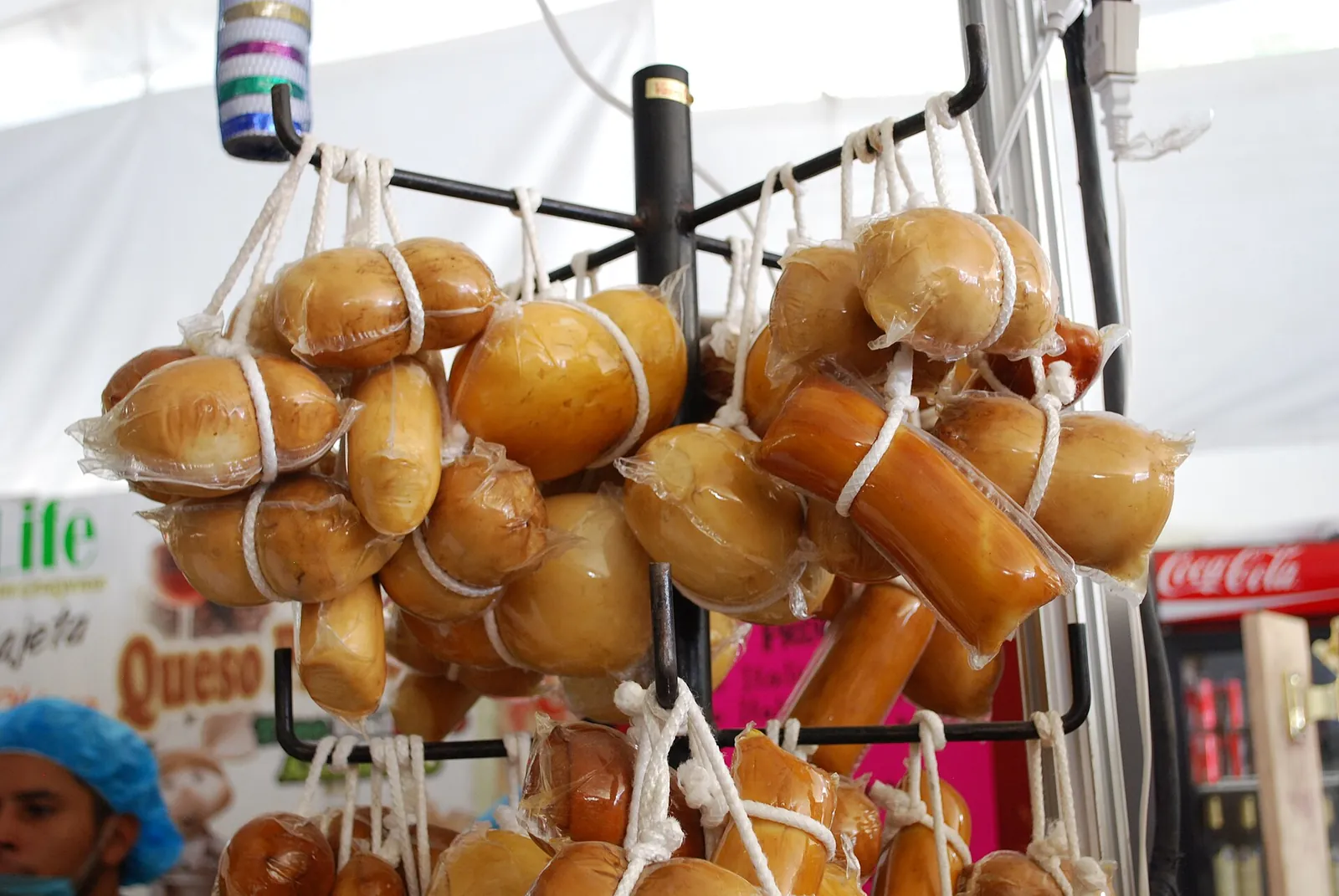
The split comes afterward. Mozzarella is shaped and sold, fresh in a liquid or as a firmer low-moisture block. Provolone is shaped into a sausage, bottle or large pear, often with a knob for hanging, and aged. Wisconsin gives 2 to 3 months for dolce and four or more for piccante. Each cheese has its own page: provolone covers the Italian PDO and the US standard, and types of mozzarella covers fresh, low-moisture and buffalo.
Milk is a small difference. Mozzarella was traditionally made from water buffalo milk, though Wisconsin notes it is now most often cow's milk. Provolone is a cow's milk cheese.
Mozzarella vs provolone texture and moisture
Mozzarella vs provolone texture is mostly a matter of water. Federal rules require low-moisture mozzarella to run more than 45 and up to 52 percent moisture, and fresh mozzarella can hold up to 60 percent, which is why a fresh ball is springy and sold in liquid. Provolone's federal ceiling is 45 percent, and USDA measures about 41 percent water in the cheese against 48 for whole-milk low-moisture mozzarella.
Less water, more age. Provolone dries as it hangs, so it sits firm, even and sliceable, and a thin deli slice folds over meat without cracking. Fresh mozzarella tears and weeps; low-moisture mozzarella grates and shreds but stays softer and more elastic than a piece of provolone.
Mozzarella vs provolone flavor
Mozzarella vs provolone flavor is the clearest difference at the counter. Wisconsin calls mozzarella's flavors mild and delicate, and describes provolone as clean, buttery and slightly smoky. Dolce is sweet and mild. Piccante is sharper, and sharp enough to hold its own against salami and hot peppers.
Mozzarella's mildness is the point: it adds milk and stretch and lets tomato, basil or sauce lead. Provolone brings flavor of its own, so it is the one you notice in a sandwich.
Mozzarella vs provolone for sandwiches, baking and snacking
Mozzarella vs provolone for sandwiches favors provolone most of the time, and baking and snacking split between them.
- Sandwiches and subs: provolone, sliced thin. Sharp provolone suits cold Italian subs, and young provolone melts well under a broiler on hot subs and cheesesteaks. Fresh mozzarella works in a caprese sandwich, where its moisture is part of the idea. See best cheeses for sandwiches and Philly cheesesteak.
- Baking: low-moisture mozzarella for baked ziti, eggplant parmesan and lasagna, where you want stretch without much extra flavor. Provolone adds tang to the same dishes.
- Snacking and boards: provolone, especially piccante, with salami, olives and roasted peppers. Fresh mozzarella is a salad or antipasto cheese, as in caprese, rather than a board cheese.
- Smoked: smoked provolone exists, and the US standard allows it if the label says "smoked." Mozzarella is rarely smoked.
Mozzarella vs provolone on pizza
Mozzarella vs provolone on pizza is a separate question with its own answer: low-moisture mozzarella is the base for most pies, and a little provolone adds tang on top of it. The detail, from blend ratios to browning, is in provolone vs mozzarella for pizza.
What most mozzarella vs provolone advice gets wrong
Most mozzarella vs provolone advice repeats a tidy rule, that mozzarella is the fresh one and provolone the aged one, and the rule leaves out three things.
Not all mozzarella is fresh. The block on the shelf is low-moisture mozzarella, and it keeps for weeks. It sits between fresh mozzarella and provolone on firmness, which is why the two cheeses overlap so much in cooking.
Provolone is not always sharp. Dolce is mild and sweet. Supermarket sliced provolone is often the mild kind, so ask for sharp or piccante by name if you want the bite.
Nutrition does not separate them. USDA lists whole-milk low-moisture mozzarella at 7.0 grams of fat and 201 milligrams of sodium per ounce, and provolone at 7.5 grams and 206. Part-skim low-moisture mozzarella is leaner at 5.6 grams of fat and 83.6 calories per ounce, so read the label for "part-skim."
Questions about mozzarella vs provolone
These are quick answers to common questions about mozzarella vs provolone.
What is the difference between mozzarella and provolone?
The difference between mozzarella and provolone is age: both are stretched-curd cheeses, but mozzarella is eaten fresh, soft and mild, while provolone is aged, firmer and tangier.
Can you substitute mozzarella for provolone?
You can substitute mozzarella for provolone in melting dishes, though you lose tang and a firm slice. Low-moisture mozzarella works best, and the substitute finder lists other swaps.
Which has more flavor, mozzarella or provolone?
Provolone has more flavor than mozzarella, and piccante has the most, because aging concentrates it. Mozzarella is mild and milky by design.
Which melts better, mozzarella or provolone?
Mozzarella melts into the more stretchy, elastic strands, while provolone melts smoothly with a mild tang. Both melt well, and the best melting cheeses ranking covers more options.
Is provolone the same as mozzarella?
Provolone is not the same as mozzarella, though it begins as the same kind of stretched curd. Provolone is salted, shaped and aged, and mozzarella is not.
Choosing between mozzarella and provolone
Choosing between mozzarella and provolone is simple: buy mozzarella for fresh salads and for stretch with little flavor, and provolone for sandwiches, boards and any dish that wants a little bite. For a first comparison, taste a slice of sharp provolone next to a piece of low-moisture mozzarella. If you are weighing mozzarella against a creamier cousin, burrata vs mozzarella is the next page.
Sources
- Mozzarella and Provolone, Dairy Farmers of Wisconsin
- 21 CFR 133.156, Low-moisture mozzarella and scamorza cheese and 133.181, Provolone cheese, Electronic Code of Federal Regulations
- USDA FoodData Central (SR Legacy): Cheese, provolone (170850), Cheese, mozzarella, whole milk, low moisture (170846) and Cheese, mozzarella, low moisture, part-skim (171244)