
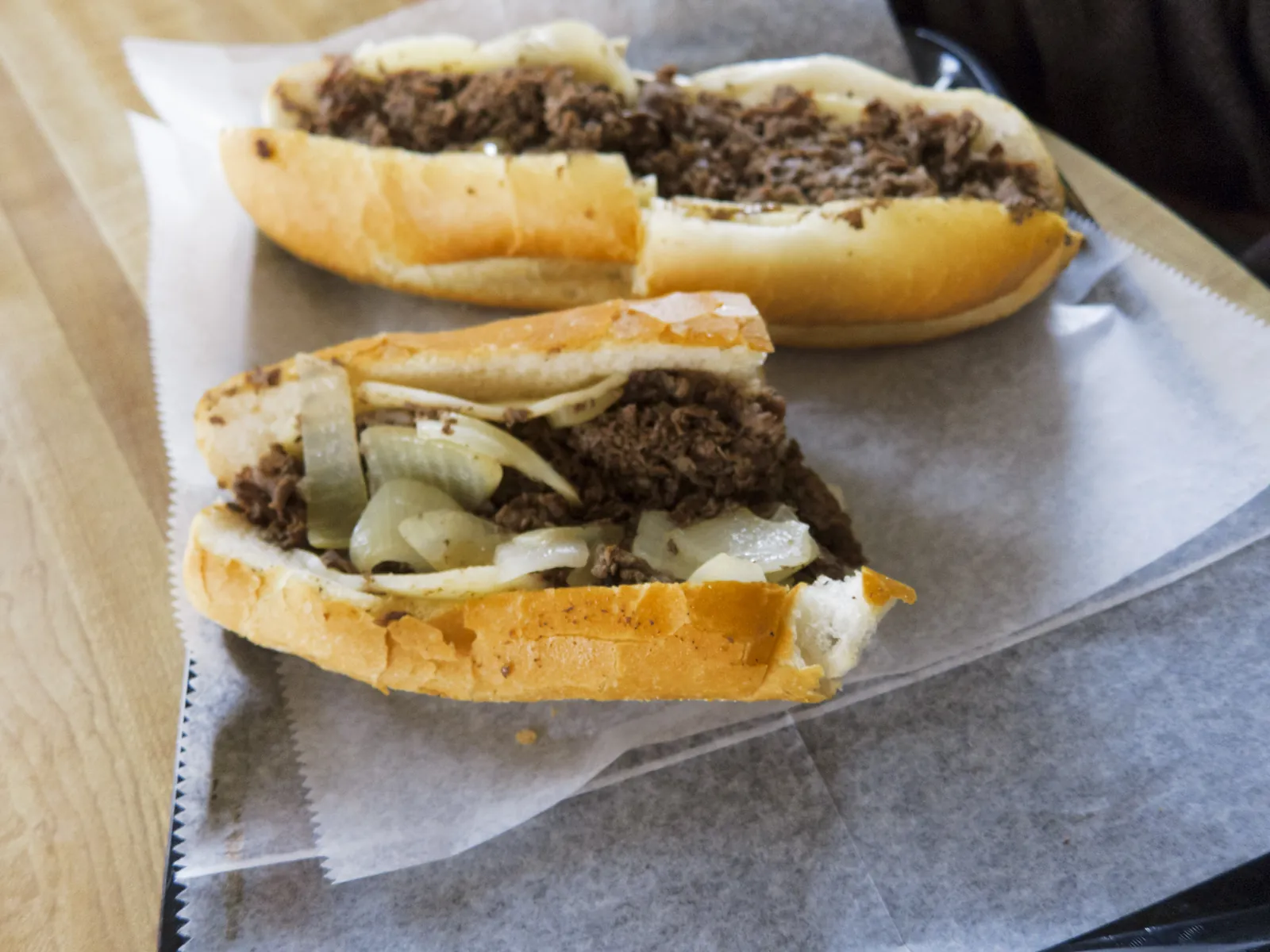
Each answers a different wish. Provolone gives real, slightly sharp cheese flavor. American melts into the creamiest blanket. Whiz coats every shred of beef with salty sauce. All three melt well, for reasons the next sections explain.
Philly cheesesteak at a glance
This Philly cheesesteak table gives the basics for four sandwiches.
| Yield | 4 sandwiches |
| Time | 20 minutes active, about 35 minutes total (plus 30 minutes freezing the beef) |
| Pan temperature | Medium high, flat top or large skillet |
| Best cheese | Provolone for flavor, American for melt, Cheez Whiz for tradition |
| Make ahead | Cook the beef and onions up to 2 days ahead; melt the cheese when serving |
How to make a Philly cheesesteak
A Philly cheesesteak needs thin beef, a hot pan and a soft roll, and the amounts here make four sandwiches.
Ingredients for a Philly cheesesteak
These ingredients for a Philly cheesesteak use boneless ribeye and the cheese of your choice.
- 1 1/2 lb (680 g) boneless ribeye, trimmed of heavy fat
- 2 medium yellow onions, thinly sliced
- 2 tablespoons neutral oil
- 8 slices (about 8 oz, 225 g) provolone or white American, or 1/2 cup (120 g) Cheez Whiz, warmed
- 4 soft hoagie or Italian rolls, 8 inches (20 cm)
- 1 teaspoon salt and 1/2 teaspoon black pepper
- Optional: sauteed mushrooms or sweet peppers
Steps for making a Philly cheesesteak
These steps for making a Philly cheesesteak brown the beef fast and melt the cheese in the pan.
- Freeze the ribeye for 30 minutes, until firm but not solid, then slice it across the grain as thin as paper.
- Heat 1 tablespoon oil in a large skillet or griddle over medium heat, add the onions with a pinch of salt and cook 10 to 12 minutes, stirring, until soft and golden, then move them aside.
- Raise the heat to medium high, add the remaining oil and spread the beef in a thin layer.
- Season with the salt and pepper, let it brown 1 to 2 minutes without moving, then chop and turn it with two spatulas for 2 to 3 minutes more, until no pink remains and an instant read thermometer shows at least 145°F (63°C).
- Divide the beef and onions into four piles the length of the rolls.
- Lay two slices of provolone or American over each pile, cover the pan for 30 seconds, until the cheese is melted into the meat.
- Split the rolls, warm them 1 minute on the griddle, and scoop each pile into a roll with a wide spatula.
- If using Cheez Whiz, spoon it over the meat in the roll instead of melting slices on the griddle.
How hot to cook the beef in a Philly cheesesteak
The beef in a Philly cheesesteak is a whole cut sliced thin, so the USDA FSIS safe minimum for steaks applies: 145°F (63°C) with a 3 minute rest. Paper thin slices on a hot griddle pass that mark in well under a minute, and the chopping and onions in the pan more than cover the rest. Use ground beef instead and the minimum rises to 160°F (71°C). A pink, rare cheesesteak is not the goal, since the meat is meant to be browned and chopped.
Philly cheesesteak cheese: provolone vs American vs Cheez Whiz
The Philly cheesesteak cheese choice among provolone, American and Cheez Whiz is a trade between flavor, melt and tradition, and each option behaves differently on the griddle.
Provolone on a Philly cheesesteak
Provolone is a stretched-curd Italian-style cheese with no more than 45 percent moisture under the FDA standard, and the provolone page explains the two styles. Mild provolone dolce, aged 2 to 3 months, melts smoothly and tastes buttery. Sharp piccante, aged 4 months or more, adds bite that stands up to beef and onions. Deli slices melt fast under a lid.
American cheese on a Philly cheesesteak
American cheese is process cheese, natural cheese melted with emulsifying salts, and the American cheese page covers the rules. Those salts keep fat and protein from separating, so slices melt into a smooth, glossy layer that does not go oily. It is mild and salty, and the easiest to get right. For the difference from natural cheese, see processed vs natural.
Cheez Whiz on a Philly cheesesteak
Cheez Whiz is a spreadable processed cheese sauce, kin to Velveeta and other processed cheese, and it is the one that needs no melting: warm it and spoon it on. It is thin enough to coat every piece of beef, which is why it feels so gooey. Its place in the story is a few decades newer than the sandwich itself.
Where the Philly cheesesteak cheese came from
The Philly cheesesteak cheese came later than the sandwich: Pat's King of Steaks says the sandwich dates to 1930, when Pat Olivieri cooked chopped meat on his hot dog grill and a cab driver asked for one, according to Pat's own history, which says only that cheese was added later. Wikipedia's account reports that the sandwich began without cheese, that Olivieri family members disagree on whether American or provolone was first, and that Whiz, first marketed in 1952, reached cheesesteaks in the late 1950s. Treat the origin as family lore, not settled fact.
Philly cheesesteak mistakes and fixes
Most failed cheesesteaks are tough meat or a cold, stiff sandwich, and both have simple fixes.
- Thick beef. Thick slices turn chewy. Freeze the steak 30 minutes, then slice thin.
- Crowded pan. Beef steams and turns gray. Cook in batches or on a hot flat top.
- Cheese that clumps. Cold slices stay stiff. Lay them on hot meat and cover the pan for 30 seconds.
- Stiff roll. A crusty baguette fights back. Pick a soft, slightly chewy hoagie roll and warm it.
Philly cheesesteak variations, storage and reheating
Philly cheesesteak variations include sauteed peppers or mushrooms, a chicken cheesesteak, and a vegetarian version with portobello caps; pepper Jack or a splash of hot cherry peppers adds heat.
To make it ahead, cook the beef and onions, cool them quickly and refrigerate up to 2 days. Refrigerate leftovers within 2 hours and eat them within 3 to 4 days, per USDA FSIS, and reheat the filling to 165°F (74°C) in a skillet before melting fresh cheese on it.
Questions about the Philly cheesesteak
These Philly cheesesteak questions cover cheese, beef and ordering.
What cheese is on a real Philly cheesesteak?
A real Philly cheesesteak is made with provolone, American or Cheez Whiz, and Philadelphia shops serve all three.
Is provolone or American better on a Philly cheesesteak?
For a Philly cheesesteak, provolone gives more flavor and American gives the smoother melt, so choose by whether you want sharpness or creaminess.
What cut of beef is best for a Philly cheesesteak?
The best beef for a Philly cheesesteak is boneless ribeye, sliced very thin, because its marbling keeps it tender and rich on the griddle.
Can you use ground beef for a Philly cheesesteak?
Ground beef in a Philly cheesesteak is safe when cooked to 160°F (71°C), but it gives a looser, crumbled texture rather than the sliced one.
Can you melt Cheez Whiz on a Philly cheesesteak?
Cheez Whiz on a Philly cheesesteak is simply warmed until pourable and spooned on; it does not need a griddle melt like slices.
Choosing the Philly cheesesteak cheese
Choosing the Philly cheesesteak cheese is easiest with a trial: make one batch of beef and top three sandwiches, one each with provolone, American and Whiz. For other sandwich pairings, see the best cheese for sandwiches.
Sources
- Safe Minimum Internal Temperature Chart, USDA Food Safety and Inspection Service
- Leftovers and food safety, USDA Food Safety and Inspection Service
- History, Pat's King of Steaks
- Cheesesteak, Wikipedia