
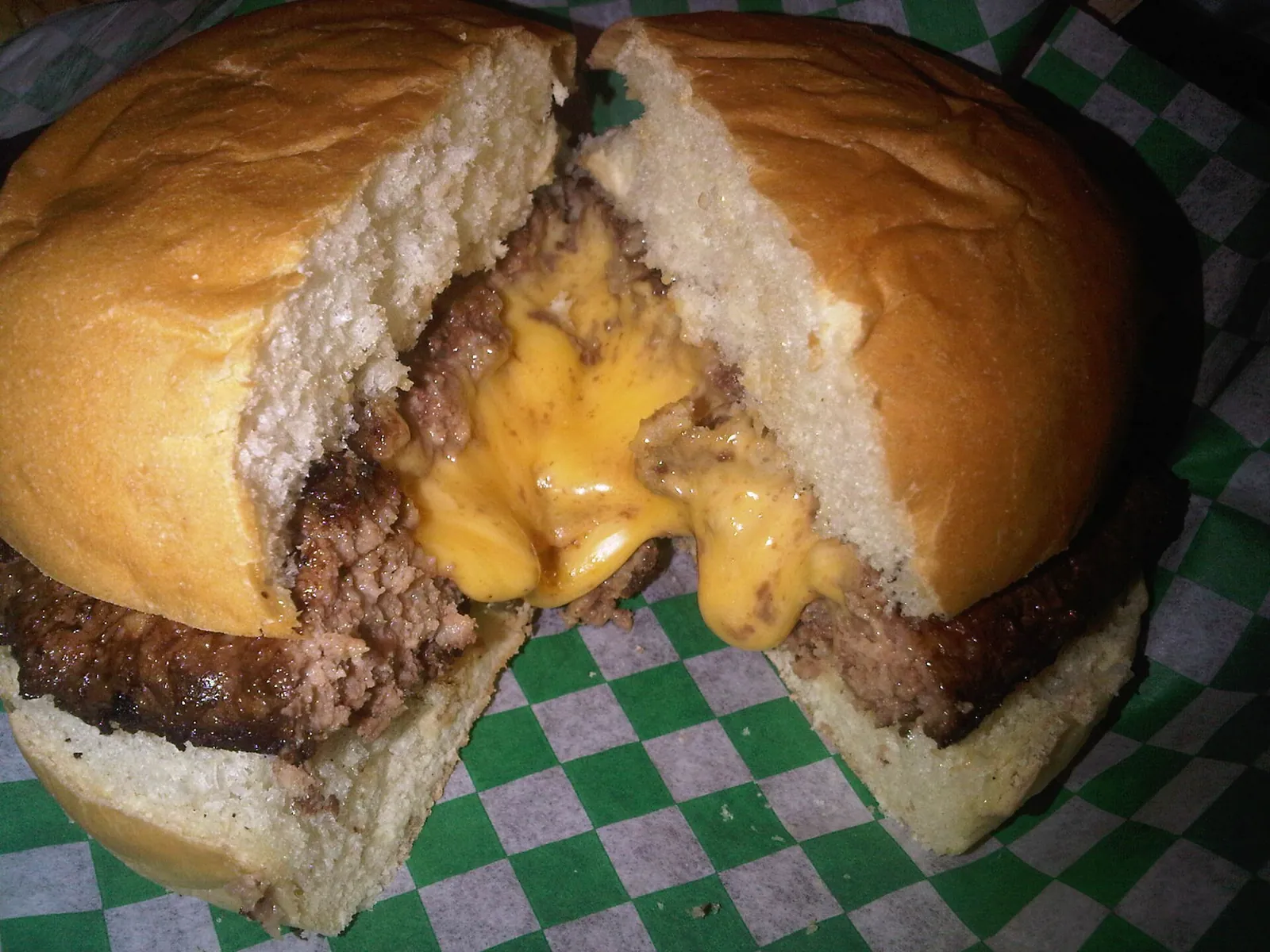
But the slice is only half of it. Timing, thickness and steam decide whether you get a drape or a stiff square.
Melting is a race between the cheese and the beef. Milk fat turns liquid at about 90°F, but the proteins holding cheese together only let go another 40 to 90 degrees higher, according to Serious Eats' guide to melting cheese. The cheese has a minute or so to cover that distance, and every technique below shortens the trip.
Burger cheese melting methods at a glance
These burger cheese melting methods differ in when the cheese goes on and where the extra heat comes from.
| Method | When the cheese goes on | Time to melt | Best for |
|---|---|---|---|
| Skillet, lid and a splash of water | About a minute before the patty is done | 45 to 60 seconds, covered | Thick pan-cooked burgers |
| Grill with the lid closed | With 1 to 2 minutes to go | 1 to 2 minutes | Backyard burgers |
| Smash burger stack | The instant the patties are flipped | A few seconds | Thin, crusty smash burgers |
| Steamed cheese cup | Steamed while the patty cooks, spooned on at the end | As long as the burger cooks | Aged cheddar, Comté, Gruyère |
| Cheese sauce | Spooned over the finished patty | Made ahead, kept warm | Mushroom, chili and loaded burgers |
When to add cheese to a burger
When to add cheese to a burger depends on how long the patty has left: the slice should finish melting as the beef finishes cooking.
Thick burgers: about a minute before done
Thick burgers get their cheese about a minute before they are done, not at the flip. In Serious Eats' grilled cheeseburgers, the slices go on with 1 to 2 minutes of cooking left. The easiest cue is a thermometer: add the cheese when the center reads about 150°F, then cover and finish to the USDA's 160°F for ground beef.
Smash burgers: the instant you flip
Smash burgers need their cheese the instant they are flipped, because the second side cooks for only a few seconds. In Kenji López-Alt's ultimate smash cheeseburger, two 2-ounce patties brown for about 45 seconds, a slice goes on one as soon as they turn, and the second patty is stacked on top so the cheese melts from both sides and glues the stack together. He calls for American cheese or homemade melty slices.
How to melt cheese on a burger
How to melt cheese on a burger comes down to adding heat from above, since the patty only warms the slice from underneath.
Cover it and add steam
Cover the burger and add steam, and a stubborn slice gives up. Serious Eats explains that steam heats cheese more evenly and gently than dry heat and puts back water that cooking drives off. In a skillet, pour a tablespoon of water onto the hot pan beside the patties, never onto the cheese, and cover at once with a lid or an upturned metal bowl; on a griddle, use a basting dome.
Use thin slices at room temperature
Thin slices at room temperature melt fastest, because fridge-cold cheese starts well below the roughly 90°F where its fat begins to soften. Take the cheese out when you start forming patties, as bringing cheese to room temperature explains. Two thin slices, overlapped to reach the edges, beat one thick slab; cut block cheddar with a cheese plane or wire slicer.
Grill or skillet
A grill or a skillet can both melt cheese well, but they trap heat differently. On a grill, close the lid with the vents open, as Serious Eats does for its grilled cheeseburgers, and bank the coals on one side so a patty that chars before it cooks through can move to the cooler side. In a skillet, use the lid and water.
The best cheese for melting on burgers
The best cheese for melting on burgers is American cheese, because process cheese is built with extra milk, extra milk protein and an emulsifying salt that give it an extremely low melting point, as Serious Eats explains (more in what's in American cheese). Among natural cheeses, the reliable melters are young, moist and rennet-set, such as Monterey Jack and young cheddar. Aged cheeses melt poorly because their proteins form tighter clumps that hold fat and water less well, and acid-set cheeses such as paneer, along with queso fresco, never melt at all. For every cheese ranked by melt and flavor, see the best cheese for burgers, ranked.
Best cheese for a wagyu burger
The best cheese for a wagyu burger is a thin slice of American or young cheddar, since the point of the burger is the beef. Daniel Gritzer of Serious Eats tested ground wagyu against supermarket ground chuck, preferred the chuck, and concluded that wagyu should be cooked like any other burger.
Cheese sauces for burgers
Cheese sauces for burgers solve the aged-cheese problem, because starch and added liquid keep the fat from breaking out. These three fit a burger; the cheese sauce guide covers the rest.
Steamed cheese cup
A steamed cheese cup turns aged cheese into a burger topping that melts like American. In Kenji López-Alt's easy-melting cheese method, each burger gets 1 ounce of coarsely grated aged cheese tossed with 1/2 teaspoon of instant flour (such as Wondra) and 1 teaspoon of cream or milk. The mixture steams in a ramekin over an inch of simmering water while the patties cook, then gets stirred smooth and scraped over the burger. It works with aged Comté, cheddar or tomme.
Evaporated milk cheese sauce
An evaporated milk cheese sauce makes enough for a crowd and reheats well. In Serious Eats' cheese sauce for fries and nachos, 8 ounces of grated extra-sharp cheddar is tossed with 1 tablespoon of cornstarch, then heated with 1 cup of evaporated milk and 2 teaspoons of hot sauce over low heat, whisking, until thick, about 5 minutes. Thin it with more evaporated milk; half pepper Jack adds heat.
Gruyère Mornay
A Gruyère Mornay is the classic sauce for a mushroom burger. Daniel Gritzer's Mornay burger cooks 1 1/2 tablespoons each of butter and flour for a minute, whisks in 1 cup of milk until the sauce coats a spoon, then whisks in 3/4 cup of grated Gruyère (about 4 ounces), moving the pan on and off the heat so it never bubbles hard; the batch covers four burgers.
Skillet cheeseburger recipe with a steamed melt
This skillet cheeseburger recipe puts the melting steps together: room-temperature slices, a thermometer and steam.
Ingredients (4 burgers)
- 1 1/2 pounds (680 g) ground beef chuck, about 80 percent lean
- Kosher salt and freshly ground black pepper
- 8 thin slices American cheese or young cheddar, about 6 ounces (170 g) total
- 1 teaspoon neutral oil
- 2 tablespoons water
- 4 hamburger buns, toasted
- Sliced onion, pickles and condiments as you like
Equipment: a 12-inch cast-iron or stainless-steel skillet, a lid or large metal bowl that covers two patties, and an instant-read thermometer.
- Take the cheese out of the fridge. Divide the beef into four 6-ounce (170 g) portions and form patties about 4 1/2 inches wide, pressing a shallow dimple into the center of each so it stays flat as it cooks.
- Just before cooking, season both sides generously with salt and pepper.
- Heat the oil in the skillet over medium-high heat until it shimmers. Add 2 patties and cook, flipping every minute or so, until both sides are well browned and the center reads about 150°F, 6 to 8 minutes.
- Lay 2 slices of cheese on each patty, overlapping them to reach the edges. Pour 1 tablespoon of water into the pan beside the patties and cover at once.
- Cook until the cheese drapes over the sides and a thermometer slid into the side of the patty reads 160°F (71°C), 45 to 60 seconds.
- Move the burgers to the toasted buns. Repeat with the remaining patties and water, then add toppings and serve.
Total time: about 30 minutes, cooking in two batches.
What most burger melting advice gets wrong
Most burger melting advice stops at "cover it," and misses the timing and temperature details that decide the melt.
Too early is as bad as too late. Cheese laid on a thick burger at the first flip sits under heat for minutes, and Serious Eats describes the result: long heat cooks off the cheese's water until the proteins shrink and the fat pools into a greasy slick.
Cheddar has to get nearly as hot as the burger. Harold McGee, quoted in Serious Eats' cheese sauce article, puts the point where cheddar's protein network collapses at around 150°F, just shy of the 160°F the patty needs. Heat rising from the patty alone is slow to get a slice that hot, so the lid and the water do the rest.
The thermometer goes in from the side. The USDA minimum for ground beef is 160°F (71.1°C), checked with a thermometer before the burger comes off the heat, and 165°F for ground turkey or chicken. Melted cheese hides the top of the patty, so slide the probe in from the side to reach the center. Stuffed burgers like the Juicy Lucy need the same care, aimed at the beef rather than the cheese pocket.
Questions about melting cheese on burgers
These quick answers cover common questions about melting cheese on burgers.
What type of cheese melts best on burgers?
The type of cheese that melts best on burgers is process American cheese, followed by young, moist natural cheeses such as Monterey Jack, Muenster and young cheddar.
What cheese is not good for melting?
Cheeses that are not good for melting are acid-set fresh cheeses such as paneer, ricotta and fresh goat cheese, plus queso fresco, which never melt. Long-aged, dry cheeses like Parmesan tend to clump and separate.
How long does it take cheese to melt on a burger?
Cheese takes about 45 to 60 seconds to melt on a burger in a covered skillet with a splash of water, and 1 to 2 minutes on a grill with the lid closed. On a smash burger stack, it takes seconds.
Do you put cheese on before or after flipping a burger?
You put cheese on after flipping a burger, on the browned side: immediately on a smash burger, and about a minute before done on a thick one.
How do you melt cheese on a burger without a lid?
To melt cheese on a burger without a lid, cover it with an upturned metal bowl or a loose tent of foil, with a spoonful of water in the pan for steam. A spoonful of hot cheese sauce needs no melting at all.
Getting the best melt on your next burger
The best melt on your next burger comes from a thin, room-temperature slice of American or young cheddar, added a minute before the patty is done and finished under a lid with a splash of water. Make the skillet recipe first, then try the steamed cheese cup with a wedge of aged cheddar.
Sources
- The Science of Melting Cheese, Serious Eats
- The Ultimate Smash Cheeseburger, Serious Eats
- Thick and Juicy Home-Ground Grilled Cheeseburgers, Serious Eats
- Seared Burgers With Easy-Melting Comté Cheese Slices, Serious Eats
- Cheese Sauce for Cheese Fries and Nachos, Serious Eats
- Mornay and Mushroom Duxelles Burger With Crispy Shallots, Serious Eats
- How to Make Wagyu Burgers, Serious Eats
- Safe Minimum Internal Temperature Chart, USDA Food Safety and Inspection Service