
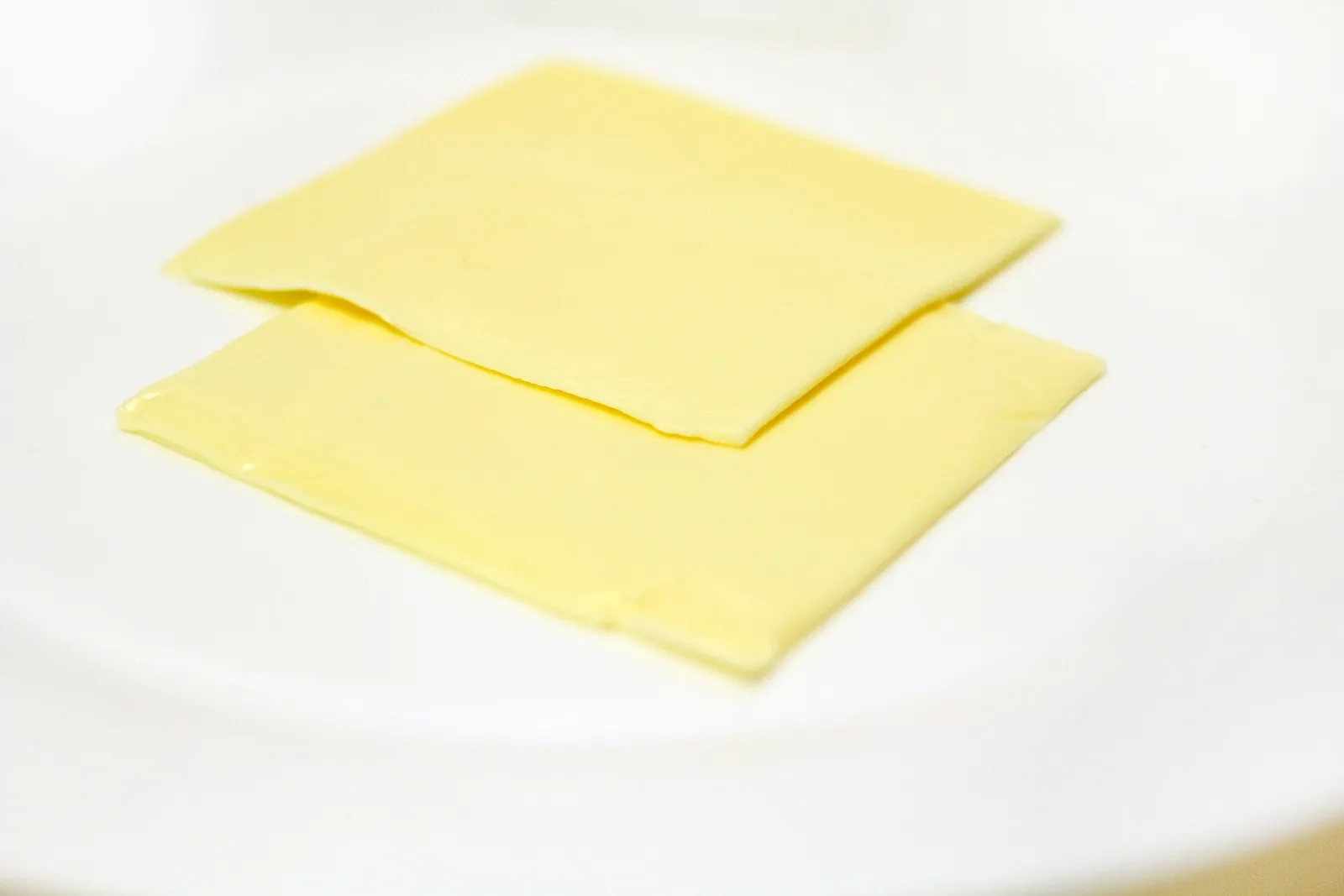
It is made from real cheese, but how much of the pack is cheese depends on the name on the front.
That name matters more than the word "American." Under FDA rules, "pasteurized process American cheese" is cheese plus a few approved additives, "cheese food" must be at least 51 percent cheese, and "cheese product" has no federal recipe at all.
American cheese at a glance
This table gives American cheese at a glance, drawn from the federal standard, USDA's 1953 cheese handbook and USDA nutrient data.
| American cheese | |
|---|---|
| What it is | Pasteurized process cheese: natural cheese melted with emulsifying salts and re-formed |
| Made from | Cheddar, Colby, washed-curd or granular cheese, alone or mixed |
| Milk | Cow's |
| Origin | United States name; USDA dates hard process cheese to Switzerland in 1911 and the first US patent to 1916 |
| Protected name | None; FDA label names and standards instead |
| Aging | None; heated to at least 150°F (66°C), it does not ripen further |
| Texture | Smooth, soft, pliable |
| Flavor | Mild, creamy, salty |
| Melt | Smooth and glossy; resists oiling off |
| Water | 39.6 g per 100 g (USDA); the limit is 40% |
| Sodium | About 470 mg per ounce (USDA); cheddar has 185 mg |
What American cheese is under FDA rules
American cheese is a label name under FDA rules, and the name comes with limits. The federal standard for pasteurized process cheese lets a maker write "pasteurized process American cheese" when the cheese going in is cheddar, washed-curd, Colby or granular cheese, alone or mixed. USDA's 1953 cheese handbook uses "American" the same way, for a family of cheddar-type cheeses rather than one cheese.
The limits are specific. The cheese is heated to at least 150°F (66°C) for at least 30 seconds, so the product is pasteurized, and moisture stays at 40 percent or below. Thirteen emulsifying salts are approved, including sodium citrate, potassium citrate and several sodium phosphates, and together they cannot exceed 3 percent of the weight. Slices may also carry a mold inhibitor and lecithin so they do not stick.
Process cheese, cheese food and cheese product
Process cheese, cheese food and cheese spread each have their own federal standard, and "cheese product" has none.
| Name on the front of the pack | Federal standard | Cheese in it | Other limits | USDA per ounce: protein, carbohydrate |
|---|---|---|---|---|
| Pasteurized process American cheese | 21 CFR 133.169 | Cheddar-family cheese plus emulsifying salts, with a little cream, water, salt and color | Moisture 40% at most | 5.1 g, 1.4 g |
| Pasteurized process cheese food | 21 CFR 133.173 | At least 51% of the weight; the rest can include milk, whey and cream | Moisture 44% at most, fat 23% at least | 4.8 g, 2.4 g |
| Pasteurized process cheese spread | 21 CFR 133.179 | At least 51% of the weight; spreadable at 70°F (21°C) | Moisture 44 to 60%, milkfat 20% at least | 4.7 g, 2.5 g |
| Cheese product, pasteurized prepared cheese product | None | Whatever the maker lists | No federal recipe or ingredient list | 4.6 g, 2.5 g |
The last row of that table is where Kraft Singles sit. In late 2002 the FDA warned Kraft that milk protein concentrate is not a legal dairy ingredient in cheese food. Kraft had already said it would rename Singles "pasteurized prepared cheese product," a name with no standard or approved ingredient list, Farm and Dairy reported in 2003. That is not a lesser grade of process cheese. It sits outside the recipes.
Why American cheese melts so smoothly
American cheese melts so smoothly because emulsifying salts change how its proteins hold fat. In natural cheese, calcium cross-links the casein proteins into a network, and heat releases free fat from it. The salts, often called melting salts, bind that calcium and swap in sodium, so the casein swells and partly dissolves. The loosened protein then re-emulsifies the fat into droplets that are less likely to pool on reheating, according to a 2023 review in Molecules. The share of water-soluble protein climbs from 5 to 20 percent in natural cheese to 60 to 80 percent in process cheese.
The result is a slice that softens evenly instead of splitting into oil and rubbery curds. A slice or two will steady a cheddar sauce too. The mac and cheese guide has ratios, and the melting cheese ranking shows where American sits.
How process cheese is made
Process cheese is made in big batches, and USDA's 1953 handbook describes the steps. Makers blend lots from as many as 20 or 30 vats so every batch matches, grind the cheese into a steam-jacketed kettle with the salts, and heat it, usually to 155 to 160°F for about 5 minutes, until strings drawn off with a spatula look smooth and glossy. Packaged and cooled, it is practically sterile, so it keeps and does not ripen further.
Deli American vs wrapped singles
Deli American vs wrapped singles is mostly a question of which name sits on the pack, and Kraft's labels show how far apart two slices can be. Kraft Deli Deluxe slices are named pasteurized process American cheese with added calcium, and the ingredients open with American cheese, then milkfat, water, sodium citrate and calcium phosphate. Kraft Singles are named pasteurized prepared cheese product, and the ingredients open with cheddar cheese, then skim milk, whey, milkfat and milk protein concentrate, with the phosphates and a little modified food starch after them.
Both carry melting salts, so both melt smoothly. The difference is what else is in the slice. "Pasteurized process American cheese" is the only one of the four names above that promises cheese and little else, so look for it when you are making a sauce, a mac and cheese or a thick sandwich. Thin wrapped slices melt in seconds on a smash burger, as the burger ranking explains. At a deli counter, ask to see the label on the loaf.
How to use American cheese
How to use American cheese comes down to one strength, a melt that does not break, and one cost, a lot of salt.
- Burgers: one thin slice covers a 4-ounce patty. Add it for the last minute and cover the pan.
- Grilled cheese: pair one slice of American with a slice of sharp cheddar for the melt and the tang.
- Sauces and queso: make American a quarter to a third of a mac and cheese blend, or melt a few slices into a splash of warm milk with diced green chiles.
- Boards and snacking: skip it. The flavor is mild and one-note next to a natural cheese.
USDA lists process American at about 470 mg of sodium per ounce, roughly two and a half times cheddar's 185 mg, so taste a sauce before you add salt.
What most American cheese explainers get wrong
Most American cheese explainers stop at "it's processed," which skips the details that decide what you are buying.
The cheese going in is chosen on purpose. USDA's handbook says makers pick cheese for flavor, texture, body, age, acidity and composition, though cheese with minor flaws such as pinholes or an imperfect rind can go in because processing hides them.
"Plastic" is cheesemaking vocabulary. The standard calls the finished product a "homogeneous plastic mass," which feeds the rumor that American cheese is plastic. In cheese language, plastic means pliable, and the same handbook calls mozzarella and provolone "plastic-curd" cheeses.
The first patent was about keeping, not melting. James L. Kraft's US patent 1,186,524, filed March 25 and issued June 6, 1916, has cheddar cut up, heated to about 175°F with constant stirring for 10 to 15 minutes and sealed hot in containers so it keeps indefinitely. It names no melting salts.
Questions about American cheese
These questions about American cheese come up most at the deli counter and the stove.
Is American cheese real cheese?
American cheese is real cheese in the sense the FDA uses: process cheese is made from natural cheese plus emulsifying salts. Cheese food must be at least 51 percent cheese, and a "cheese product" can contain whatever its maker lists. The page on American cheese vs. real cheese compares the two side by side.
What is the difference between American cheese and cheddar?
American cheese is cheddar-family cheese reworked with emulsifying salts into smooth slices, while cheddar is the natural cheese it often starts from. Aged cheddar sharpens and can split into oil when melted, and American stays smooth.
Why is American cheese orange?
American cheese is orange because the maker adds color. Kraft's yellow slices list annatto extract and paprika oleoresin as color, and its Deli Deluxe white American lists neither.
Does American cheese need to be refrigerated?
American cheese slices need to be refrigerated, and Kraft says its Singles should always be kept cold and should not be frozen.
What can you use instead of American cheese?
Instead of American cheese, use a young cheddar, Colby, Monterey Jack or muenster for a sandwich or burger. For a sauce that will not break, dissolve a little food-grade sodium citrate in the liquid first, and see the substitute finder for more swaps.
Choosing American cheese
Choosing American cheese starts at the front of the package. For sauces, mac and cheese and sandwiches, buy slices named "pasteurized process American cheese," and for a smash burger, thin wrapped singles melt in seconds. At the counter, pick up a quarter pound of deli American and a wedge of sharp cheddar and make a grilled cheese with one slice of each cheese. The guide to reading a cheese label covers the same habit for every other pack.
Sources
- 21 CFR 133.169, Pasteurized process cheese, with 133.173, Pasteurized process cheese food and 133.179, Pasteurized process cheese spread, eCFR (FDA standards of identity)
- Cheese Varieties and Descriptions (Agriculture Handbook No. 54, 1953), U.S. Department of Agriculture
- A Review on the Effect of Calcium Sequestering Salts on Casein Micelles: From Model Milk Protein Systems to Processed Cheese (Deshwal and others, 2023), Molecules via PubMed Central
- US Patent 1,186,524, Process of sterilizing cheese and an improved product produced by such process (J. L. Kraft, 1916), U.S. Patent Office via Google Patents
- FDA warns Kraft about using MPCs in cheese products (January 9, 2003), Farm and Dairy
- Kraft Heinz product information: Kraft Singles FAQ, Singles American Slices, Deli Deluxe American Cheese Slices and Deli Deluxe White American Cheese Slices, Kraft Heinz
- USDA FoodData Central (SR Legacy): pasteurized process American, cheese food, pasteurized process American, cheese spread, pasteurized process American, cheese product, pasteurized process American and cheddar, U.S. Department of Agriculture