
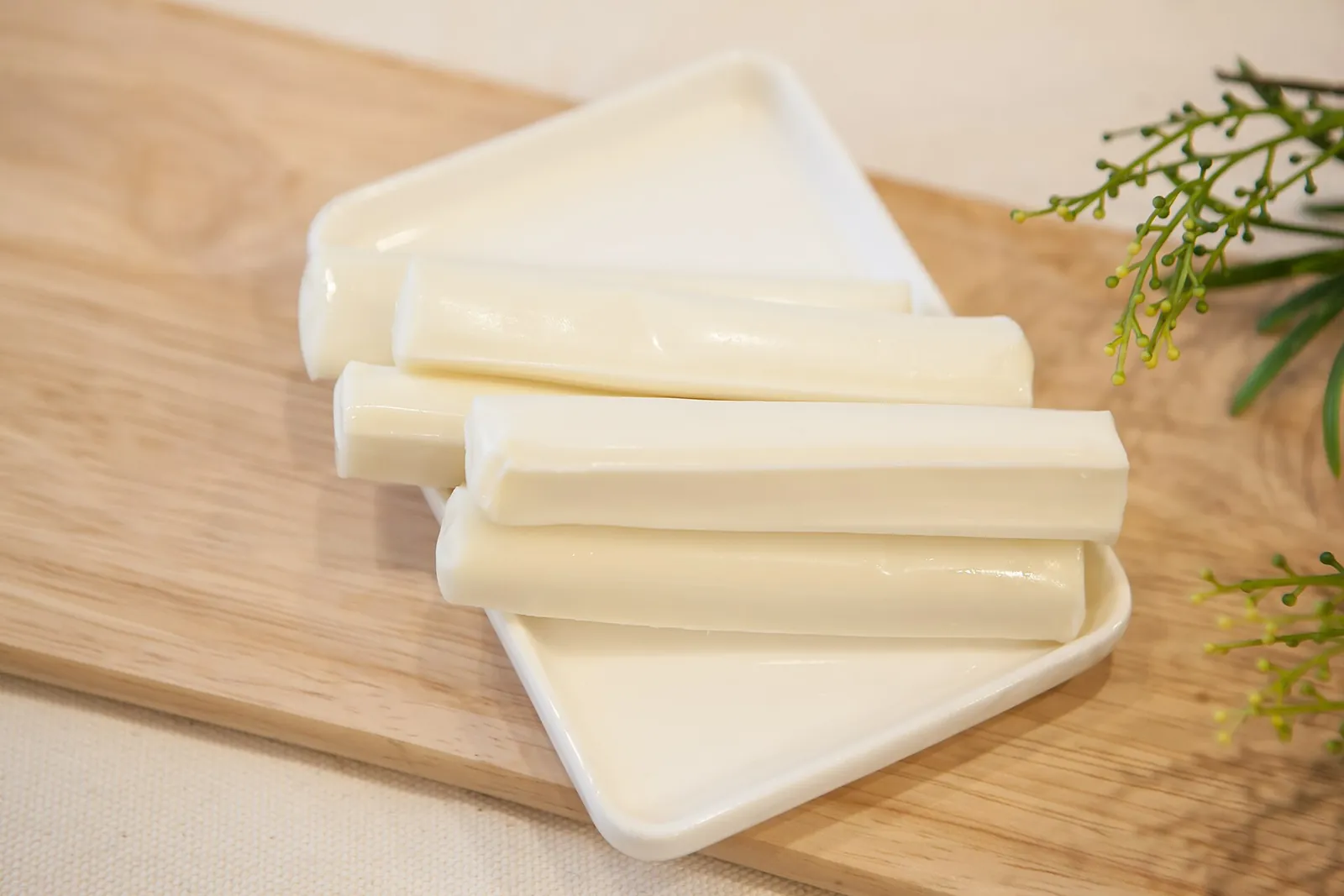
Under the wrapper it is the same family of cheese as the mozzarella on a pizza, so a stick is mostly a shape and a texture rather than a separate cheese.
That single fact explains the rest of this page: why low-fat sticks pull less cleanly, why an old stick loses its strings, and why the FDA standard that covers it describes the cheese and not the stick.
String cheese at a glance
Here is string cheese at a glance, drawn from the FDA standard, university dairy research and the USDA table.
| Detail | String cheese |
|---|---|
| What it is | Low-moisture part-skim mozzarella formed into sticks |
| Cheese family | Pasta filata (stretched curd) |
| Milk | Pasteurized dairy ingredients, which the FDA standard requires |
| FDA standard | 21 CFR 133.158: milkfat 30 to under 45 percent of solids, moisture over 45 up to 52 percent |
| Per ounce (28 g) | 84 calories, 6.7 g protein, 5.6 g fat, 189 mg sodium, 198 mg calcium |
| Texture | Springy and firm, peels lengthwise into strings |
| Flavor | Mild, milky, lightly salty |
Why string cheese peels into strings
String cheese peels into strings because its curd was stretched until the protein fibers lined up in one direction, like the grain in a plank of wood. Mozzarella belongs to the pasta filata, or stretched-curd, group, and a 2021 review of mozzarella stretching says that stretching gives the cheese a fibrous texture.
Two conditions have to be right. The curd must reach a pH of about 5.2 to 5.4, where its protein can soften in hot water and reorganize into one-direction fibers, and the water must be hot enough, because below the plasticizing temperature the fibrous structure never forms. Stretching water runs from 140 to 185°F (60 to 85°C), and the cheese leaves the stretcher at 122 to 149°F (50 to 65°C). Wisconsin Cheese's string cheese guide puts the heating at 140°F.
String cheese adds one step to ordinary mozzarella. In a University of Wisconsin study, the hot curd is extruded through narrow tubes or pipes, which align the protein fibers that give string cheese its pull.
String cheese and the FDA standard
Most string cheese falls under the FDA standard for low-moisture part-skim mozzarella, 21 CFR 133.158, which describes the cheese by its composition and not by its stick shape.
The standard sets milkfat at less than 45 percent but not less than 30 percent of the solids, and it points to the low-moisture mozzarella standard for the rest: moisture of more than 45 and up to 52 percent, pasteurized dairy ingredients, and a curd that is immersed in hot water and kneaded and stretched until smooth, molded warm and firmed in cold water. Whole-milk sticks fall under that standard directly, with milkfat of at least 45 percent of the solids. The wetter plain mozzarella standard allows more than 52 and up to 60 percent moisture, and the mozzarella guide lays out all four.
The standard also lists what a maker may add: salt, vinegar, coloring, calcium chloride (no more than 0.02 percent of the dairy ingredients by weight), and clotting enzymes of animal, plant or microbial origin, which a label may simply call enzymes. Emulsifying salts are not on the list.
String cheese nutrition
String cheese nutrition per ounce, from USDA's low-moisture part-skim mozzarella row, is 84 calories, 6.7 g of protein, 5.6 g of fat, 189 mg of sodium and 198 mg of calcium.
| Per ounce (28 g) | Part-skim (most sticks) | Whole milk |
|---|---|---|
| Calories | 84 | 90 |
| Protein | 6.7 g | 6.1 g |
| Fat | 5.6 g | 7.0 g |
| Carbohydrate | 1.6 g | 0.7 g |
| Sodium | 189 mg | 201 mg |
| Calcium | 198 mg | 163 mg |
Sticks differ in weight by brand, so read the wrapper and scale the per-ounce numbers. USDA lists about 47 g of water per 100 g for the part-skim cheese, which sits inside the standard's 45 to 52 percent moisture range.
How to pick string cheese
Pick string cheese by its label: part-skim or whole milk, the enzymes line and the freshest date on the shelf.
Part-skim is the standard stick, at 5.6 g of fat per ounce, and whole milk is richer at 7.0 g. Take the latest date you can find, because stringiness fades with storage. Brands can also feel different in the hand: the Wisconsin team compared the two main commercial types, cultured string cheese and direct-acid string cheese, and the cultured sticks tested about 4 newtons firmer, while the direct-acid sticks were higher in fat (by about 2.2 percent) and in pH (by about 0.2 units). Two brands can feel different even when both say mozzarella.
How to use string cheese
Use string cheese cold as a snack, peeled lengthwise along the grain, and treat it as pre-portioned low-moisture mozzarella everywhere else.
Cold sticks peel more cleanly than warm ones, and a lunch bag needs an ice pack because it is a perishable cheese; the cooking versus snacking guide puts it in the ice-pack group. In the kitchen, tear a stick over a pizza the way you would use low-moisture mozzarella, layer sticks into baked pasta or quesadillas, or bread and fry them as mozzarella sticks, which the mozzarella sticks recipe walks through.
What most string cheese advice gets wrong
Most string cheese advice misses three facts: fat sets the stringiness, age erases it, and the cheese is natural, not processed.
Low-fat string cheese is less stringy
Low-fat string cheese is less stringy because pasta filata cheese loses its fibrous texture when the fat is lowered, according to a Utah State study of low-fat sticks. The researchers tried starches and gums as fat mimics, and xanthan gum worked best, so the part-skim stick at 5.6 g of fat per ounce is still the one built to pull.
Old string cheese loses its strings
Old string cheese loses its strings, because stringiness and firmness decrease during prolonged storage, the Wisconsin team found. Storing sticks at 32°F (0°C) reduced protein breakdown and helped keep them firm, so the coldest shelf of the fridge and the date on the wrapper both matter.
String cheese is not processed cheese
String cheese is not processed cheese: the FDA standard describes a natural cheese made from cultured milk and clotting enzymes, with no emulsifying salts among the optional ingredients it allows. A stick is closer to a ball of pizza mozzarella than to a slice of American cheese, which is ground and re-melted with emulsifying salts.
Questions about string cheese
These are the questions about string cheese that come up most.
Is string cheese the same as mozzarella?
String cheese is mozzarella, specifically low-moisture part-skim mozzarella shaped into sticks, and not the wet fresh kind sold in balls.
Is string cheese vegetarian?
String cheese is not always vegetarian, because the FDA standard lets makers use animal, plant or microbial clotting enzymes and label them simply as enzymes. Ask the maker if you avoid animal rennet.
Can you melt string cheese?
You can melt string cheese, since it is low-moisture mozzarella, so it browns and stretches on pizza and in baked dishes.
Does string cheese need to be refrigerated?
String cheese should be refrigerated, and colder storage keeps it firmer: the Wisconsin team's test at 32°F (0°C) helped retain firmness over time.
Is string cheese a choking hazard for toddlers?
String cheese is a choking hazard for toddlers, according to the American Academy of Pediatrics, which lists chunks of cheese and string cheese among the foods to avoid or modify for children under 4 and advises pieces no larger than half an inch. The cheese for kids guide covers ages and shapes.
How many calories are in string cheese?
A one-ounce stick of part-skim string cheese has about 84 calories, per USDA, and a whole-milk stick has about 90.
Your next string cheese
For your next string cheese, buy a part-skim stick with the latest date, keep it cold and peel it lengthwise. If you want a different lunchbox cheese, a peeled Babybel round is the other common pick.
Sources
- 21 CFR 133.158, Low-moisture part-skim mozzarella and scamorza cheese, with 133.156 and 133.155, Legal Information Institute, Cornell Law School
- 21 CFR 133.158, 2025 edition, U.S. Government Publishing Office
- Mozzarella Cheese Stretching: A Minireview (Gonçalves and Cardarelli, 2021), Food Technology and Biotechnology via PubMed Central
- Use of high-pressure processing and low-temperature storage to extend the performance shelf life of 2 types of string cheese, Journal of Dairy Science (2024), University of Wisconsin-Madison
- Increasing stringiness of low-fat mozzarella string cheese using polysaccharides, Journal of Dairy Science (2015), Utah State University
- USDA FoodData Central, SR Legacy: Cheese, mozzarella, low moisture, part-skim and Cheese, mozzarella, whole milk, low moisture, U.S. Department of Agriculture
- String cheese guide, Wisconsin Cheese
- Choking Prevention, American Academy of Pediatrics (HealthyChildren.org)