
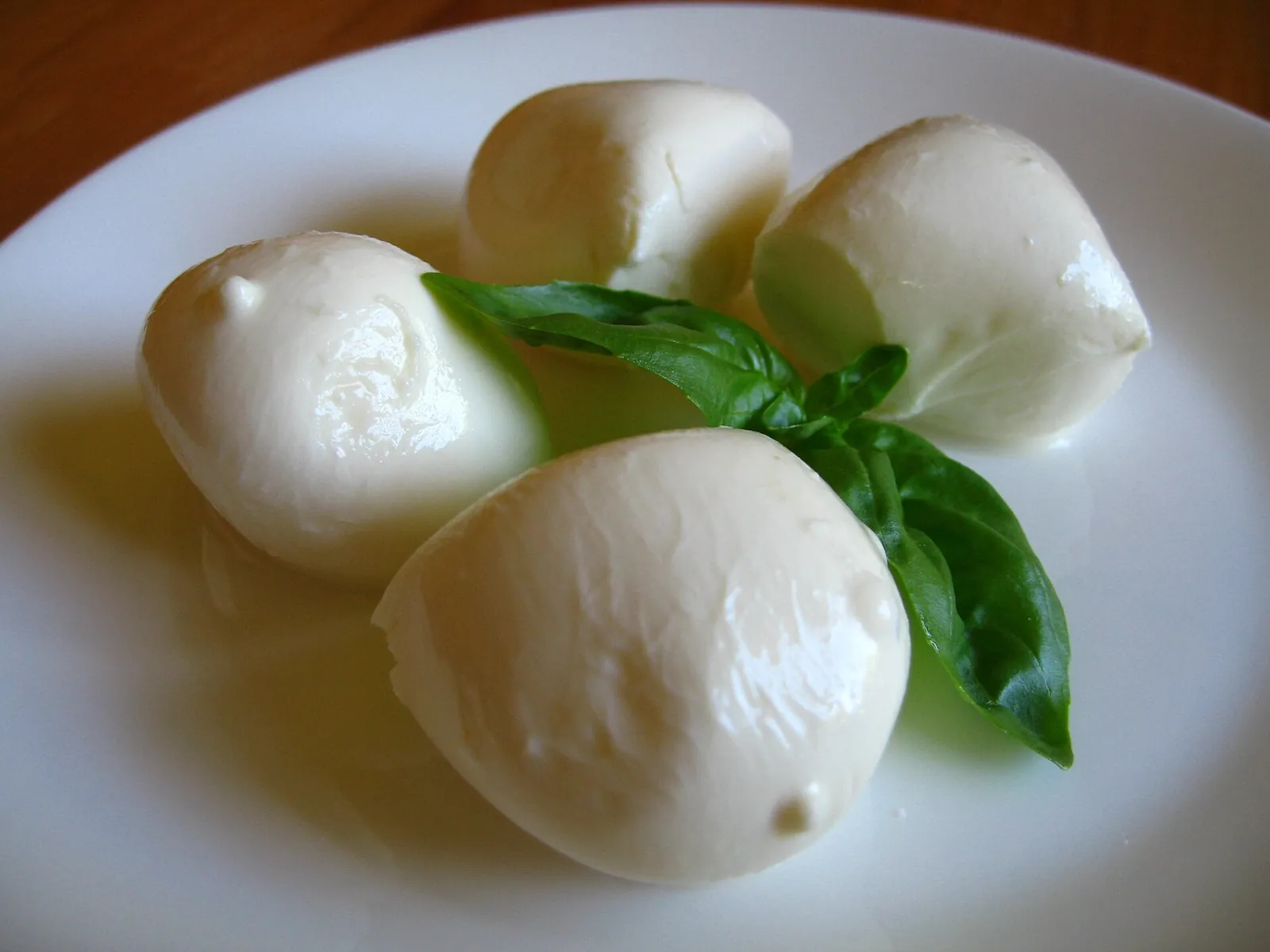
Fresh mozzarella, called fior di latte when it is made from cow's milk, is the soft white ball sold in liquid. Low-moisture mozzarella is the firm block or shredded bag that goes on pizza and into baked pasta. Buffalo mozzarella is made from water buffalo milk and is at its best raw.
All three are pasta filata, or stretched-curd, cheeses: the curd is worked in hot water until it turns smooth and elastic. What differs is how much whey stays in the curd and which animal gave the milk. The FDA's standards of identity draw the line between plain and low-moisture mozzarella at 52 percent moisture, and that line explains most cooking advice: wetter mozzarella tastes milkier but weeps in the oven, while drier mozzarella bakes without flooding the dish.
Types of mozzarella at a glance
This table compares the types of mozzarella, with water, sodium and calories from lab tables (CREA for the Italian cheeses, USDA for the American block).
| Fresh (fior di latte) | Low-moisture | Buffalo | |
|---|---|---|---|
| Milk | Cow's | Cow's, whole or part-skim | Water buffalo |
| Texture | Springy, layered, wet | Firm and smooth; slices and shreds | Softest and loosest; weeps whitish whey |
| Flavor | Fresh, mild, slightly sour milk | Saltier and denser than fresh | Milky and rich, with a lactic aroma |
| Water per 100 g | 54.8 g (CREA) | 48.4 g (USDA, whole milk) | 61.3 g (CREA, PDO cheese) |
| Sodium per 100 g | 200 mg (CREA) | 710 mg (USDA, whole milk) | 211 mg (CREA, PDO cheese) |
| Calories per ounce | 76 (CREA) | 90 (USDA, whole milk) | 73 (CREA, PDO cheese) |
| Shelf life | Short; follow the date on the tub | Much longer than fresh | Short; best soon after it is made |
| Best for | Caprese, salads, sandwiches | Home-oven pizza, baked pasta | Eating raw; very hot pizza ovens |
What makes mozzarella stretch
Mozzarella stretches because its curd is soured to the right acidity and then worked in hot water. A 2021 review in Food Technology and Biotechnology puts the best stretching pH at roughly 5.2 to 5.5, the range where the calcium that cross-links the casein proteins loosens. In water between about 140 and 185°F (60 to 85°C) the curd turns plastic and its proteins line up into long fibers, which is the pull you see when a slice of pizza comes away. Provolone and scamorza are stretched-curd cheeses too, and making mozzarella at home lets you watch the curd go from crumbly to glossy.
Fresh mozzarella (fior di latte)
Fresh mozzarella is the soft, springy cheese sold in a tub of liquid, and it is the type to buy close to the day you will eat it. The liquid keeps it moist; the buffalo PDO's rules, for example, call for a slightly acidic, optionally salted bath until the cheese is eaten. Shops sell it in named sizes: ciliegine (cherry-size), bocconcini (bite-size), ovoline (egg-size) and perline (pearls) for salads, or a large ball to slice. Pat it dry before slicing; slicing mozzarella and soft cheeses covers the knife and the cheese wire.
Low-moisture mozzarella
Low-moisture mozzarella is the firm, pale cheese on most American pizza, made by the same stretching as fresh mozzarella but drier and denser. The FDA's procedure lets the curd be cut and piled to separate out extra whey before stretching, and the same review notes that mozzarella traditionally matures for 7 to 21 days to develop its baking qualities, as the calcium balance and protein structure change. The payoff is a cheese that shreds cleanly and melts into strings without flooding a dish. Buy a block and grate it yourself, since pre-shredded cheese melts poorly.
Buffalo mozzarella
Buffalo mozzarella is mozzarella made from water buffalo milk, and its best-known version, Mozzarella di Bufala Campana, has been a protected designation of origin (PDO) since June 21, 1996, according to the EU register. The specification requires whole fresh buffalo milk with at least 7.2 percent fat and 4.2 percent protein, turned into cheese within 60 hours of the first milking, in Campania and parts of Lazio, Puglia and Molise. The paste stays slightly elastic for the first 8 to 10 hours, then turns softer and more melting, so the cheese is at its best soon after it is made. Buffalo-milk mozzarella made elsewhere is not the PDO cheese, and fior di latte vs buffalo mozzarella shows how to tell them apart and how each compares with cow's milk mozzarella.
Which type of mozzarella to use
Which type of mozzarella to use depends on how hot and how long the cheese will cook.
- Pizza in a home oven: low-moisture, whole milk, grated from a block.
- Pizza in an oven that bakes a pie in a minute or two: fresh, or buffalo for the richest result.
- Lasagna, baked ziti and eggplant parmesan: low-moisture, sliced or shredded.
- Caprese, salads and antipasto: fresh or buffalo, at room temperature.
- Sandwiches and panini: low-moisture slices when hot, fresh slices when cold or barely toasted.
- The richest plate: burrata, a pouch of mozzarella curd filled with cream, eaten raw.
FDA standards for mozzarella and low-moisture mozzarella
The FDA's standards for mozzarella and low-moisture mozzarella sort the cheese into four label names by moisture and milkfat.
| Label name | Moisture | Milkfat, as a share of solids | Rule |
|---|---|---|---|
| Mozzarella | Over 52 up to 60% | At least 45% | 21 CFR 133.155 |
| Part-skim mozzarella | Over 52 up to 60% | 30% to under 45% | 21 CFR 133.157 |
| Low-moisture mozzarella | Over 45 up to 52% | At least 45% | 21 CFR 133.156 |
| Low-moisture part-skim mozzarella | Over 45 up to 52% | 30% to under 45% | 21 CFR 133.158 |
Milkfat is counted against the solids left after the water is subtracted, so the percentages look larger than the fat on a nutrition label: a whole-milk low-moisture block with 48 percent water has 52 percent solids, which puts its legal minimum near 23 percent fat by weight. All four must be made from pasteurized dairy ingredients. Cow's milk and water buffalo products may each be used but never combined, and a cheese made from buffalo milk must say "made with water buffalo milk" beside its name. The word "fresh" appears in none of the four, so the legal split between a tub of fresh mozzarella and a block for pizza is the moisture range.
What most advice on types of mozzarella gets wrong
Most advice on types of mozzarella ranks them, buffalo first and low-moisture last, but each is built for a different job, and three details change what you buy.
Low-moisture mozzarella is not processed cheese. The FDA describes the same core steps as for the fresh kind: milk set with a culture and rennet, drained, then kneaded and stretched in hot water. Look for a short ingredient list on the pale block: milk, cultures, salt, enzymes.
Part-skim is not drier, only leaner. USDA lists 47.1 grams of water per 100 grams for low-moisture part-skim and 48.4 for whole milk; the gap is fat, 19.8 grams against 24.6, or 84 calories an ounce against 90. Less fat means a firmer, less supple melt, so pick whole milk for pizza, grilled cheese and baked pasta and part-skim for snacking.
Fresh mozzarella cannot go straight into a long bake. The law lets it hold up to 60 percent water, and a long bake gives that water time to leave. Tear or slice it, salt it lightly, drain it on paper towels for about 30 minutes and add it for the last few minutes, or switch to low-moisture.
Questions about types of mozzarella
These are the questions about types of mozzarella that come up most often.
What is the difference between fresh and low-moisture mozzarella?
The difference between fresh and low-moisture mozzarella is mostly water: fresh runs over 52 to 60 percent moisture and low-moisture 45 to 52 percent, so fresh is soft and short-lived while low-moisture is firm, salty and long-lasting.
Which type of mozzarella is best for pizza?
Low-moisture mozzarella is the best type of mozzarella for pizza baked in a home oven, and fresh mozzarella suits an oven hot enough to bake a pie in a minute or two.
What is buffalo mozzarella made from?
Buffalo mozzarella is made from the milk of water buffalo, which the PDO rules require to carry at least 7.2 percent fat, roughly double the 3.7 percent in USDA's data for cow's milk.
Can you substitute low-moisture mozzarella for fresh mozzarella?
You can substitute low-moisture mozzarella for fresh mozzarella in baked dishes, using the same weight, but not in caprese, where fresh mozzarella's milky softness is the point.
Does mozzarella have to be pasteurized?
Under the FDA's standards, mozzarella and low-moisture mozzarella are made from pasteurized dairy ingredients, while the buffalo PDO allows raw, thermized or pasteurized milk and requires raw-milk cheese to say so. The FDA's pregnancy guidance says to avoid cheeses made with unpasteurized milk, so check the label and see cheese during pregnancy.
Choosing a type of mozzarella
Choosing a type of mozzarella comes down to heat: low-moisture for anything that bakes, fresh for anything served cool or added at the end, and buffalo when the cheese is the dish. For a first test, taste a ball of fresh and a bite of low-moisture plain at room temperature, then melt a spoonful of each in a skillet and watch which one weeps.
Sources
- 21 CFR 133.155, Mozzarella cheese and scamorza cheese, plus 133.156 (low-moisture), 133.157 (part-skim), 133.158 (low-moisture part-skim) and 133.181 (provolone), Electronic Code of Federal Regulations (FDA)
- Mozzarella Cheese Stretching: A Minireview (Gonçalves and Cardarelli, 2021), Food Technology and Biotechnology via PubMed Central
- Mozzarella di Bufala Campana (PDO, EUGI00000012996) and its product specification, European Commission eAmbrosia register
- Food composition tables: CREA Fior di latte and Mozzarella di bufala campana DOP, CREA Alimenti e Nutrizione; USDA FoodData Central (SR Legacy) mozzarella, whole milk, low moisture, mozzarella, low moisture, part-skim and milk, producer, fluid, 3.7% milkfat, U.S. Department of Agriculture
- Listeria (Food Safety for Moms-to-Be), U.S. Food and Drug Administration