
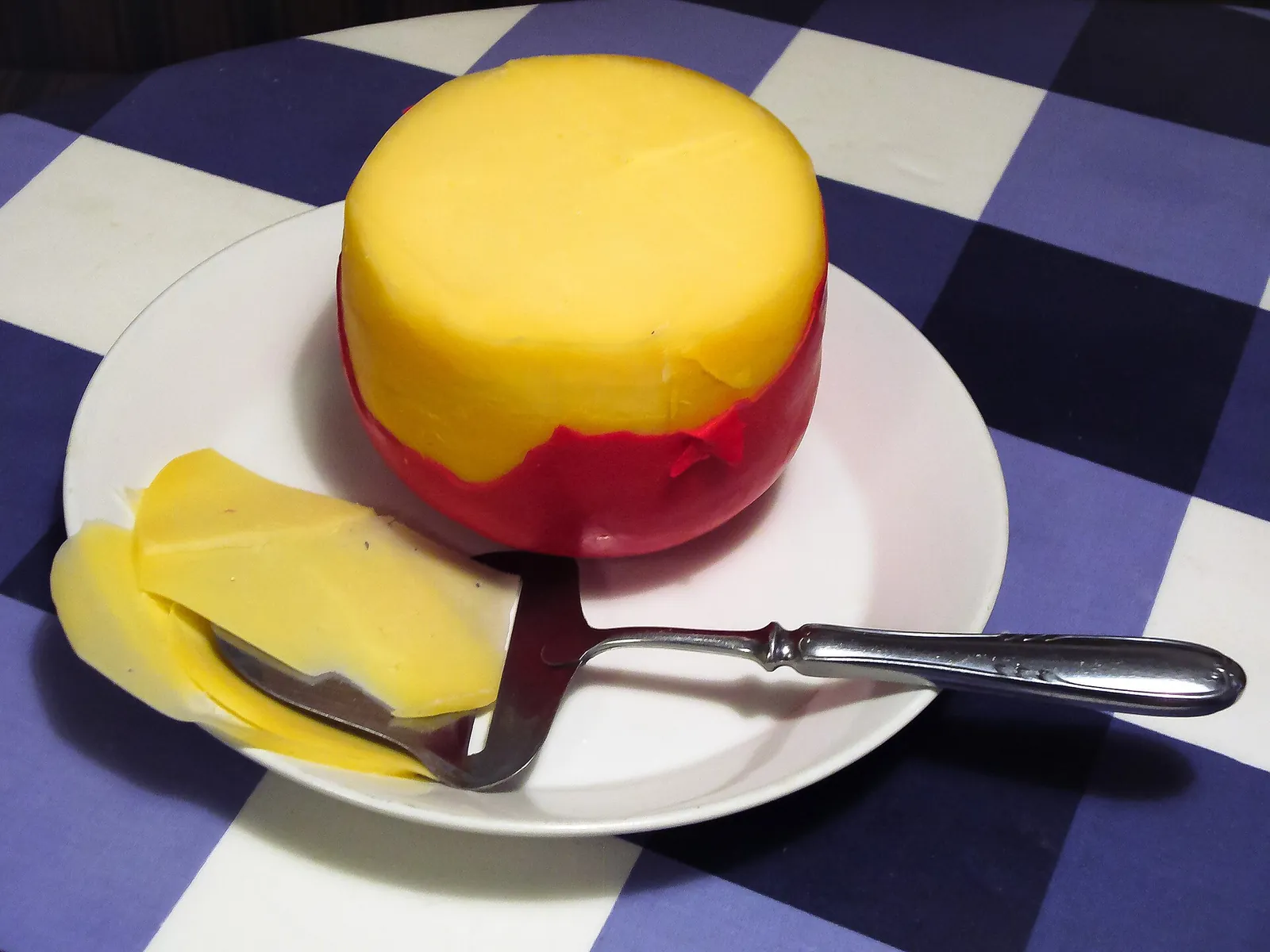
Under the wax it is pale yellow, firm and gently salty, and it turns sharper the longer it ages.
Two things define Edam in most shoppers' minds, the red wax and the lean reputation, and both are more complicated than the label suggests. The wax is an old trade habit rather than a rule, and how lean your Edam is depends on which Edam you buy.
Edam cheese at a glance
This Edam cheese at a glance table covers the cheese itself and the main rules behind the Edam Holland name.
| Edam | |
|---|---|
| Milk | Cow's milk, partly skimmed; Edam Holland uses pasteurized Dutch milk |
| Where | The Netherlands, named for the port town of Edam in North Holland |
| Protected names | Edam Holland (EU PGI, 2010) and Noord-Hollandse Edammer (EU PDO, 1996) |
| Shape | A ball with flattened top and bottom, or a loaf or block |
| Weight | Ball 3.3 to 5.5 lb (1.5 to 2.5 kg); baby Edam up to 3.3 lb (1.5 kg) |
| Fat | Edam Holland: 40 to 44% of dry matter; US standard: at least 40% of solids |
| Age | At least 28 days (21 for baby Edam), up to a year or more |
| Texture | Firm and sliceable, with a few small round holes |
| Flavor | Mild, nutty and slightly salty, sharper with age |
| Per ounce | 101 calories, 7.1 g protein, 8.1 g fat, 276 mg sodium (USDA) |
Where Edam cheese comes from
Edam cheese takes its name from the Dutch port town of Edam in North Holland, which shipped much of the cheese made in the north of the province. A toll register from 1439 to 1441 in Kampen lists an Edam skipper carrying 2,500 "cleyne kasekens," small cheeses, which the Edam Holland product dossier takes as a sign that the round shape already existed and suited long-distance trade.
The lean recipe came later. In the 19th century North Holland cheesemakers began skimming part of the milk, apparently after finding that lower-fat cheese kept better on export voyages. The first mention is from 1808, and early in the 20th century the standard fat level was fixed at today's values.
Edam Holland and the other protected Edam names
Edam Holland is the protected name to look for, an EU PGI registered in 2010 for cheese made in the Netherlands from Dutch cow's milk. The EU regulation sets 40 to 44 percent fat in dry matter, pasteurized milk and at least 28 days of ripening (21 for baby Edam), with no foil ripening, and each cheese carries a casein mark. A second name, Noord-Hollandse Edammer, has been a PDO since 1996 and adds a rule that the milk must come from North Holland.
Edam Holland covers seven types. The two most buyers will meet are baby Edam, up to 3.3 pounds (1.5 kg), and the full ball of 3.3 to 5.5 pounds (1.5 to 2.5 kg); the rest are a hard, many-holed type called bros, a speckled type called stip, a block and two loaves.
As with Gouda, the bare word is unprotected. The regulation says "Edam" may keep being used, and the US standard in 21 CFR 133.138 defines it by recipe: at least 40 percent milkfat in the solids and no more than 45 percent moisture, with no country named.
The red wax on Edam cheese
The red wax on Edam cheese is a coating applied for protection and shelf appeal, and nothing in the Edam Holland specification requires it. The product dossier says Dutch cheesemakers once smeared Edam with a red dye to help it keep, later used linseed oil and a red dye called tournesol, and today use red paraffin. The red balls evidently stood out in foreign shops.
Dutch rules allow rind coatings of refined paraffin, petrolatum or microcrystalline wax, and the regulation defines every rind coating as inedible. Wisconsin Cheese says the wax is there to stop mold growing on the surface. Peel it off or cut it away before you eat the cheese, and do not read the color as a grade, since the Edam Holland specification never mentions it.
Edam fat content compared with Gouda
Edam fat content is lower than Gouda's on paper and almost the same in USDA's database, and the gap between those two views is the most useful thing to know about it.
| Measure | Edam | Gouda |
|---|---|---|
| Fat in dry matter, Dutch PGI | 40 to 44% | 48 to 52% |
| Minimum milkfat in solids, US standard | 40% | 46% |
| Fat per ounce, USDA | 8.1 g | 7.8 g |
| Calories per ounce, USDA | 101 | 101 |
The rules measure fat as a share of dry matter, the cheese left once the water is gone, so the Dutch shorthand "48+" for Gouda means 48 percent or more of the dry matter, not of the whole cheese. Edam's lower figure is real, and it comes from the partly skimmed milk described above. But USDA lists a single generic entry for each cheese, and its Edam works out to about 28.6 grams of fat per 100 grams, a little more than Gouda's 27.4. That entry may not describe the lean Dutch type, so read the Nutrition Facts on the cheese you buy; Wisconsin Cheese notes that reduced-fat Edam exists too.
How Edam cheese tastes and ages
Edam cheese tastes mild, nutty and a little salty when young, then sharper and tangier as it ages, according to Wisconsin Cheese. The Edam Holland specification calls the flavor mild to piquant by age and type, with ivory-to-yellow paste that is firm enough to cut cleanly and dotted with a few small round holes.
How to use Edam cheese
How to use Edam cheese is simple, because it slices cleanly, snacks well and melts when young. Wisconsin calls it a great melting cheese for pasta, potato dishes and baked egg casseroles, and it works sliced on sandwiches or diced over a salad. Aged Edam suits a platter with apples and pears.
For drinks, Wisconsin suggests a pinot gris, Riesling or sauvignon blanc, a Beaujolais, or an American lager, Belgian ale or bock; the pairing guide has more. If you run out, young Gouda is the closest stand-in, and the substitute finder lists others.
How to buy and store Edam cheese
To buy Edam cheese, look for Edam Holland and the EU PGI logo on the package, then check the Nutrition Facts for fat and sodium. Wisconsin's Edam comes in the same round red-wax shape, so the wax alone does not tell you the origin.
Leave the wax on a whole Edam until you cut it, then wrap the cut face in parchment or cheese paper in the fridge; how to store cheese properly has the full routine.
What most Edam cheese advice gets wrong
Most Edam cheese advice misses three details about the cheese itself.
Edam is saltier, not just leaner. USDA lists 276 milligrams of sodium per ounce against 232 for Gouda, and the Dutch specifications allow Edam Holland up to 5.0 percent salt in dry matter in the ball, against 4.0 for Gouda Holland.
The curd is washed for Edam too. Some guides call washed curd a Gouda trait. Both Dutch specifications describe curd separated from the whey, then washed until moisture and pH are right, and the FDA's Edam standard allows dilution with water or brine while the curd is handled.
Edam is not automatically vegetarian. Edam Holland may be made with calf rennet or microbial rennet, and US labels can simply say "enzymes," so look for the word microbial.
Questions about Edam cheese
These are quick answers to common questions about Edam cheese.
What does Edam cheese taste like?
Edam cheese tastes mild, nutty and a little salty, and it gets sharper and tangier with age.
Is Edam cheese lower in fat than Gouda?
Edam cheese is lower in fat than Gouda in the Dutch specification, at 40 to 44 percent of dry matter against 48 to 52, but not in USDA's generic data, which show 8.1 grams per ounce for Edam and 7.8 for Gouda.
Can you eat the red wax on Edam cheese?
You cannot eat the red wax on Edam cheese, because Dutch rules define a rind coating as inedible. Peel it off before you slice the cheese.
Does Edam cheese melt?
Edam cheese melts well when it is young, and Wisconsin recommends it for pasta, potato dishes and casseroles. Aged Edam melts less smoothly, as aged cheese generally does.
What is Edam cheese similar to?
Edam cheese is most similar to young Gouda, which shares its Dutch roots, washed curd and mild flavor. Maasdam and Havarti are other mild, sliceable options.
Buying your first Edam cheese
For your first Edam cheese, buy a baby Edam in red wax and put its Nutrition Facts next to those of a wedge of Gouda from the same counter. Peel the wax, slice the paste thin onto rye with mustard, and taste the two side by side; Gouda vs Edam explains what you will notice.
Sources
- Dutch and EU rules for Edam Holland: Commission Regulation (EU) No 1121/2010, European Commission; Productdossier BGA Edam Holland and Productdossier BGA Gouda Holland (product specifications, in Dutch), Netherlands Enterprise Agency (RVO); Warenwetregeling kaaskorstbedekkingsmiddelen (cheese rind coatings, in Dutch), Wettenbank, Government of the Netherlands
- 21 CFR 133.138, Edam cheese, Electronic Code of Federal Regulations; USDA FoodData Central (SR Legacy): Cheese, edam (173419) and Cheese, gouda (171241), USDA
- Edam, Wisconsin Cheese (Dairy Farmers of Wisconsin)