
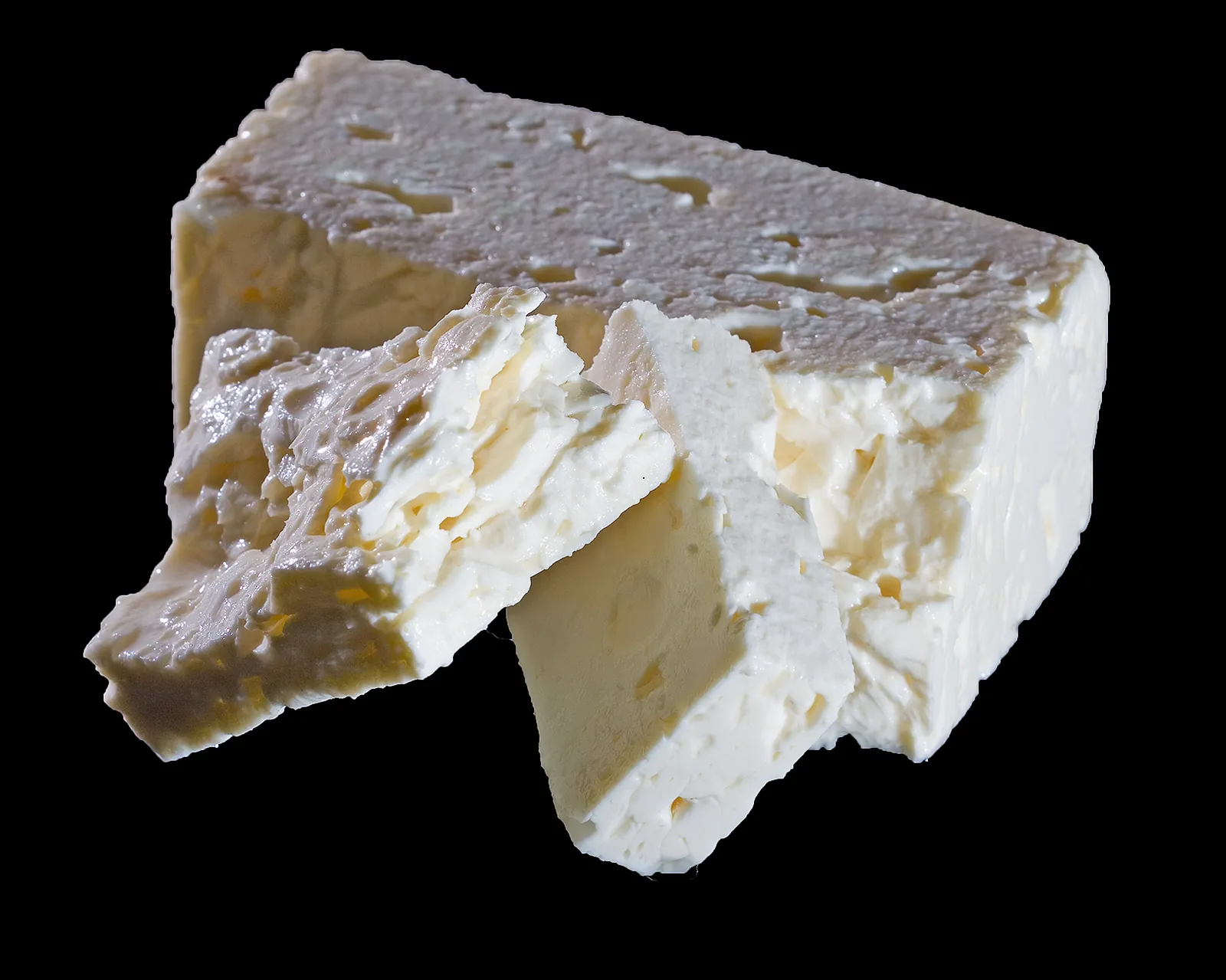
US cheese standards do not define the name, so a tub labeled feta in a US store can be cow's milk.
Brine explains most of what feta does. Cured at least two months in salt water of about 7 percent, the cheese turns salty and tangy, firm enough to slice and too acidic to melt.
Feta cheese at a glance
Here is feta cheese at a glance, with figures from the EU specification and USDA.
| Feta cheese | |
|---|---|
| Greek name | Φέτα |
| Milk | Sheep's, or sheep's with up to 30% goat's (PDO) |
| Origin | Mainland Greece and Lesbos |
| Protected name | EU PDO since 2002; not defined in US law |
| Cured | At least 2 months in brine of about 7% salt |
| Texture | Soft but sliceable, rindless, crumbly; 56% water at most |
| Flavor | Tangy, salty, a little peppery |
| Salt | About 2.9% (323 mg sodium per ounce) |
| Per ounce | 75 kcal, 4.0 g protein, 6.1 g fat |
What real feta cheese is
Real feta cheese is a Protected Designation of Origin (PDO) cheese, so EU law fixes its milk, its place and its method. The product specification allows only sheep's milk, or sheep's milk with no more than 30 percent goat's milk, from mainland Greece and the island of Lesbos. Crete and the other island groups are outside the area. The specification traces the name, a word for slice, to Greece's Venetian period in the 17th century.
Protection took two tries. The EU registered feta in 1996, the Court of Justice annulled that in 1999 because the Commission had not weighed the name's long use in other member states, and the EU registered it again in 2002. Germany and Denmark challenged the new registration, and the Court upheld it in 2005. Feta's brined relatives, which go by other names, are in the guide to Balkan white cheeses.
How feta cheese is made
Feta cheese is made by setting milk with rennet, draining the curd without pressing it, salting it and curing it in brine. The specification describes traditional rennet from the stomachs of unweaned lambs and kids, now often mixed with commercial rennet. The curd drains in perforated molds, gets coarse salt on its surface and goes into barrels or tins of brine at about 7 percent salt. It ripens about 15 days at up to 64°F (18°C), then in a cold store at 36 to 39°F (2 to 4°C), for at least two months in all.
Raw or pasteurized milk is allowed; powdered milk, casein salts, colorants and preservatives are not. The cheese may hold no more than 56 percent water, and at least 43 percent of its dry matter must be fat. Greek market samples from a 1989 study, cited in the specification, averaged 52.9 percent water, 26.2 percent fat, 16.7 percent protein, 2.94 percent salt and a pH of 4.41.
Sheep's milk makes feta rich. USDA lists it at 7.0 grams of fat and 6.0 grams of protein per 100 grams, against 4.1 and 3.6 for goat's milk and 3.25 and 3.15 for whole cow's milk. The specification adds that sheep's and especially goat's milk carry fatty acids such as caproic and caprylic acid, which it credits for a richer smell and a more peppery taste than cow's milk can give.
How salty feta cheese is
Feta cheese is salty by design: USDA lists 323 milligrams of sodium in an ounce, about 2.9 percent salt, matching the 2.94 percent in the Greek samples. That is about 1.7 times the sodium in an ounce of cheddar (185 mg).
To tame a salty block, soak it for 20 to 30 minutes in cold water or milk, then pat it dry. Utah State researchers held feta in brines of 6.5 to 9.5 percent salt and found the salt in the cheese settled at a level set by the brine, so a soak in plain water pulls salt out. Taste before you season anything else in the dish.
How to buy feta cheese in the US
The best way to buy feta cheese in the US is as a block in its brine, with the milk and the country printed on the label. For the Greek original, look for "Feta PDO" and Greece as the origin; the guide to spotting authentic feta covers the label words. Federal cheese standards, 21 CFR Part 133, have no section for feta, and Dairy Farmers of Wisconsin says Wisconsin makers use cow's milk for a lighter, less gamy flavor.
Check for "pasteurized" if you are pregnant or at higher risk. The PDO allows raw milk, and the CDC lists feta among its safer choices only when it is made with pasteurized milk; see cheese during pregnancy. Prefer a block to dry pre-crumbled feta, since Wisconsin's dairy board notes that the brine keeps the cheese from drying out.
How to use feta cheese
Feta cheese suits dishes where its salt and tang are the point. Lay a thick slab on a Greek salad of tomato, cucumber, olives and red onion with olive oil and oregano. Crumble about 1/4 cup (a bit over an ounce) over roasted vegetables, eggs or a grain bowl. Fold it with spinach and eggs into the filling for spanakopita. Sweet partners soften the salt: watermelon, honey, roasted beets.
For baked feta, set a block in a dish with tomatoes and olive oil and roast it at 400°F (200°C) for 15 to 20 minutes, until the edges brown. Stir it into pasta while it is soft.
Storing feta cheese in brine
Storing feta cheese well means keeping it cold and under brine. In a 10-day Utah State test, feta held in brine at 37°F (3°C) kept a steady pH and swelled, gaining moisture up to 58 percent. Feta held at 72°F (22°C) kept souring, to a pH as low as 4.1, and lost 13 to 18 percent of its weight, and the shrinkage was not reversed when it was chilled again. Put the tub back in the refrigerator as soon as you have served.
If the brine runs low, stir 1 tablespoon of table salt into 1 cup of water, about 7 percent, the strength the specification uses. Throw the cheese out if the tub swells or the cheese turns slimy, discolored or smells off. Freeze only what you will crumble into cooked dishes; the Center for Dairy Research says thawed feta crumbles.
What most feta cheese advice gets wrong
Most feta cheese advice repeats three shortcuts, and each one hides a rule worth knowing.
Baked feta does not melt. It softens and browns but does not flow or string like mozzarella. Its pH of 4.41 in the Greek samples sits where cheese stops flowing, as the melting cheese guide explains.
Feta is not a goat cheese. The specification allows pure sheep's milk or a blend capped at 30 percent goat's milk, and nothing else. The feta vs. goat cheese comparison covers the difference.
Feta is not always vegetarian. Traditional feta uses lamb and kid rennet, and the specification says it is now often mixed with commercial rennet. Look for "microbial rennet" on the label, or read what rennet is.
Questions about feta cheese
These quick answers cover what people ask most about feta cheese.
What is feta cheese made of?
Feta cheese is made of sheep's milk, or sheep's milk with up to 30 percent goat's milk, plus salt, rennet and cultures. US versions can use cow's milk.
Is feta cheese safe during pregnancy?
Feta cheese is on the CDC's list of safer choices when it is made with pasteurized milk. Raw-milk feta is not, so read the label.
Is feta cheese healthy?
Feta cheese has 75 calories, 4.0 grams of protein, 140 milligrams of calcium and 323 milligrams of sodium in an ounce, per USDA, so count the salt.
What can you use instead of feta cheese?
The closest substitute for feta cheese is crumbled soft goat cheese, with about 1/3 teaspoon of salt added per 4 ounces to match feta's sodium. Cotija also crumbles but is drier and saltier. The substitute finder lists more.
What does feta cheese taste like?
Feta cheese tastes tangy and salty with a peppery edge, richer in sheep's-milk versions and lighter in cow's-milk ones.
Your first block of feta cheese
For your first block of feta cheese, buy one Greek PDO block in brine and one pasteurized US cow's-milk block, and taste them side by side. Use the sharper one on salad and the milder one in cooking.
Sources
- Feta, PDO-GR-0427: product specification (English) and register entry, European Commission eAmbrosia register
- Judgment of the Court (Grand Chamber), Germany and Denmark v Commission, Joined Cases C-465/02 and C-466/02 (2005), Court of Justice of the European Union
- 21 CFR Part 133, Cheeses and Related Cheese Products, eCFR (FDA standards of identity)
- Influence of Brine Concentration and Temperature on Composition, Microstructure and Yield of Feta Cheese (Journal of Dairy Science, 2009), Utah State University
- Feta, Dairy Farmers of Wisconsin
- Preventing Listeria Infection, Centers for Disease Control and Prevention
- Strategies to Properly Store or Extend the Shelf Life of Cheese (Technical Bulletin, 2020), University of Wisconsin Center for Dairy Research
- USDA FoodData Central, SR Legacy rows: feta, milk, sheep, milk, goat, milk, whole, goat cheese, soft, cheddar and cotija, USDA