
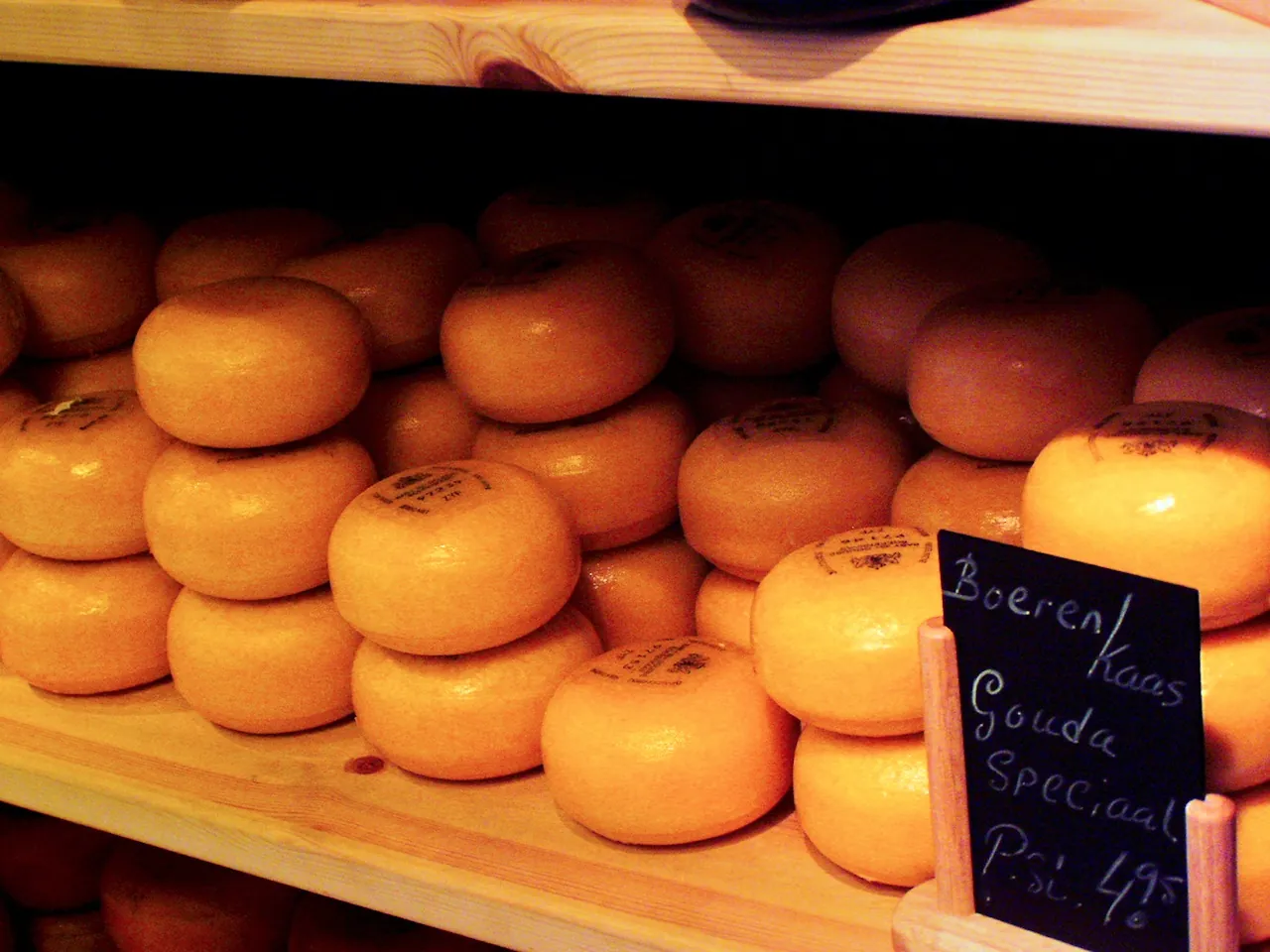
A wheel ripened for four weeks and one kept for two years share a name and little else, so the age on the label tells you more than the brand does.
Gouda is one recipe stretched across time. The curd is washed to keep the cheese sweet and gentle, then the wheel dries and builds flavor for weeks or years. Only two Gouda names are protected as places of origin in the EU, so much of the work at the counter is reading what the label promises.
Gouda cheese at a glance
This Gouda cheese at a glance table covers the cheese itself and the main rules behind the Gouda Holland name.
| Gouda | |
|---|---|
| Milk | Cow's milk; Gouda Holland uses pasteurized Dutch milk |
| Where | The Netherlands, named for the town of Gouda, where it was traded; also made in the US |
| Protected names | Gouda Holland (EU PGI, 2010) and Noord-Hollandse Gouda (EU PDO, 1996) |
| Style | Semi-hard, washed curd, brined, with a natural rind that is often coated |
| Wheel | Gouda Holland: flattened cylinder, block or loaf, 5.5 to 44 lb (2.5 to 20 kg) |
| Fat | Gouda Holland: 48 to 52% of dry matter; US standard: at least 46% of solids |
| Age | At least 28 days for Gouda Holland; 4 weeks to a year or more in shops |
| Texture | Pliable when young, firm after months, hard and crystalline when old |
| Flavor | Mild and creamy young; nutty and caramel-sweet when aged |
| Per ounce | 101 calories, 7.1 g protein, 7.8 g fat, 232 mg sodium (USDA) |
Where Gouda cheese gets its name and its sweetness
Gouda cheese is named for the Dutch town of Gouda, where it was traded rather than made. The EU regulation that protects Gouda Holland says cheese sold in Gouda's market became known as Gouda from the 18th century on.
The sweetness comes from washing the curd. Makers replace some of the draining whey with water, which rinses out lactose, Wisconsin Cheese explains. The Dutch specification describes the same step, with the curd washed until moisture and pH are right.
Gouda Holland and the other protected Gouda names
Gouda Holland is the protected name to look for, a PGI the EU registered in 2010 for cheese made in the Netherlands from Dutch cow's milk. Its specification calls for 48 to 52 percent fat in dry matter, pasteurized milk (heated to at least 162°F, or 72°C, for 15 seconds) and at least 28 days of ripening. Every whole cheese carries a casein mark with its own code, and the EU PGI logo must appear beside the name on the packaging.
Gouda Holland cannot be ripened in plastic foil, which the Dutch product dossier calls a cheaper, lower-quality method used for generic Gouda. The second name, Noord-Hollandse Gouda, has been a PDO since 1996 and adds one rule: the milk must come from the Dutch province of North Holland.
Plain "Gouda" is protected by nothing. The 2010 regulation says the word may keep being used, and the US standard in 21 CFR 133.142 defines the cheese by recipe alone: at least 46 percent milkfat in the solids, no more than 45 percent moisture and no country of origin.
Young Gouda vs aged Gouda: taste and texture by age
Young Gouda vs aged Gouda is mostly a story of water: as a wheel dries over months, it goes from pliable and mild to firm, tangy and caramel-sweet. Dutch cheese labels follow fixed minimum ripening times, which Wageningen University's magazine Resource says are set in law.
| Stage | Dutch label (minimum ripening) | What to expect | Best use |
|---|---|---|---|
| Young | jong (4 weeks), jong belegen (8 weeks) | Pliable, mild and creamy | Melting, sandwiches, kids |
| Matured | belegen (4 months), extra belegen (7 months) | Firmer, buttery and nutty | Sandwiches, cooking, snacking |
| Old | oud (10 months) and older | Hard, tangy, caramel notes, often crunchy | The board, shaving, grating |
The Gouda Holland dossier notes that in the Netherlands young and matured Gouda goes on bread, while matured and old Gouda is a dessert cheese after dinner. American packages rarely use the Dutch words. They print months or phrases like "aged," so go by the number when there is one.
Why aged Gouda crunches: the crystals
The crunch in aged Gouda comes from crystals, and it is a sign of age, not a flaw. In a 2015 study of cheese crystals, X-ray diffraction on commercial Gouda aged two years confirmed that the hard, crunchy crystals were tyrosine, an amino acid released as the proteins break down. The researchers also found small spherical "pearls" that they tentatively identified as an unusual form of leucine.
The crystals in the cheddar they tested were calcium lactate, a different compound, and neither kind is salt or mold. Crystallized vs spoiled cheese explains how to tell crystals from spoilage.
Gouda wax and rind: what to do with the coating
Gouda wax is a coating applied after the cheese has been brined and aged for a few days, and it is not meant to be eaten. Wisconsin Cheese says makers coat the wheel with wax or plastic before it ages. Dutch rules allow plastic-based coatings and mineral wax such as paraffin, and the regulation defines every rind coating as inedible.
Cut it off before you slice, grate or smoke the cheese, and go by the months on the label, since the color is the maker's choice.
How to use Gouda cheese
How to use Gouda cheese comes down to age: young Gouda melts, matured Gouda slices, and aged Gouda belongs on the board. Wisconsin Cheese says young Gouda melts beautifully in pasta, gratins and casseroles, and it is one of the creamy melters in the mac and cheese guide.
Aged Gouda behaves like aged cheddar and resists a smooth melt, so shave it over dishes in small amounts. On a board, break a wheel aged a year or more into shards and serve it with spicy mustard, crisp apples and Marcona almonds, as Wisconsin suggests; the charcuterie cheese guide gives the same age advice.
Smoked Gouda is stronger, so a third of a mac and cheese blend is plenty; the best smoked cheeses cover what to buy. For drinks, Wisconsin suggests a bock, brown ale, farmhouse cider, Riesling or cava, and the pairing guide has more.
How to buy Gouda cheese in the US
To buy Gouda cheese in the US, check the age first, then the name:
- The age. Look for months or words like young and aged; the Dutch terms above appear mostly on imported wheels. If nothing is printed, ask for a taste.
- The name. "Gouda Holland" with the EU PGI logo means Dutch milk, at least 28 days of ripening and no foil ripening. A cut wedge has to show the name and logo on its package.
Wrap cut Gouda in cheese paper or parchment and keep it in the fridge; how to store cheese properly has the full routine.
What most Gouda cheese advice gets wrong
Most Gouda cheese advice treats the fat figure and the word aged as if they had fixed meanings, and neither does.
The fat number is not fat per slice. A "48+" on a Dutch label means fat as a share of the dry matter, not of the whole cheese. Old cheese holds less water, so an old 48+ Gouda carries more fat and salt per slice than a young one with the same label, as Wageningen dairy scientist Kasper Hettinga points out in Resource. USDA's generic Gouda has 7.8 grams of fat per ounce.
"Aged" has no US definition for Gouda. The federal standard sets no age terms at all, only a 60-day cure for cheese made from raw milk, so "aged" and "extra aged" are the maker's words.
Questions about Gouda cheese
These are quick answers to common questions about Gouda cheese.
What does Gouda cheese taste like?
Gouda cheese tastes mild, creamy and slightly sweet when young, and nuttier, tangier and more caramel-like as it ages.
Is Gouda a good melting cheese?
Gouda is a good melting cheese when it is young and a poor one when it is aged, because an aged wheel melts like old cheddar and can turn greasy or grainy.
What are the crunchy bits in aged Gouda?
The crunchy bits in aged Gouda are tyrosine crystals, which form as the cheese ages. They are not salt or spoilage.
Can you eat the wax on Gouda?
You cannot eat the wax on Gouda, because Dutch rules define a rind coating as inedible. Cut it off, along with any plastic coating.
Is Gouda cheese vegetarian?
Gouda cheese is not vegetarian by default. Gouda Holland may be made with calf rennet or microbial rennet, and US rules let makers declare any rennet as "enzymes," so look for the word microbial.
Buying your first Gouda cheese
For your first Gouda cheese, buy two wedges from the same counter, one young and one aged a year or more, and taste them side by side at room temperature. Melt the young one into a grilled cheese and save the aged one for a board with apples. Its Dutch cousin Edam is saltier and traditionally leaner, and Gouda vs Edam lays out the rest.
Sources
- Dutch and EU rules for Gouda Holland: Commission Regulation (EU) No 1122/2010, European Commission; Productdossier BGA Gouda Holland (product specification, in Dutch), Netherlands Enterprise Agency (RVO); Warenwetregeling kaaskorstbedekkingsmiddelen (cheese rind coatings, in Dutch), Wettenbank, Government of the Netherlands
- 21 CFR 133.142, Gouda cheese and 133.138, Edam cheese, Electronic Code of Federal Regulations; Cheese, gouda (FDC 171241), USDA FoodData Central
- Gouda, Wisconsin Cheese (Dairy Farmers of Wisconsin)
- Crystal fingerprinting: elucidating the crystals of Cheddar, Parmigiano-Reggiano, Gouda, and soft washed-rind cheeses using powder x-ray diffractometry, Tansman, Kindstedt and Hughes, Dairy Science & Technology (2015)
- Als je jonge kaas laat liggen, wordt het dan oude kaas? (Weer Wat Wijzer, in Dutch), Resource, Wageningen University & Research (October 15, 2020)