
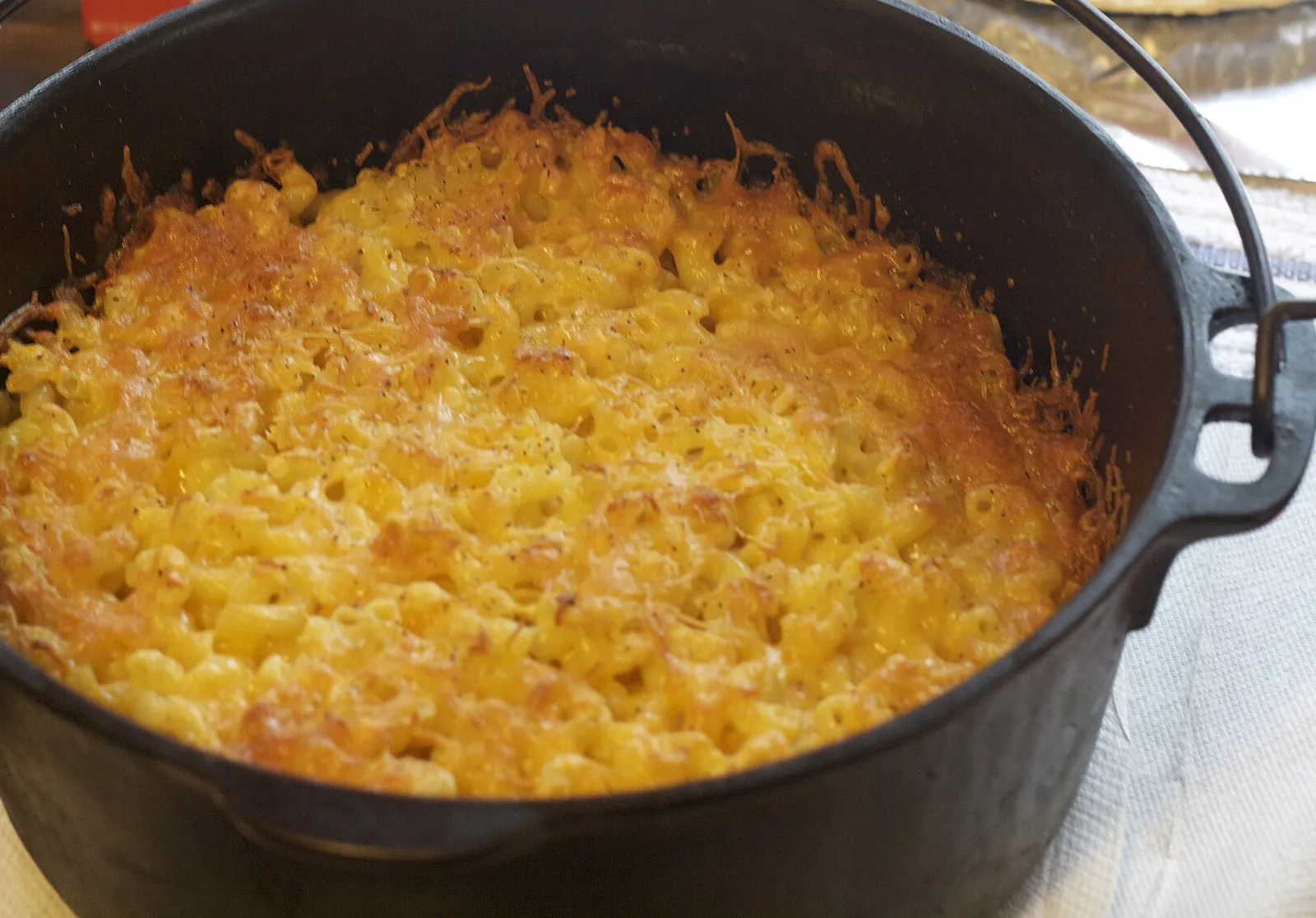
For a pound of pasta on the stovetop, a reliable blend is 12 ounces of sharp cheddar, 4 ounces of Gruyère or Monterey Jack, and a few slices of deli American if you want the sauce glossy.
The blend exists because flavor and melt pull in opposite directions. The months of aging that make cheddar taste sharp also dry it out and tighten its proteins, so the tastiest block in the case is the one most likely to go grainy or greasy in a hot sauce. Let a young melter carry the texture and the cheddar carry the taste, and neither cheese has to do both jobs.
Best cheeses for mac and cheese at a glance
These are the best cheeses for mac and cheese sorted by the job each one does, with amounts for 1 pound (450 g) of dry pasta.
| Cheese | Job in the pot | How it behaves in sauce | Per pound of pasta |
|---|---|---|---|
| Sharp cheddar, aged 6 to 12 months | Flavor | Tangy and savory, melts well at this age | 8 to 16 ounces |
| Extra-sharp cheddar, aged past a year | Big flavor | Clumps and leaks fat unless it has help | Half the blend or less |
| Gruyère | Melter with flavor | Smooth and nutty, stretchy when folded in | 4 to 8 ounces |
| Monterey Jack or Colby | Mild melter | Melts fast and smooth, gentle taste | 4 to 8 ounces |
| Fontina or young Gouda | Creamy melter | Soft, buttery, very smooth | 4 to 8 ounces |
| Deli American cheese | Stabilizer | Will not break; mild and salty | 2 to 8 ounces |
| Parmesan or Pecorino Romano | Savory accent | Barely melts, clumps if overused | 1 to 2 ounces, mostly on top |
The three jobs in a mac and cheese blend
A mac and cheese blend works when every cheese in it has a job, and the best versions cover flavor, melt and stability with two or three cheeses. Think of it as a seesaw: the more aged, punchy cheese you add, the more the sauce needs a smooth melter or an emulsifier on the other side.
Sharp cheddar, the flavor cheese
Sharp cheddar is the flavor cheese in classic American mac and cheese, the tang most people picture when they hear the name. America's Test Kitchen describes sharp cheddar as aged 6 to 12 months, and that window is the sweet spot for a sauce: enough age for flavor, not so much that the cheese fights the heat.
Buy a block, and if the label gives an age in months, aim for that range. Make cheddar half to two-thirds of the cheese, so 8 to 12 ounces in a 1-pound stovetop batch.
Its weak spot is age itself. Past about a year, cheddar gets harder to melt smoothly, which is why extra-sharp works best as a partner rather than the whole show. Here is more on how cheddar changes as it ages.
Gruyère, the melter with real flavor
Gruyère is the rare melter with real flavor of its own, nutty and a little sweet, and savory enough to stand next to cheddar instead of diluting it. It is also the classic cheese of a French Mornay sauce, which is mac and cheese sauce with better manners.
Serious Eats' classic baked casserole puts cheddar in the sauce, then folds 8 ounces of grated Gruyère into the sauced pasta for small pockets that stretch when you lift a forkful. Buy a younger, softer piece, save the crunchy, long-aged wedges for a cheese board, and use 4 to 8 ounces per pound of pasta. The weak spot is price, so on a budget, split the melter slot between Gruyère and Jack. The full Gruyère profile covers the rest.
Monterey Jack and Colby, the mild melters
Monterey Jack and Colby are mild melters that go smooth almost as soon as they hit warm sauce. Part of the reason is water. The federal standards of identity cap Monterey Jack at 44 percent moisture and Colby at 40 percent, against 39 percent for cheddar, and moister, younger cheese needs less heat to melt.
Plain blocks or a Colby-Jack marble both work. On their own they taste thin, so they belong at a third to a half of the blend. The full ranking of the best melting cheeses has more options in this reliable lane.
Fontina and young Gouda, the creamy melters
Fontina and young Gouda are the creamy melters, softer and more buttery than Jack, and both are on Serious Eats' list of good melters for mac and cheese. Fontina is mild, so pair it with a sharp cheddar rather than with Jack, or the sauce will taste of very little.
Gouda is where label reading pays off. Young Gouda melts beautifully. The long-aged, crystal-flecked kind behaves like old cheddar and resists a smooth melt. Smoked Gouda is strong, so a third of the blend is plenty, and if its package says "pasteurized process," it was made with emulsifying salts and will melt like American cheese.
American cheese, the insurance policy
American cheese is the insurance policy in a mac and cheese blend, because it is built to melt without breaking. For the Food Lab's ultra-gooey stovetop mac and cheese, J. Kenji López-Alt microwaved a chunk of American next to extra-sharp cheddar; the American stayed smooth and the cheddar broke. His recipe then pairs 8 ounces of American with 1 pound of extra-sharp cheddar.
Buy it at the deli counter and look for "pasteurized process American cheese" on the label. A quarter to a third of the blend is the useful range. Its flavor is mild and its salt is high, so it supports the cheddar and never replaces it. Here is what American cheese actually is: real cheese, reworked.
Parmesan and Pecorino, the savory accent
Parmesan or Pecorino Romano is a savory accent, not a sauce cheese. Both are dry by design: federal standards cap Parmesan at 32 percent moisture and Romano at 34 percent, and López-Alt notes that well-aged Parmigiano-Reggiano needs 180°F (82°C) or more before its proteins let go enough to flow.
An ounce stirred into the sauce adds a savory, almost brothy depth. Much more and it sits in the sauce as sandy bits, because it barely melts. Its best seat is on top: mix an ounce of finely grated Parmesan into the breadcrumbs on a baked dish and it browns into a salty crust. Pecorino tastes sharper and tangier, so start with less.
How much cheese per pound of pasta
How much cheese per pound of pasta depends mostly on whether the dish is going into the oven. For a stovetop sauce, 1 pound of cheese per pound of dry pasta is a good floor, and the ultra-gooey Food Lab version goes to 1 1/2 pounds. Baked mac and cheese needs more, because the pasta keeps drinking sauce in the oven; Serious Eats' classic casserole uses 2 pounds of cheese for 1 pound of elbows.
Once the total is set, split it by job. These blends assume 1 pound of cheese for a stovetop pot; double them for a baked dish.
| Blend | Ratio | What you get |
|---|---|---|
| Classic | 2 parts sharp cheddar, 1 part Gruyère | Tangy, nutty, smooth |
| Kid-friendly | 1 part medium cheddar, 1 part Jack or Colby, 2 slices American | Mild and very creamy |
| Extra-sharp | 2 parts extra-sharp cheddar, 1 part American | Big flavor that will not break |
| Smoky | 2 parts sharp white cheddar, 1 part smoked Gouda | Campfire flavor, pale sauce |
| Silky | 1 part sharp cheddar, 1 part fontina, plus 1 ounce Parmesan | Rich and savory, less tang |
Why aged cheddar turns grainy in mac and cheese
Aged cheddar turns grainy in mac and cheese because its proteins have spent months tightening into a network that no longer holds fat and water together once it melts. America's Test Kitchen tested this directly, melting slices of one brand of cheddar aged 3, 16 and 24 months in a 175°F oven, all sealed against moisture loss so that age was the only variable. The 3-month cheddar flowed smoothly, the 16-month cheddar clumped, and the 24-month cheddar broke into two pieces and never melted.
Heat finishes the job. Milk fat starts to liquefy around 90°F (32°C), and as the sauce keeps getting hotter, the fat pools while the proteins knot into rubbery, gritty clumps. The deeper chemistry is in why cheese sauces split, but the fixes are practical:
- Keep the oldest cheddar to half the blend or less, with a young melter making up the rest.
- Grate it fine and add it off the heat, a handful at a time.
- Add an emulsifier (next section), and extra-sharp cheddar can fill the whole pot.
Sodium citrate or American cheese: the anti-break trick
Sodium citrate and American cheese pull the same anti-break trick, because American cheese is made with sodium citrate or a similar emulsifying salt. The federal standard for pasteurized process cheese lists sodium citrate, potassium citrate and several sodium phosphates among the approved emulsifiers, capped at 3 percent of the finished weight. They keep melted cheese creamy instead of letting fat and protein go their separate ways.
You can borrow that chemistry two ways. The first is food-grade sodium citrate, sold online. Serious Eats' creamy baked mac and cheese dissolves 20 grams (4 teaspoons) in 3 cups of simmering water, then whisks in 1 1/2 pounds of sharp cheddar a little at a time. That is roughly 3 percent of the cheese's weight, no flour required, and it turns even extra-sharp cheddar into a glossy sauce. The second way needs no special shopping: make a quarter to a third of the blend American cheese and the salts come along for free.
The tradeoff is texture. A sodium citrate sauce is boxed-mac smooth but more pourable than stretchy, which is why that recipe folds grated Gruyère into the sauced pasta before baking.
Baked vs stovetop mac and cheese
Baked and stovetop mac and cheese ask different things of the cheese, mostly because of what happens to the pasta. Stovetop mac and cheese is eaten the minute the sauce comes together, so smoothness is everything. López-Alt tosses the grated cheese with a tablespoon of cornstarch and cooks it with a 12-ounce can of evaporated milk, whose concentrated milk proteins help hold the emulsion.
Serious Eats' classic casserole bakes 35 to 40 minutes at 350°F (175°C) while the pasta keeps absorbing liquid, so it needs more sauce and pasta pulled about 2 minutes early. Daniel Gritzer of Serious Eats found the cornstarch and evaporated milk sauce tends to break when baked, so his casserole uses a flour-thickened béchamel, and a 2022 update added 50 percent more sauce and a lower oven to stop it breaking.
The cheese shifts with the method. In the oven, béchamel carries sharp cheddar well, Gruyère folded in last gives stretch, and Parmesan belongs in the crumb topping. On the stovetop, lean on younger melters and American. The complete macaroni and cheese guide walks through both methods step by step.
What most mac and cheese advice gets wrong
Most mac and cheese advice gets the cheese list right and then skips the details that decide whether the sauce works.
The boil, not the cheese, breaks most sauces. Once the cheese goes in, the sauce should never bubble; Serious Eats' béchamel recipe warns against letting it boil after the cheese is added. Pull the pot off the heat, add the cheese in four or five handfuls, and let the warm sauce finish the job.
Bagged shreds are coated on purpose. Federal rules let shredded cheese carry anti-caking agents and mold inhibitors, which exist to stop the shreds from fusing together. A sauce needs the opposite. A block and a box grater take two minutes; here is why bagged shreds melt worse.
American cheese adds salt along with smoothness. USDA data put process American cheese at 1,670 mg of sodium per 100 grams, about 473 mg per ounce, against 653 mg per 100 grams (185 mg per ounce) for cheddar. That is about two and a half times as much. Salt the pasta water as usual, but taste the sauce before adding more.
Leftovers need water, not more cheese. In the fridge, the pasta keeps soaking up water from the sauce, which leaves too much fat behind and makes reheated mac and cheese break. López-Alt's fix is a few tablespoons of milk stirred in as it warms.
Questions about cheese for mac and cheese
Here are quick answers to common questions about cheese for mac and cheese, from kid-friendly blends to the cheese pull.
What are the three best cheeses for mac and cheese?
The three best cheeses for mac and cheese are a sharp cheddar for flavor, a smooth melter such as Gruyère, fontina or Monterey Jack, and either American cheese for stability or Parmesan for savory depth. Start with 2 parts cheddar to 1 part melter.
What is the secret to creamy mac and cheese?
The secret to creamy mac and cheese is an emulsifier plus gentle heat. Evaporated milk, a little American cheese or a few teaspoons of sodium citrate keeps the sauce together, and adding the cheese off the boil keeps it from splitting.
What is the best cheese for mac and cheese for kids?
The best cheese for mac and cheese for kids is a mild blend of medium cheddar and Monterey Jack or Colby in equal parts, with a slice or two of American for boxed-mac smoothness. Save extra-sharp and smoked cheeses for the adults.
Can you use mozzarella in mac and cheese?
You can use mozzarella in mac and cheese, but not as the sauce cheese, because the long, tangled protein strands that make it stretch also make a sauce ropey. For a cheese pull, fold 2 to 4 ounces of shredded low-moisture mozzarella into a baked dish.
What cheese makes white mac and cheese?
The cheese that makes white mac and cheese is white cheddar, usually blended with Gruyère, fontina or Monterey Jack. For a stabilizer that will not tint the sauce, use white American, which contains no added coloring, unlike yellow slices tinted with annatto.
Your next mac and cheese shopping list
Your next mac and cheese starts with a short shopping list. For a pound of pasta on the stovetop, buy a 12-ounce block of sharp cheddar aged 6 to 12 months, a 4- to 8-ounce piece of Gruyère or Monterey Jack, and either a quarter pound of deli American or a bag of food-grade sodium citrate.
Grate it all yourself, keep the pot below a simmer once the cheese goes in, and taste before you salt. When the classic is dialed in, try the mac and cheese variations from around the world.
Sources
- The Food Lab's Ultra-Gooey Stovetop Mac and Cheese, Serious Eats
- Classic Baked Macaroni and Cheese Casserole, Serious Eats
- Creamy Baked Mac and Cheese (made with sodium citrate), Serious Eats
- What Is American Cheese, Anyway?, Serious Eats
- Why Young Cheese Melts Better than Aged Cheese, America's Test Kitchen
- The Gooey Science of Melting Cheese, America's Test Kitchen
- 21 CFR Part 133, Cheeses and Related Cheese Products, eCFR (FDA standards of identity)
- Cheese, cheddar (FDC 173414) and Cheese, pasteurized process, American (FDC 170853), USDA FoodData Central