
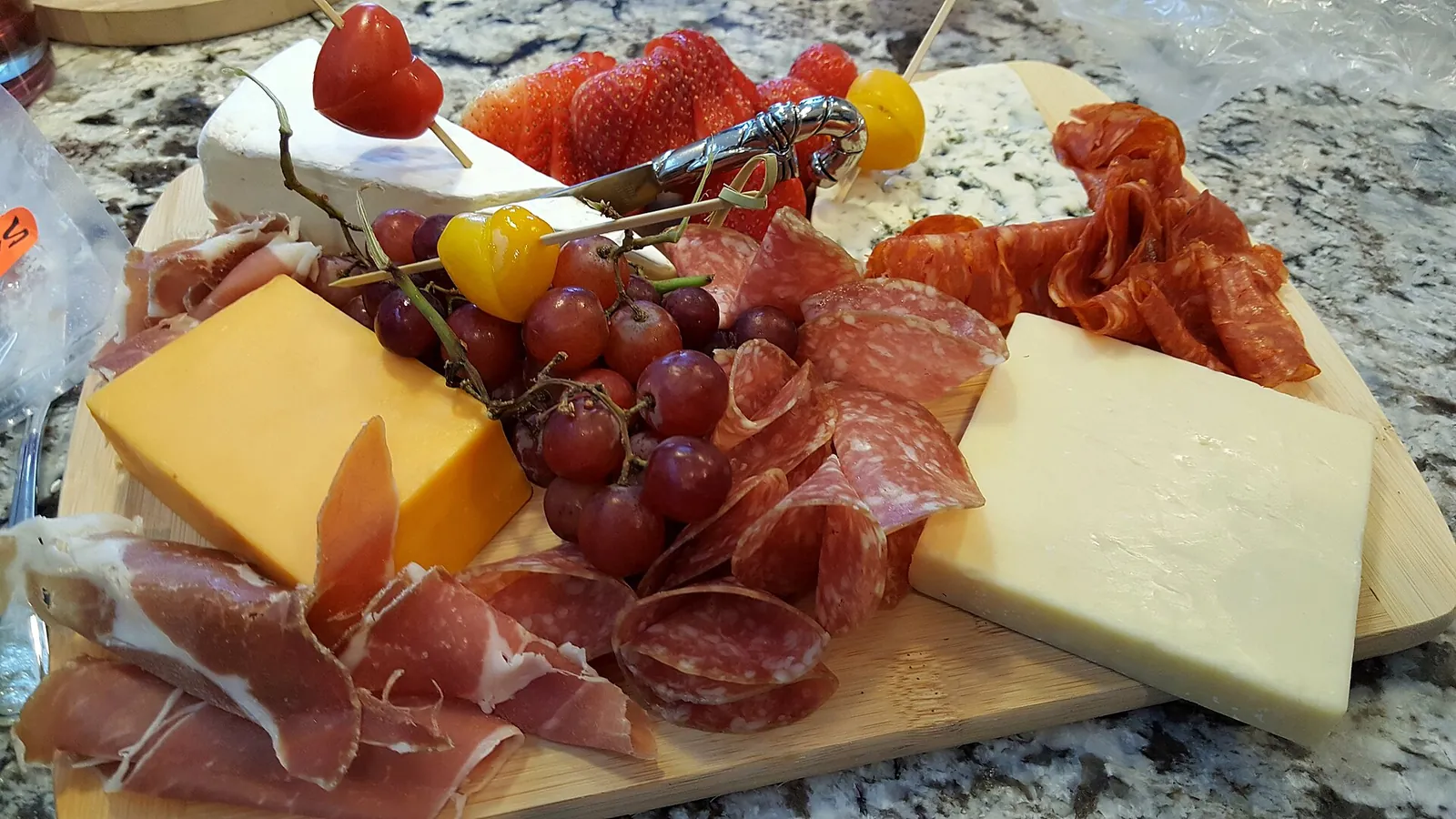
Three of those roles make a good small board. All four, or five cheeses with a second firm one, suit a crowd.
The idea behind the formula is contrast. Cured meats are salty, fatty and chewy, so the cheeses should bring what the meat lacks: cream, crunch, tang and a little sweetness. Four similar semi-hard cheeses taste like one long bite, while a board that runs from spoonable to crystalline keeps people reaching back in. If you are new to boards, cheese and charcuterie for beginners covers the whole spread.
Charcuterie cheeses at a glance
This table pairs each charcuterie cheese with its role, the meats it suits and the easiest way to cut it.
| Cheese | Role | What it brings | Meats it suits | How to cut it |
|---|---|---|---|---|
| Brie or Camembert | Soft | Buttery, mild cream | Prosciutto, cooked ham | Small whole wheel or wedge, own knife |
| Fresh goat cheese | Soft | Bright tang that cuts fat | Salami, chorizo | Log cut into thick coins |
| Manchego | Firm, aged | Tangy, buttery sheep's milk | Jamón serrano, chorizo | Thin triangles, rind off |
| Aged Gouda | Firm, aged | Caramel notes, crunchy crystals | Soppressata, smoked sausage | Broken shards |
| Parmigiano-Reggiano | Hard, aged | Deep savory flavor | Prosciutto di Parma, mortadella | Rough chunks |
| Gruyère | Firm, aged | Refined young, fruity older | Ham, French saucisson | Thin batons |
| Gorgonzola dolce | Blue | Creamy with a sharp edge | Bresaola, speck | Spoon or small knife |
| Sharp cheddar | Crowd-pleaser | Familiar tang | Salami, pepperoni | Planks or cubes |
| Havarti | Crowd-pleaser | Mild and buttery | Mortadella, ham | Slices |
The four-cheese charcuterie formula
The four-cheese charcuterie formula works because each role covers a different texture and strength. The soft cheese gives cream to spread on bread, the aged cheese gives crunch and depth, the blue gives one sharp, salty accent, and the crowd-pleaser makes sure nobody goes hungry. Mixing milks helps too: Manchego is sheep's milk and chèvre is goat's milk, so a board with both plus brie tastes noticeably varied. If you see the "3-3-3 rule" online, read it as three cheeses, three meats and three things to eat them with, a sensible floor for a small board. Taste and arrange from mild to strong, so the blue never comes first.
The best soft cheeses for charcuterie
The best soft cheeses for charcuterie are creamy enough to spread and mild enough to sit beside salty meat.
Brie or Camembert
Brie or Camembert is the default soft cheese for a charcuterie board: buttery, mild and soft enough to spread at room temperature, since USDA data put brie at about 48 percent water and Camembert at 52. Buy a small whole wheel rather than a cut wedge so the paste stays put, and give it its own knife. It suits the most delicate meats, prosciutto and cooked ham. Weak spot: a very ripe wheel flows across the board, so choose one that is still slightly firm.
Fresh goat cheese
Fresh goat cheese brings tang, and acid is what cuts through the fat of salami and chorizo. Soft goat cheese holds about 61 percent water in USDA data, so it stays creamy without collapsing. Buy a plain log, slice thick coins with a hot knife or unflavored dental floss, or roll the log in chopped herbs or pistachios. Weak spot: some guests dislike the goaty note, and a drizzle of honey softens it.
The best hard cheeses for charcuterie
The best hard cheeses for charcuterie give the board crunch and depth, and they are the easiest cheeses to cut ahead.
Manchego
Manchego is the classic firm cheese for a Spanish-style board, made only from the milk of Manchega sheep and matured at least 30 days for small pasteurized cheeses and 60 days for the rest, according to the Manchego PDO council. Serve it with jamón serrano, chorizo, Marcona almonds and quince paste, and see the Manchego guide for aging stages. Cut thin triangles from the wedge. Weak spot: the rind may carry a coating, so trim it off before serving.
Aged Gouda
Aged Gouda turns hard, tangy and crystalline, with sweeter, nuttier caramel notes and a slightly crunchy texture, according to Wisconsin Cheese. That crunch is the point on a board, against soft meats like soppressata or smoked sausage. Look for a Gouda aged a year or more, since young Gouda is mild and creamy. Weak spot: it resists neat slicing, so break it into shards with the tip of a sturdy knife.
Parmigiano-Reggiano
Parmigiano-Reggiano belongs on a board in rough chunks, not slices. The consortium that protects it uses short almond-shaped knives to split wheels, and the same tool breaks a wedge into bite-size pieces with natural, craggy edges; its guide also notes that wheels aged 12 to 18 months are moister than older ones. Pair it with prosciutto di Parma or mortadella and a drizzle of aged balsamic. Weak spot: salt, at about 333 mg of sodium per ounce for hard Parmesan in USDA data.
Gruyère
Gruyère is the alpine choice, and the Swiss Gruyère AOP makers sell two main ages: Classic, matured 6 to 9 months for a soft, refined taste, and Réserve, matured more than 10 months for a fuller, fruity flavor and a firmer, slightly crumbly texture. Classic is the better slicer and the safer crowd choice. Cut it into thin batons for ham or French saucisson. Weak spot: Réserve crumbles if you slice it thin, so cut it in chunks.
Blue and bold cheeses for charcuterie
Blue and bold cheeses for charcuterie are the board's exclamation point, so one is plenty. For an adventurous crowd, a washed rind such as Taleggio can take the bold slot; the guide to the smelliest cheeses lists the options.
Gorgonzola dolce
Gorgonzola dolce is the easiest blue for a mixed crowd: the younger of Gorgonzola's two official styles, it is soft and creamy with a slightly spicy edge, while piccante is firmer, crumblier and stronger, says the Gorgonzola consortium. Take it out about half an hour before serving, set it in a small dish with its own spoon, and put honey, pears or walnuts next to it; air-dried beef such as bresaola is a good meat match. The Gorgonzola guide compares the two styles. Weak spot: salt, at about 325 mg of sodium per ounce for blue cheese in USDA data.
Crowd-pleasing cheeses for charcuterie
Crowd-pleasing cheeses for charcuterie are the ones guests recognize and finish first, so buy a little extra.
Sharp cheddar
Sharp cheddar is the cheese most guests reach for, and its tang stands up to salami and pepperoni better than mild cheddar, which is aged only 3 to 6 months. A white aged cheddar looks more distinct next to orange meats, and the color is cosmetic anyway: orange cheddar is usually tinted with annatto. Cut planks or cubes close to serving time. Weak spot: precut cubes dry out at the edges, so cut them shortly before serving.
Havarti
Havarti is the gentle option for kids and cautious eaters: a semi-soft Danish-style cheese with a sweet, buttery flavor that is very mild when young, and its dill version adds interest without heat. Pair it with mortadella or cooked ham. Weak spot: it softens quickly, so slice it cold and put it out last.
How much cheese per person for charcuterie
How much cheese per person for a charcuterie board depends on whether the board is a snack or the meal. When cured meat shares the board, a good starting point is roughly 2 ounces of cheese per person in total for an appetizer, split across all the cheeses, and about 5 ounces per person when the board is dinner. For an appetizer board for 8 with four cheeses, that comes to about 1 pound of cheese, roughly a quarter pound of each. Use the board builder for exact amounts for any headcount and number of cheeses.
Cutting and arranging charcuterie cheeses
Cutting and arranging charcuterie cheeses well comes down to a few habits. Cut hard and firm cheeses into bite-size pieces ahead of time, but leave soft cheeses whole or in a wedge with their own knife. Give the blue a separate knife or spoon so it does not streak everything else. Place the cheeses first, spaced apart from mild to strong, then fold or ribbon the meats between them and fill gaps with fruit, nuts and crackers. Take the cheeses out about 30 minutes before guests arrive, and count that time toward the 2-hour limit below. The full method, including spacing and labels, is in how to build and arrange a cheese board.
Budget charcuterie cheeses
Budget charcuterie cheeses start with one standout and three workhorses. Spend on a single special cheese, such as a PDO Manchego or a chunk of Parmigiano-Reggiano, and fill out the board with supermarket sharp cheddar, Havarti, a plain goat cheese log and a small brie. Buy whole pieces and cut them yourself rather than paying for precut cubes. More money-saving ideas are in the budget cheese board guide, and for which meat goes with which cheese, see pairing cheese with charcuterie.
What most charcuterie cheese advice gets wrong
Most charcuterie cheese advice stops at the shopping list and skips the details that decide how the board actually eats.
Room temperature has a time limit
Room temperature brings out the flavor of cheese and cured meat, but it has a time limit. University of Nebraska-Lincoln food safety specialists advise keeping cut cheeses and produce out of the fridge no more than 2 hours in total, or 1 hour above 90°F, and replacing dips every two hours. The fix is to build a smaller board, keep a plate of cut refills in the fridge, and top it up as it empties.
Salt stacks up fast
Salt stacks up fast on a board of cured meat, so choose some cheeses for relief rather than more salt. Per ounce, USDA data put hard Parmesan at about 333 mg of sodium and blue cheese at 325, against 178 for brie, 130 for soft goat cheese and just 53 for Swiss. With salty prosciutto and salami, one salty cheese is enough; let the soft cheeses carry the rest.
Not every Manchego is the real thing
Not every Manchego is the real thing, and the label tells you. Genuine Manchego carries a "Denominación de Origen Queso Manchego" label stating it was made entirely from Manchega sheep's milk, a numbered back label, and the woven pattern of esparto molds pressed into the rind. Cheese sold as "Manchego-style" is not the protected product.
Pregnant guests need a different board
Pregnant guests need a different board, not just a warning. The University of Nebraska-Lincoln does not recommend charcuterie boards for pregnant, elderly, very young or immunocompromised guests, and the CDC advises people at higher risk to avoid raw-milk cheese and to eat deli meats only reheated to 165°F or until steaming hot. Its safer cheese list includes hard cheeses made with pasteurized milk, such as cheddar, Parmesan and Swiss or Gruyère.
Questions about charcuterie cheeses
These are the questions about charcuterie cheeses that come up most often, with short answers.
What cheeses go on a charcuterie board?
The cheeses that go on a charcuterie board are usually one soft cheese (brie or goat cheese), one firm aged cheese (Manchego, aged Gouda or Parmigiano-Reggiano), one blue (Gorgonzola dolce) and one familiar crowd-pleaser (sharp cheddar or Havarti).
How many cheeses should be on a charcuterie board?
Three to five cheeses suit most charcuterie boards: three for a small group, four or five for a crowd or when the board is the meal.
What is the 3-3-3 rule for charcuterie boards?
The 3-3-3 rule for charcuterie boards is usually explained as three cheeses, three meats and three accompaniments such as crackers, fruit and nuts.
What is the best hard cheese for a charcuterie board?
The best hard cheese for a charcuterie board is usually Manchego, because it slices cleanly, pleases most guests and pairs with nearly every cured meat; aged Gouda is the pick if you want crunch.
Should you remove the rind on charcuterie cheeses?
Remove the rind on charcuterie cheeses when it is hard, waxed or coated, as on Manchego and Parmigiano-Reggiano, and leave the soft white rind on brie and Camembert, which most people eat with the paste.
How long can a charcuterie board sit out?
A charcuterie board can sit out for no more than 2 hours in total, or 1 hour above 90°F, according to University of Nebraska-Lincoln food safety guidance; refrigerate or discard what is left.
Your charcuterie cheese shopping list
Your charcuterie cheese shopping list for an appetizer board for 8 is simple: a small brie, a wedge of Manchego, a piece of aged Gouda and a Gorgonzola dolce, about a quarter pound of each, plus crackers, fruit and two or three cured meats. Swap the Gorgonzola for sharp cheddar if your crowd is cautious, and use the board builder for any other headcount.
Sources
- Charcuterie Boards and Food Safety, University of Nebraska-Lincoln Extension
- Preventing Listeria Infection, Centers for Disease Control and Prevention
- Manchego cheese and Identification, Consejo Regulador de la Denominación de Origen Queso Manchego
- Our types of Le Gruyère AOP, Interprofession du Gruyère
- The Gorgonzola, Consorzio per la Tutela del Formaggio Gorgonzola
- Product guide: cutting and storage, Consorzio del Formaggio Parmigiano Reggiano
- Wisconsin Cheese style guides: Gouda, Havarti and Mild cheddar, Dairy Farmers of Wisconsin
- USDA FoodData Central (SR Legacy): brie, camembert, goat cheese, soft, parmesan, hard, blue and swiss, U.S. Department of Agriculture