
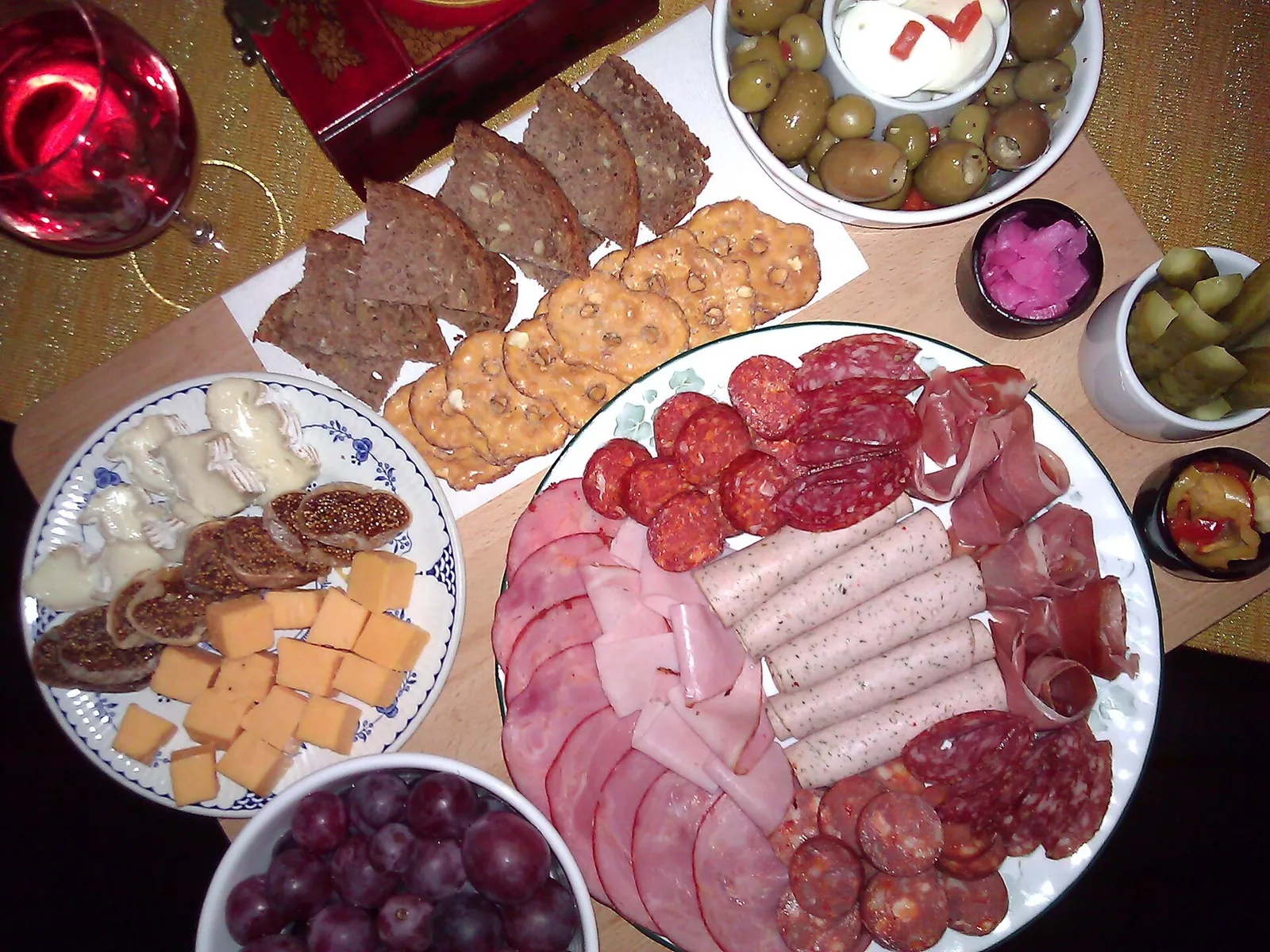
Nothing gets cooked. The skill is in choosing contrasts and buying the right amount.
Charcuterie itself means prepared meats, mostly cured, smoked or cooked ones such as prosciutto, salami and pâté. Most people say "charcuterie board" for any board that has them, and nearly every one also has cheese. This page is the build, in order. For which cheeses to buy, see the best cheeses for a charcuterie board; this page does not repeat those picks.
Charcuterie for beginners at a glance
This charcuterie for beginners table shows the amounts, number of items and time for a first board at three sizes.
| 4 people | 8 people | 12 people | |
|---|---|---|---|
| Cured meat, appetizer (about 2 oz each) | 8 oz | 1 lb | 1.5 lb |
| Cheese, appetizer (about 2 oz each) | 8 oz | 1 lb | 1.5 lb |
| Meats | 2 | 3 | 3 or 4 |
| Cheeses | 3 | 3 or 4 | 4 |
| Crackers or sliced baguette | 1 box or 1 small loaf | 1 box plus half a baguette | 2 boxes or 1 large loaf |
| Time to build | 15 minutes | 20 minutes | 30 minutes |
For dinner, roughly double the meat and cheese, to about 4 ounces of meat and 5 ounces of cheese a person.
Step 1: choose the cured meats for your charcuterie board
Choosing the cured meats for a charcuterie board starts with three textures. Take one thin and silky, such as prosciutto or another dry-cured ham, one firm sliced sausage, such as a plain salami, and one with a kick, such as soppressata or a sliced chorizo. Two meats is enough for a small board, and a spreadable one such as a coarse pâté can be the third.
Buy the meats sliced thin by the deli, or ask for them cut at the counter. Packaged slices work fine and are the cheapest route. Whole sticks of salami are cheaper per ounce but need a sharp knife and a minute of peeling, so they suit confident cooks. Prosciutto tears when it is cold and stacked, so lay the slices apart on a plate in the fridge until the last minute.
Step 2: add cheese to the charcuterie board
Adding cheese to the charcuterie board is a matter of balance, because cured meat is already salty and fatty. A simple beginner set is one soft cheese, one firm aged cheese and one familiar cheese everybody eats, plus a fourth that is blue or bold if the crowd is adventurous. Use the cheese-roles guide from the intro for specific names, and the board builder for exact amounts at any headcount.
Choose cheeses that taste different from the meats, not louder versions of them. If both salami and a salty hard cheese are on the board, add a creamy cheese so there is somewhere to rest the palate.
Step 3: pick the accompaniments for a charcuterie board
Accompaniments for a charcuterie board fill four jobs, and one item per job is plenty for a first board. Something sweet (fig jam, honey or grapes), something briny (cornichons or olives), something crunchy (crackers, sliced baguette or almonds) and something fresh (apple or pear slices). Those four cut through the fat and give every bite a different shape.
Buy crackers in two styles, one plain and one with seeds or grain, so the flavors do not compete with the cheese. The cheese and crackers guide goes deeper on matching them, and cheese and honey shows what to drizzle on what. Put wet items such as olives and jam in small bowls so they do not soak the crackers.
Step 4: slice and prep everything for the charcuterie board
Slicing and prepping for the charcuterie board is the part to do ahead, because once guests arrive nothing should need a knife except the soft cheese. Cut hard and firm cheeses into thin triangles, slabs or small cubes, and leave soft cheeses whole with their own knife. Wash and dry the fruit. Slice the baguette. Drain olives and pickles on a paper towel.
Take the cheeses out of the fridge 30 minutes before serving, since cold cheese tastes muted. The room temperature guide explains how long each style needs. That time counts toward the 2-hour limit below.
Step 5: arrange the charcuterie board in order
Arranging the charcuterie board goes faster in a fixed order, and the order keeps the board from looking crowded. Use a board, a tray or a large plate.
- Set out the small bowls first (jam, olives, pickles), spaced apart, one near each corner and one near the middle.
- Place the cheeses next, with their knives, spread across the board rather than clustered, mild to strong in the direction people will reach.
- Fold the salami slices in half twice, or fan them in a curve, and ribbon the prosciutto loosely so it can be lifted.
- Pile the crackers and bread in two or three spots near the cheeses, not in one long row.
- Fill the gaps with fruit and nuts, then add a sprig of rosemary or a handful of herbs if you like color.
For more layouts, see how to build and arrange a cheese board.
Charcuterie for beginners: mistakes that cost the most
The mistakes that cost beginners most are small ones. Buying too much meat is the usual one, since meat is the most expensive item and the first to be left over. Using five similar salamis is the second: the board reads as one flavor. Forgetting a knife for each cheese is the third, and it turns the blue cheese into a smear across the brie.
A fourth is leaving the board out all evening. The University of Nebraska-Lincoln food safety guidance says cut cheeses should not sit at room temperature for more than 2 hours total, or 1 hour when it is above 90°F, and recommends a refrigerated supply of sliced meats and cheeses to restock from. The easy fix is to build a smaller board and refill it from the fridge. Whatever was out for the full 2 hours goes in the trash; what stayed in the fridge follows the USDA leftovers rule of 3 to 4 days for cooked items, and the leftover cheese guide covers the cheese.
Serving your first charcuterie board safely
Serving a charcuterie board safely mostly means clean utensils and a clock. The same guidance recommends separate serving utensils for each dish, and replacing dips and condiments at least every two hours. It does not recommend this style of board for pregnant, elderly, very young or immunocompromised guests. If one is coming, add a hot dish or a plate of pasteurized hard cheeses for them.
Pairing drinks with your charcuterie board
Pairing drinks with a charcuterie board is simple when you pick one style that handles salt and fat. A dry sparkling wine, a light red or a crisp lager all work. The wine and cheese beginner's guide and the pairing cheese with charcuterie page show which meat goes with which cheese and glass.
Questions about charcuterie for beginners
These questions about charcuterie for beginners come up most when people build a first board.
How much meat for a charcuterie board?
Meat for a charcuterie board runs about 2 ounces per person as an appetizer and about 4 ounces per person when the board is dinner. For 8 appetizer guests that is about a pound, split across two or three meats.
How many meats should a beginner charcuterie board have?
A beginner charcuterie board needs two or three meats in different styles, such as a silky ham, a firm salami and one spiced sausage. More than four is hard to arrange and expensive.
Can a charcuterie board be made ahead of time?
A charcuterie board can be prepped a charcuterie board ahead, but build it close to serving. Slice cheeses and wash fruit a day early, store them covered in the fridge, and assemble in the 30 minutes before guests arrive so crackers stay crisp and meat does not dry out.
What goes on a charcuterie board besides meat and cheese?
On a charcuterie board besides meat and cheese, add something sweet, something briny, something crunchy and something fresh: for example jam, cornichons, crackers and apple slices.
Is a special board needed for charcuterie?
A special board is not needed for charcuterie, since any large wooden board, tray or sheet pan lined with parchment works. Pick one big enough to leave small gaps between items.
Your first charcuterie board, start to finish
For a first charcuterie board, buy two meats, three cheeses, a jar of jam, a jar of pickles, one fruit and two kinds of crackers, prep them that afternoon, and build in the last 20 minutes. Next, learn how the cheeses behave in the cheese-roles guide, or plan a cheese-only spread with the cheese board guide.
Sources
- Charcuterie Boards and Food Safety, University of Nebraska-Lincoln Extension
- Leftovers and Food Safety, USDA Food Safety and Inspection Service
- Cold Food Storage Chart, FoodSafety.gov (USDA, FDA and CDC)