
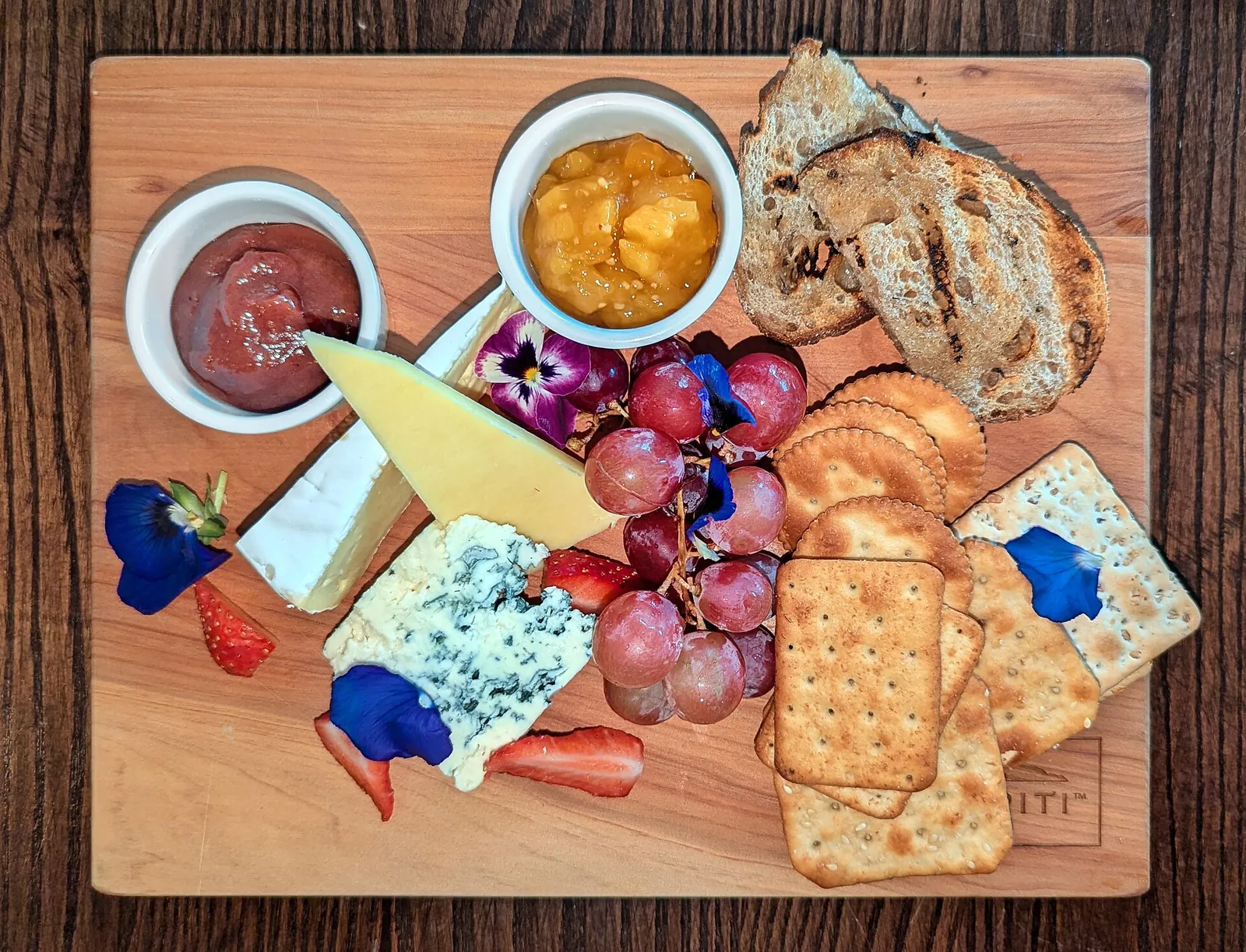
Everything else (crackers, fruit, honey) is supporting cast.
This page is the cheese-only version. If cured meat is on the board, the beginner charcuterie guide covers meats and assembly, and the best cheeses for a charcuterie board page has specific picks. Here the focus is how many cheeses, how much of each, in what order, and what goes beside them.
Cheese board amounts at a glance
This cheese board table shows total cheese by headcount and the usual number of cheeses, at the two serving sizes the board builder uses.
| Guests | Appetizer (about 2 oz each) | Main event (about 5 oz each) | Cheeses |
|---|---|---|---|
| 4 | 8 oz | 1 lb 4 oz | 3 |
| 8 | 1 lb | 2 lb 8 oz | 4 |
| 12 | 1 lb 8 oz | 3 lb 12 oz | 4 or 5 |
| 20 | 2 lb 8 oz | 6 lb 4 oz | 5 |
Those figures are totals across all the cheeses, not per cheese. They sit inside the usual guidance of about 1 to 2 ounces per person when cheese is a nibble and about 4 to 6 ounces when it is dinner, which the cheese per person guide breaks down.
How many cheeses go on a cheese board
The number of cheeses on a cheese board should rise with the crowd, but slowly. Three cheeses is a full board for four to six people, four suits eight to twelve, and five is the ceiling for most home boards. More than five and each cheese shrinks to a sliver, guests lose track of what they are eating, and the budget climbs without making the board better.
Choose by contrast rather than by name. A reliable mix is one soft or spreadable cheese, one firm aged cheese, and one that is different in a way you can taste: blue, goat's or sheep's milk, or a washed rind. A fourth can be the cheese everybody already likes. When two cheeses are the same milk and the same texture, drop one. For a lower-cost version of this, see the budget cheese board guide.
How much of each cheese for a cheese board
How much of each cheese for a cheese board follows from the total. Divide the total by the number of cheeses, then shift a little weight toward the mild, familiar ones, since those go first. For an appetizer board for 8 with four cheeses, that is a pound in all, about 4 ounces each, with 5 ounces of the crowd-pleaser and 3 ounces of the blue.
Buy wedges, not cubes. A 4 ounce wedge keeps better and looks better than the same weight in precut pieces, and you control the thickness. If a cheese is sold in a fixed size (a small round of brie, a goat log), buy the nearest size up rather than splitting hairs.
Cheese board order from mild to strong
Cheese board order from mild to strong matters because a strong cheese early flattens everything after it. Arrange the board so the mildest cheese is at the starting point, such as the left side for right-handed guests, and the blue or washed rind is last. Taste in that order too: fresh and soft, then creamy bloomy rinds, then firm and aged, then blue.
Cut the cheeses so they invite eating. Slice a few pieces from the hard wedges, leave the soft ones whole, and give every cheese its own knife so flavors and molds stay where they belong. A small paper label for each, with the name and milk, saves a lot of questions.
What goes with a cheese board
What goes with a cheese board comes in four jobs: sweet, crunchy, fresh and briny. One item per job is enough: honey or a jam for sweet, plain crackers or sliced baguette for crunch, grapes or pear slices for fresh, and a few olives or cornichons for salt. The detail is in cheese and crackers, cheese and honey and the nuts and jam pairing pages.
For drinks, a dry sparkling wine or a light white works with the widest range, and the wine and cheese pairing guide covers the rest. Water and a non-alcoholic option should be on the table too.
How to set up a cheese board step by step
How to set up a cheese board is a short routine, and a worked example is below for 8 people at an appetizer party.
- Buy 1 pound of cheese in four pieces, a day or two ahead, and keep them in their wrapping in the fridge.
- Thirty minutes before guests arrive, unwrap the cheeses and let them rest on the board or counter.
- Place the cheeses first, spaced evenly, with a knife by each, mild to strong.
- Cut a few slices or shards from the hard cheeses so guests have a way in.
- Set honey or jam in a small bowl, then add crackers and bread in two piles.
- Fill gaps with fruit and nuts, and add labels.
The arrange a cheese board guide has more layouts,.
Cheese board mistakes that cost you flavor
Cheese board mistakes mostly come from timing and storage. Serving cheese straight from the fridge mutes it, and serving it too long is a safety issue. The University of Nebraska-Lincoln advises that cut cheeses should not stay at room temperature for more than 2 hours total, or 1 hour above 90°F, and suggests keeping a refrigerated supply to refill from. So put out half the cheese and bring out the rest later.
Other common mistakes are one knife for the whole board, five cheeses that are all semi-soft cow's milk, and crackers so flavored that they cover the cheese. And for pregnant, elderly, very young or immunocompromised guests, the same source does not recommend this style of board, so include a pasteurized hard cheese on a separate plate.
Questions about the cheese board
These questions about the cheese board come up most often from first-time hosts.
How many cheeses should be on a cheese board?
Three to five cheeses should be on a cheese board: three for four to six guests, four for eight to twelve, and five for larger crowds.
How much cheese per person for a cheese board?
Cheese per person for a cheese board is about 2 ounces as an appetizer and about 5 ounces when the board is the main event, which matches the board builder.
What order do you eat cheese on a cheese board?
The order to eat cheese on a cheese board is mild to strong: fresh and soft, then bloomy rind, then firm aged, then blue or washed rind.
Should a cheese board include crackers and fruit?
A cheese board should include crackers and fruit, plus one sweet item such as honey and one briny item such as olives, so the cheeses have something to ride on and something to contrast.
How far ahead can a cheese board be made?
A cheese board can be prepped a day ahead but assembled 30 minutes before serving. Keep cut cheese and fruit in the fridge until then; USDA FoodKeeper data give opened hard cheese 3 to 4 weeks in the fridge, so buying early is safe.
Plan your cheese board
For your cheese board, pick three to five cheeses by contrast, buy 2 ounces per guest, set them out mild to strong, and add one item each for sweet, crunchy and fresh. Run your headcount through the builder for the exact weights, and read the leftover cheese guide for what to do with what remains. The USDA says to refrigerate leftovers within 2 hours, so pack the board away early.
Sources
- Charcuterie Boards and Food Safety, University of Nebraska-Lincoln Extension
- FoodKeeper App, FoodSafety.gov (USDA)
- Leftovers and Food Safety, USDA Food Safety and Inspection Service