
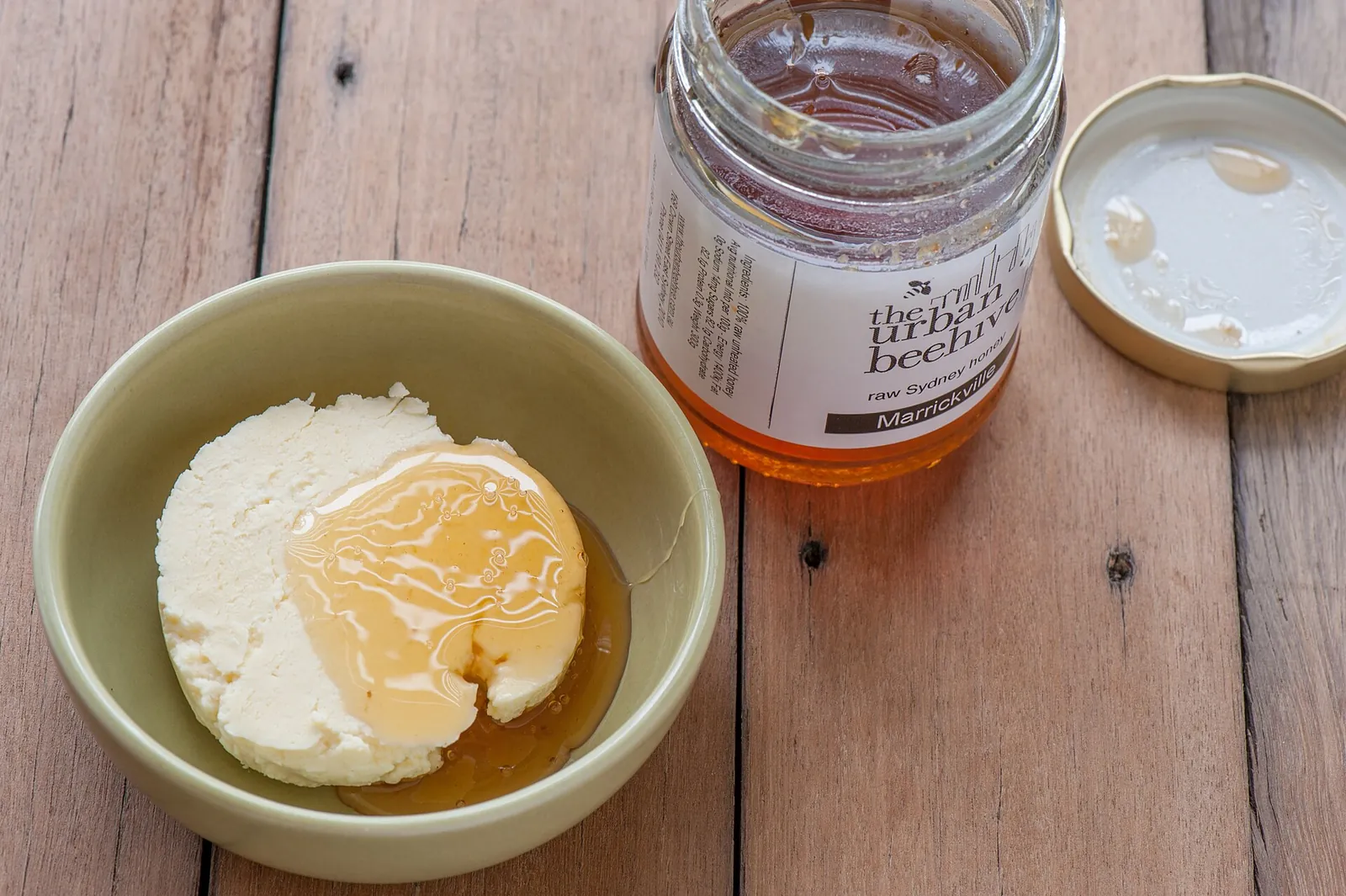
If you buy only one jar, make it a light, runny honey, because it flatters the most cheeses and never buries them.
The pairing works on contrast. Cheese brings salt, acid and the funk of mold and age; honey, about 82 percent sugars by weight in USDA data, brings sweetness and floral aroma. A little sugar takes the edge off salt and sourness without hiding the cheese, so a strong blue tastes rounder and a mild cheese tastes richer. Choosing the honey is mostly a matter of color: lighter honeys taste milder and darker honeys stronger, as the National Honey Board puts it.
Cheese and honey pairings at a glance
This cheese and honey pairings table runs from the saltiest cheeses, which want the boldest honeys, to the mildest, with sodium per ounce from USDA.
| Cheese | Sodium per ounce | Honey to try | Why it works | How to serve |
|---|---|---|---|---|
| Roquefort and other strong blues | 513 mg (Roquefort) | Chestnut or buckwheat | A bitter, dark honey stands up to salt and mold | A spoonful over the wedge, walnuts alongside |
| Gorgonzola and milder blues | 325 mg (blue cheese) | Chestnut, or acacia for dolce | Sweetness softens the salty bite | Drizzle at the table |
| Aged Pecorino or Romano | 406 mg | Chestnut | Bitter-sweet honey against sharp sheep's milk | Thin shards, honey on the side |
| Parmesan or Parmigiano-Reggiano | 333 mg (hard Parmesan) | Acacia or chestnut | Light honey keeps the cheese in front | Rough chunks, a few drops each |
| Aged Gouda or aged cheddar | 232 mg (Gouda), 183 mg (sharp cheddar) | Buckwheat | Molasses notes stand up to an aged cheese | Cubes with a dish of honey for dipping |
| Brie or Camembert | 178 mg (brie) | Orange blossom, clover or honeycomb | Floral honey lifts a buttery paste | At room temperature or baked |
| Fresh goat cheese | 130 mg | Acacia or orange blossom | Sweet against bright tang | Drizzled over a log with black pepper |
| Fresh ricotta | 31 mg | Acacia or chestnut | Turns a mild cheese into dessert | In a bowl with lemon zest and pistachios |
Best honey for blue cheese
The best honey for blue cheese is a dark, bold one, because blue cheese pairs heavy salt with the funk of its mold. Chestnut honey has the right build: in the EU's official description of Lunigiana chestnut honey, it is dark amber, often reddish, with a fairly strong, sharp smell and a long-lasting taste with some bitterness. That bitterness keeps the pairing from turning cloying against Roquefort. Buckwheat honey, a US varietal the National Honey Board describes as dark with marked molasses and malt flavors, does the same job.
Creamy blues are the exception. A young, soft Gorgonzola dolce is mild enough for acacia or clover honey, and the sweetness reads like cream. Add walnuts or pear slices to either version; the blue cheese pairing guide has more.
Honey with aged hard cheeses
Honey with aged hard cheeses works because these cheeses are salty, dry and savory, and honey adds the moisture and sweetness they lack. Aged Pecorino and chestnut honey make a bold, bitter-sweet match. For Parmigiano-Reggiano, a few drops of mild acacia honey keep the savory chunks in front, while chestnut makes a darker after-dinner plate. Aged Gouda and aged cheddar can stand up to buckwheat honey's molasses notes. Manchego takes either a mild honey or the classic quince paste.
Honey with fresh goat cheese and ricotta
Honey with fresh goat cheese is the gentlest pairing on this page and the best place to start. Fresh chèvre is tangy and only lightly salted, so a pale, mild honey balances it without a fight: acacia, clover or orange blossom, the honey the National Honey Board specifically recommends with goat cheese, brie and Camembert. Crack black pepper or scatter thyme over the honey to keep it savory. Fresh ricotta, at 31 mg of sodium per ounce, has almost no salt to balance, so honey turns it into a dessert; add lemon zest and chopped pistachios. The goat cheese pairing guide covers wine and fruit.
Honey with brie
Honey with brie works best with a floral or fruity honey that lifts the buttery paste, such as orange blossom, which the National Honey Board describes as white to extra light amber, with a pronounced orange aroma and a sweet, fruity taste. Serve brie at room temperature with honeycomb, or bake it: a round topped with honey and walnuts is the classic, and there are more baked brie toppings to try.
Honey types for cheese
The honey types for cheese below are the ones worth seeking out. Under FDA guidance, a flower name on the label, such as "orange blossom" or "clover," means that plant should be the honey's chief floral source.
Acacia honey
Acacia honey is the gentlest of these honeys and the safest all-rounder with cheese. EU rules define it as honey from Robinia pseudoacacia, the black locust tree, and describe it as very light, from almost colorless to straw-yellow, decidedly sweet, slightly acidic but not bitter, with a very delicate flavor, often a note of vanilla and no aftertaste. It also stays clear and liquid for a long time, which makes it the easiest honey to drizzle.
Chestnut honey
Chestnut honey is the bitter one: dark amber, long-lasting and, in the EU's words, with some bitterness. Use it sparingly with blue cheese, aged Pecorino and ricotta, where its bitterness reads as a feature.
Buckwheat honey
Buckwheat honey is dark and malty, with marked molasses flavors and a lingering aftertaste, and the National Honey Board notes that it pairs well with strong cheeses. Its color and flavor vary by region, so taste before you pour.
Clover and orange blossom honey
Clover and orange blossom honey are the easy-to-find mild choices. Clover is sweet and flowery with a mild taste; orange blossom is fruitier, with a clear orange aroma. Either suits fresh, soft and creamy cheeses.
Honeycomb
Honeycomb is honey still sealed in its wax cells, and the comb is edible, the National Honey Board confirms. A slab on the board looks dramatic and gives each bite a chewy, waxy texture. Cut it into squares with a hot knife and set it on a plate, since it leaks.
Hot honey
Hot honey, honey spiked with chili, is best with cheeses that can take heat and sweetness at once: aged cheddar, pepperoni pizza with fresh mozzarella, fried halloumi or burrata. Keep it away from delicate fresh goat cheese, where the chili drowns the tang.
How to serve honey with cheese
How to serve honey with cheese comes down to a few habits. Plan about a teaspoon of honey per ounce of cheese; for an appetizer board for 8 at roughly 2 ounces of cheese each, that is about 1/3 cup of honey. Serve it in a small bowl with a dipper or spoon so guests can choose, and drizzle only the cheese that wants it. Give the blue cheese its own honey spoon, so blue crumbs stay out of the shared bowl. Take the cheese out about 30 minutes before serving. The board builder works out cheese amounts for any headcount, and how to build and arrange a cheese board covers layout.
What most cheese and honey advice gets wrong
Most cheese and honey advice stops at "honey goes with blue cheese" and misses the details that change what you buy.
Acacia honey does not come from acacia
Acacia honey does not come from acacia trees. The EU's official text defines it as honey from Robinia pseudoacacia, which the USDA PLANTS database lists as black locust, a tree native to the lower 48 states and also called falsa acacia. A jar of European acacia honey and a jar of American black locust honey can come from the same tree.
Crystallized honey is not spoiled
Crystallized honey is not spoiled honey. Crystallization is glucose coming out of solution, the National Honey Board explains, and different honeys do it at different rates. Set the jar in warm water and stir until the crystals dissolve, without boiling or scorching it, or simply spread the crystallized honey on bread with the cheese.
"Honey for cheese" is a pairing, not a type
"Honey for cheese" on a jar is a pairing suggestion, not a type of honey. What protects you is federal labeling: under FDA guidance, a product sold simply as "honey" must be only honey, and a mix with sugar or corn syrup must be labeled as a blend. "Raw," by contrast, has no official federal definition, the National Honey Board notes.
Keep honey off the baby's plate
Keep honey off any plate for a baby. Honey can carry Clostridium botulinum spores, and MedlinePlus advises that it should not be fed to infants under 1 year old. Older children and adults are not normally affected, the National Honey Board notes, so on a family board just set the honey out of reach of the smallest hands.
Questions about cheese and honey
These questions about cheese and honey come up most often.
What is cheese honey?
"Cheese honey" is not a separate kind of honey; the name covers whatever honey a seller picks for cheese boards. Read the floral source on the label to know what you are getting.
Which cheese is best with honey?
The cheese that is best with honey is usually blue cheese, because it combines salt with strong funk for sweetness to balance. Aged Pecorino, fresh goat cheese, ricotta and brie are close behind.
What is the best honey for a charcuterie board?
The best honey for a charcuterie board is one light, runny honey such as acacia or clover, plus one dark honey such as chestnut or buckwheat if there is a blue cheese. Honeycomb is the showy extra.
What cheese do you put hot honey on?
Put hot honey on cheeses that can handle both heat and sweetness, such as aged cheddar, fried halloumi, burrata and pizza with fresh mozzarella.
Is cheese with honey healthy?
Cheese with honey adds sugar to a salty, fatty food, so portion is what matters. A tablespoon of honey, 21 grams, has about 64 calories and 17 grams of sugars in USDA data, and a teaspoon is a third of that.
Can you eat honeycomb wax?
You can eat honeycomb wax: the National Honey Board confirms that comb honey is edible. Chew it with the cheese, or spit out the wax once the honey is gone if you prefer.
Your first cheese and honey plate
For your first cheese and honey plate, buy a wedge of Gorgonzola, a log of fresh goat cheese and a piece of aged Pecorino, plus a jar of acacia or clover honey and a small jar of chestnut or buckwheat. Taste each cheese plain, then with each honey, and you will know your own rules after one plate.
Sources
- National Honey Board: Honey varietals, Forms of honey and FAQ, National Honey Board
- 'Miele della Lunigiana', communication of approval of a standard amendment (C/2026/2419), Official Journal of the European Union
- Proper Labeling of Honey and Honey Products: Guidance for Industry, U.S. Food and Drug Administration
- USDA FoodData Central (SR Legacy): honey, blue, Roquefort, romano, parmesan, hard, gouda, sharp cheddar, brie, goat, soft and ricotta, whole milk, U.S. Department of Agriculture
- Infant botulism, MedlinePlus, U.S. National Library of Medicine
- Robinia pseudoacacia L., black locust, USDA PLANTS Database, Natural Resources Conservation Service