
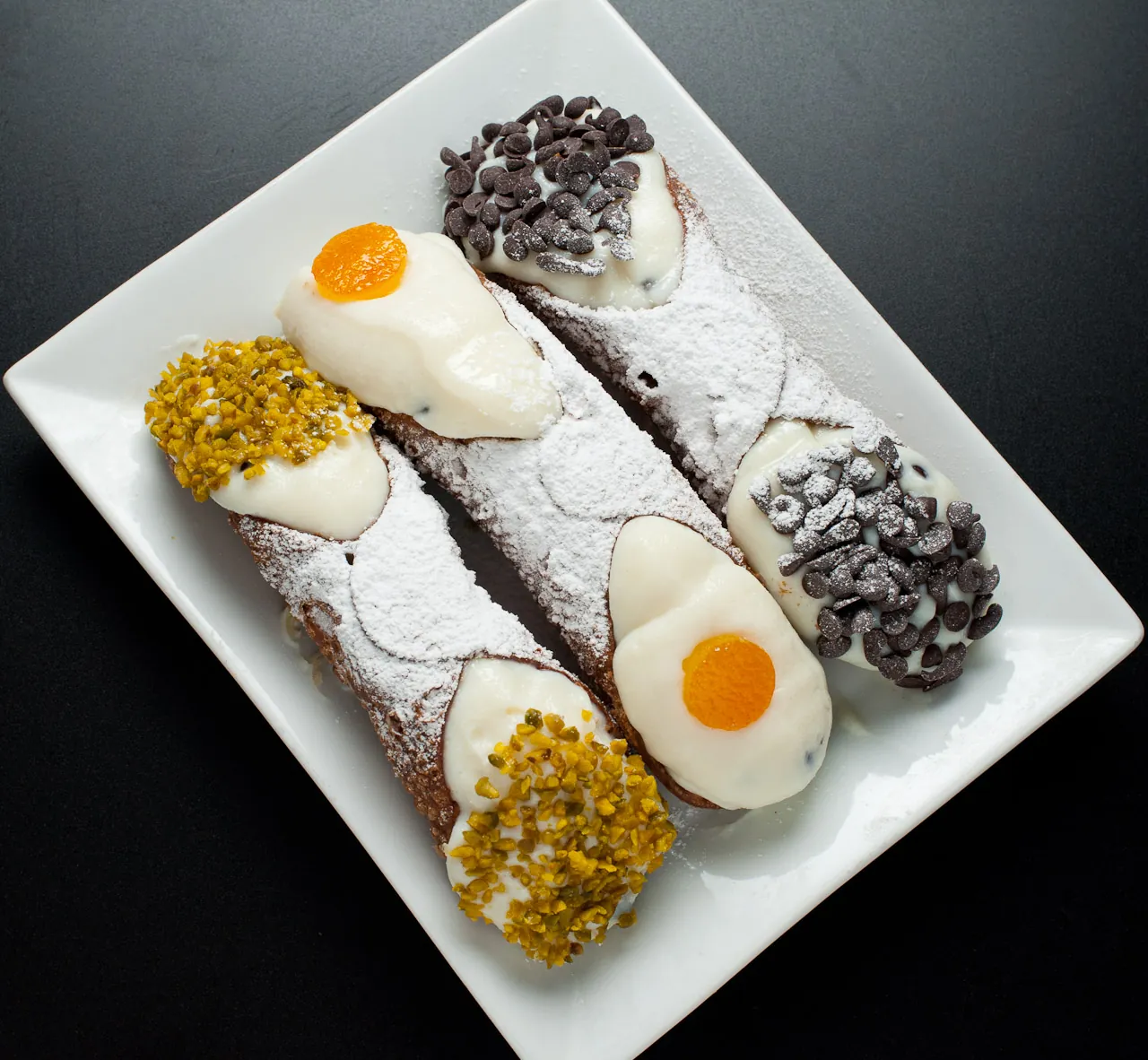
The filling is the soul of the dessert and the shell is the hard part. You need well-drained ricotta so the cream holds, thin dough so the shell shatters, and the discipline to fill them just before you eat them.
Cannoli at a glance
This cannoli table gives the quick numbers for a batch of 12.
| Yield | 12 cannoli |
| Active time | 1 hour, plus 1 hour to rest the dough and 4 to 12 hours to drain the ricotta |
| Frying time | About 20 minutes in 350°F (175°C) oil |
| Best cheese | Whole-milk ricotta, drained, with confectioners' sugar |
| Make ahead | Shells keep 2 days in an airtight tin; fill just before serving |
Where cannoli come from
Where cannoli come from is a Sicilian question, and the origin stories are partly legend. Wikipedia's account says some food historians trace them to Caltanissetta between 827 and 1091, under Arab rule, and that the name may come from the Arabic qanawat, meaning tubes, or from the Latin canneolus, a reed joint of the kind used to roll the dough. It also notes a tradition that they were a Carnival treat in the Palermo and Messina areas. Treat these as claims, not settled history.
Regional finishes differ: Palermo versions are decorated with candied orange zest and Catania versions with chopped pistachios, per the same account.
How to make cannoli
This cannoli recipe makes the shells and the filling from scratch and needs metal cannoli tubes about 1 inch (2.5 cm) wide, available at kitchen stores, or short pieces of clean wooden dowel.
Ingredients for cannoli
The cannoli list below is split into shell, filling and finish, and the ricotta should be drained a day ahead.
- Shell: 2 cups (250 g) all-purpose flour, plus more for rolling
- Shell: 2 tablespoons granulated sugar
- Shell: 1/2 teaspoon ground cinnamon
- Shell: 1/4 teaspoon salt
- Shell: 2 tablespoons (28 g) cold butter or lard
- Shell: 1 large egg
- Shell: about 1/2 cup (120 ml) dry Marsala or dry white wine
- Shell: 1 egg white, lightly beaten, for sealing
- Shell: neutral oil for frying, about 1 1/2 quarts (1.4 L)
- Filling: 2 cups (500 g) whole-milk ricotta, drained
- Filling: 3/4 cup (85 g) confectioners' sugar, plus more for dusting
- Filling: 1 teaspoon vanilla extract
- Filling: zest of 1 orange
- Filling: 1/3 cup (55 g) mini chocolate chips
- Finish: 1/4 cup (30 g) chopped pistachios
Steps for making cannoli
These steps for making cannoli run from draining through filling, and the order matters because the shells must be cold and dry when the cream goes in.
- Line a sieve with cheesecloth, spoon in the ricotta, set it over a bowl and refrigerate 4 to 12 hours, until the cheese is firm and the bowl has collected the whey.
- Whisk the flour, sugar, cinnamon and salt in a bowl, rub in the butter until the mix looks like coarse sand, then stir in the egg and enough Marsala to make a stiff dough that holds together.
- Knead the dough on a floured board for 2 minutes until smooth, wrap it, and rest it 1 hour at room temperature so the gluten relaxes.
- Roll the dough as thin as you can, about 1/16 inch (1.5 mm), cut 4 inch (10 cm) circles, wrap each loosely around a tube, and seal the overlapping edge with a dab of egg white, pressing firmly.
- Heat the oil to 350°F (175°C) and fry 2 or 3 shells at a time for 1 to 2 minutes, turning once, until deep golden and covered in small blisters.
- Lift the shells onto paper towels, let them cool for a minute, slide them off the tubes carefully with a towel to protect your fingers, then cool completely before filling.
- Beat the drained ricotta with the confectioners' sugar, vanilla and orange zest until smooth, fold in the chocolate chips, then chill 30 minutes to firm up.
- Spoon the filling into a piping bag, pipe it from the middle out to each end of every shell, dip the ends in pistachios, dust with confectioners' sugar and serve within the hour.
The best ricotta for cannoli
The best ricotta for cannoli is whole-milk ricotta that has been drained well, because fat gives a creamy filling and low water keeps it stable. Wet ricotta thins the cream and leaks into the shell, which is why the draining step matters more than any flavoring.
Ricotta in Italy is traditionally made from whey, including sheep's milk whey, while much American ricotta is made from whole or part-skim milk, so a tub from a US store gives a filling that is milkier and plainer than a Sicilian one. A pinch of cinnamon or orange zest fills in the flavor. Sweeten with confectioners' sugar, which dissolves, rather than granulated sugar, which stays gritty. If you make your own, the 30 minute ricotta works, though you should drain it overnight. For a firmer filling that pipes cleanly, some bakers fold in a few spoonfuls of mascarpone, which also appears in tiramisu.
Cannoli mistakes and fixes
Cannoli mistakes come from moisture in the filling and thickness in the dough.
- The shells are soft. They were filled too early, or the dough was too thick. Roll thinner and fill just before serving.
- The filling is runny. The ricotta was not drained enough. Drain it 12 hours, then beat it with the sugar and chill.
- The shells are pale and tough. The oil was too cool, or the dough was not rolled thin. Hold the oil at 350°F (175°C).
- The shells will not slide off the tubes. They cooled too long on the tube or the dough was sealed with too much egg white. Slide them off while still warm.
- The filling is grainy. Beat it with a hand mixer or press it through a fine sieve before adding the chips.
Cannoli variations
Cannoli variations change the flavor of the cream or the garnish.
- Pistachio: stir 2 tablespoons of pistachio paste into the filling.
- Chocolate: dip the shells in melted dark chocolate and let it set before filling.
- Candied fruit: fold in diced candied orange peel in place of chocolate chips.
- Shortcut: use store-bought shells and just make the filling.
Make ahead, store and reheat cannoli
Make cannoli shells up to 2 days ahead and keep them in an airtight tin at room temperature, then fill them just before serving. The filling keeps in a covered bowl in the refrigerator, and USDA's leftovers guidance says to refrigerate perishable food within 2 hours and use most cooked leftovers within 3 to 4 days. Filled cannoli will go soft within a few hours, so do not reheat; eat the extras the same day or refrigerate and accept a softer shell.
Questions about cannoli
These cannoli questions come up most often once the shells are fried.
What is the filling in cannoli?
The filling in cannoli is sweetened ricotta cream, usually flavored with vanilla, orange zest or cinnamon and often studded with chocolate chips or candied fruit.
How do you keep cannoli shells crisp?
To keep cannoli shells crisp, fill them just before serving, keep unfilled shells in an airtight tin and make the filling thick by draining the ricotta well.
What is the best ricotta for cannoli?
The best ricotta for cannoli is whole-milk ricotta, drained for several hours or overnight so the filling stays smooth and holds its shape.
Do you need cannoli tubes?
Cannoli tubes make shaping easy, but clean wooden dowels about 1 inch (2.5 cm) wide or even foil-wrapped wooden spoon handles can stand in.
Can you make cannoli filling ahead?
Cannoli filling can be made a day ahead and kept covered in the refrigerator. Stir it before piping.
Why is cannoli dough made with wine?
Cannoli dough uses Marsala or dry white wine for flavor, and the liquid helps the shell blister as it fries. Other liquids work in a pinch.
Cannoli, start to finish
Cannoli, start to finish, come down to dry ricotta, thin shells and last-minute filling, so drain the cheese the day before and fry the shells ahead. For more of Italy's dairy, browse Italy's cheeses.
Sources
- Cannoli, Wikipedia
- Leftovers and Food Safety, USDA Food Safety and Inspection Service
- Ricotta: The Italian Whey Cheese, cheese.help