
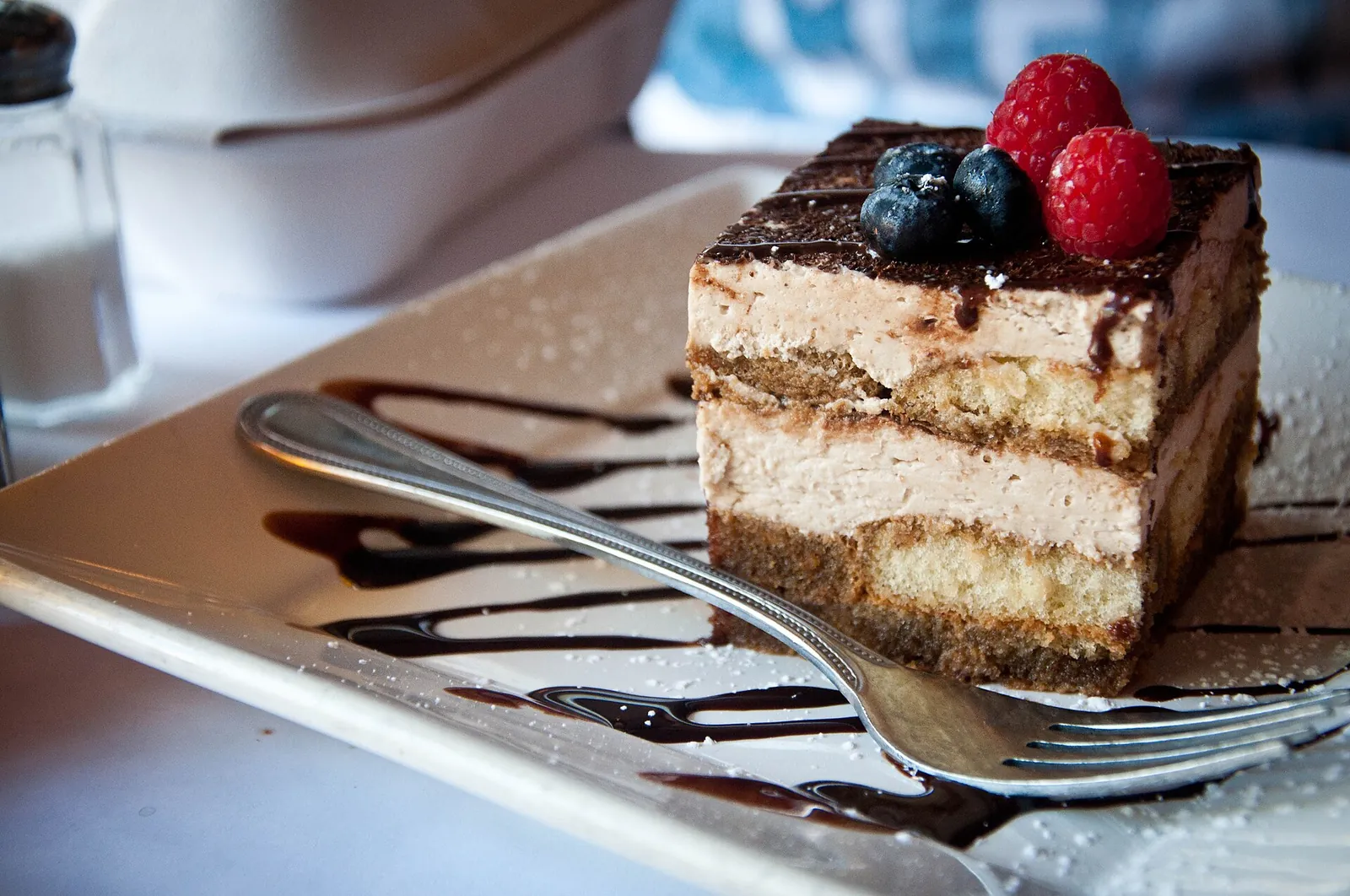
The cream carries the dish, so the mascarpone has to be good and the yolks have to be handled safely, following USDA's egg safety guidance.
The method here cooks the yolks into a warm custard base first. That takes about 10 minutes, removes the raw egg problem, and makes a cream that holds a clean slice after a night in the fridge.
Tiramisu at a glance
This tiramisu table gives the numbers to plan around before you start.
| Tiramisu | |
|---|---|
| Yield | 8 servings in an 8 by 8 inch (20 cm) dish |
| Active time | About 45 minutes |
| Total time | About 7 hours, mostly chilling |
| Oven | None |
| Best cheese | Cold mascarpone, 16 oz (450 g) |
| Make ahead | Yes, best after 12 to 24 hours |
How to make tiramisu
Making tiramisu takes three short jobs: cook the yolk base, fold in the mascarpone and cream, then dip and layer.
Ingredients for tiramisu
These ingredients for tiramisu make one 8 by 8 inch dish, and the mascarpone should come straight from the fridge.
- Cream: 4 large egg yolks, from pasteurized in-shell eggs if you have them
- Cream: 1/2 cup (100 g) granulated sugar
- Cream: 1/4 cup (60 ml) dry marsala or water
- Cream: 16 oz (450 g) mascarpone, cold
- Cream: 1 cup (240 ml) cold heavy cream
- Cream: 1 teaspoon vanilla extract
- Soak: 1 1/2 cups (360 ml) strong brewed coffee or espresso, cooled to room temperature
- Soak: 2 tablespoons coffee liqueur or marsala, optional
- Layers: 7 oz (200 g) crisp savoiardi ladyfingers, about 24 to 30
- Top: 2 tablespoons unsweetened cocoa powder, sifted
- Top: a little shaved dark chocolate, optional
Steps for making tiramisu
These steps for making tiramisu keep the cream cold and the cookies briefly wet.
- Set a heatproof bowl over a pan of barely simmering water, with the bowl not touching the water, and whisk the yolks, sugar and marsala for 8 to 10 minutes until thick, pale and 160°F (71°C) on a thermometer.
- Take the bowl off the heat and keep whisking for 2 minutes, then cool it to room temperature, about 15 minutes.
- Stir the cold mascarpone in a separate bowl with a spatula for 30 seconds until just smooth, then stir in the cooled yolk mixture and the vanilla. Do not use a mixer.
- Whip the cold cream to medium peaks, stiff enough to hold a soft point, and fold it into the mascarpone mixture in two additions until no streaks remain.
- Pour the cooled coffee into a shallow dish and stir in the liqueur. Dip each ladyfinger for 1 to 2 seconds per side, so it is damp outside and still firm in the center.
- Line the bottom of the dish with a single layer of dipped ladyfingers, trimming to fit, then spread half the cream over them in an even layer.
- Repeat with a second layer of dipped ladyfingers and the rest of the cream, smoothing the top with a spatula.
- Cover and refrigerate for at least 6 hours, ideally overnight, until the cream is firm enough to slice.
- Dust the top with cocoa through a fine sieve just before serving, add chocolate shavings if you like, and cut with a hot, wiped knife.
The best cheese for tiramisu
The best cheese for tiramisu is mascarpone, because it is cream with the water taken out: mascarpone runs about 47 percent fat, which is why the cream whips up silky and spoons like thick custard. It tastes milky and slightly sweet, with no culture to sour it, so coffee and cocoa do the flavoring.
Buy it from the cold case, keep it cold until the moment you stir it, and do not freeze it. The University of Wisconsin Center for Dairy Research found that frozen mascarpone turned cracked and brittle, and tiramisu foam made from it was weaker. Cold matters for safety too: Italian investigators linked a 1996 botulism outbreak to commercial mascarpone eaten alone or in tiramisu, after a break in the cold chain at retail. Keep the dish refrigerated.
Cream cheese is not a good swap. It is cultured, so it is tangier and firmer, and the result tastes like cheesecake filling. The page on cream cheese vs mascarpone explains the difference. If you only have cream cheese, the fix is to beat 8 ounces with 1/4 cup of heavy cream first and accept a tangier dessert. Short on mascarpone? Quick mascarpone can be made at home from cream and acid in an afternoon.
Raw eggs and tiramisu safety
Raw eggs and tiramisu are a known pairing, and USDA's Food Safety and Inspection Service lists tiramisu by name among foods that should be made with pasteurized eggs when the eggs stay raw or lightly cooked. FSIS also says to cook egg dishes to 160°F, and to keep eggs out of the refrigerator no more than 2 hours.
The recipe above follows that: the yolks reach 160°F over simmering water, and the cream gets its lift from whipped cream instead of raw whites. If you prefer a classic version with whipped whites, use pasteurized in-shell eggs for them, since the whites never get heated. Pregnant women, older adults and young children should stay with the cooked-yolk version, and the pregnancy cheese guide covers mascarpone and pasteurized cream.
Tiramisu mistakes and fixes
Tiramisu mistakes almost always come from three places: soggy cookies, grainy cream and a rushed chill.
Soggy tiramisu. Ladyfingers drink coffee fast, so a 1 to 2 second dip per side is enough. Longer, and the layer turns to paste. Make sure the coffee is cool, because hot coffee collapses them on contact.
Grainy or split cream. At 47 percent fat, mascarpone breaks if it is beaten hard or warm. Stir it cold with a spatula, fold in the whipped cream, and never use a stand mixer on the mascarpone alone. If it has already split, whisk in 2 to 3 tablespoons of cold cream by hand.
Loose cream that slumps. The dish needs 6 hours at least. The ladyfingers take up moisture from the cream as it sets, and the whole block firms up. Cutting it at 3 hours gives a puddle.
Tiramisu variations
Tiramisu variations change the soak or the topping and leave the cream alone. Swap the coffee for strong espresso with amaretto, or skip alcohol with decaf and a spoonful of vanilla. Add 2 tablespoons of lemon curd between layers for a berry version, or fold 3 ounces of grated dark chocolate into the cream. For individual servings, break the ladyfingers into glasses and layer the cream above them.
Making tiramisu ahead and storing it
Making tiramisu ahead is the best way to serve it, because the flavor settles overnight. Cover the dish tightly and refrigerate for up to 2 days, and dust with cocoa only on the day, since the cocoa turns damp. FDA and USDA advice is to refrigerate leftovers within 2 hours and use them within 3 to 4 days, so a tiramisu left on a party table past 2 hours should be thrown out. Do not freeze it: the cream turns watery and the ladyfingers go mushy as they thaw.
Questions about tiramisu
These questions about tiramisu cover eggs, swaps and timing.
Is tiramisu made with raw eggs?
Tiramisu made the traditional way uses raw or lightly cooked eggs, and USDA advises using pasteurized eggs for it. The version here cooks the yolks to 160°F and skips raw whites.
Is tiramisu without alcohol possible?
Tiramisu without alcohol works fine: use plain coffee in the soak and water instead of marsala in the yolk base. Add a little vanilla for depth.
How long does tiramisu need to chill?
Tiramisu needs at least 6 hours in the fridge, and overnight is better. That time lets the cream set and the ladyfingers soften all the way through.
Does cream cheese work in tiramisu?
Cream cheese in tiramisu gives a tangier, denser cream that tastes like cheesecake. Mascarpone is the cheese the dessert is built around.
Why is tiramisu runny?
Runny tiramisu usually comes from warm mascarpone, under-whipped cream, over-dipped cookies or too little chilling. Keep everything cold and wait the full 6 hours.
How long does tiramisu last?
How long tiramisu lasts is 3 days at most, since it keeps up to 4 days in the refrigerator under the USDA leftover guidance, though the cookies soften with each day. Eat it within 2 days for the best texture.
Your tiramisu next step
Your tiramisu next step is simple: tiramisu comes down to cold mascarpone, cooked yolks and a quick dip. Make it the day before a dinner, cover it, and dust the cocoa on at serving. If you want the cheesecake cousins that use cream cheese instead, try the New York cheesecake for a baked, dense slice or the no-bake cheesecake for a chilled one.
Sources
- Egg Products and Food Safety, USDA Food Safety and Inspection Service
- Shell Eggs from Farm to Table, USDA Food Safety and Inspection Service
- Frozen storage is detrimental to the functionality of cream cheese and mascarpone even in high-pressure-treated samples (Jiménez-Maroto and others, 2026), Journal of Dairy Science via PubMed
- An outbreak in Italy of botulism associated with a dessert made with mascarpone cream cheese (Aureli and others, 2000), European Journal of Epidemiology via PubMed