
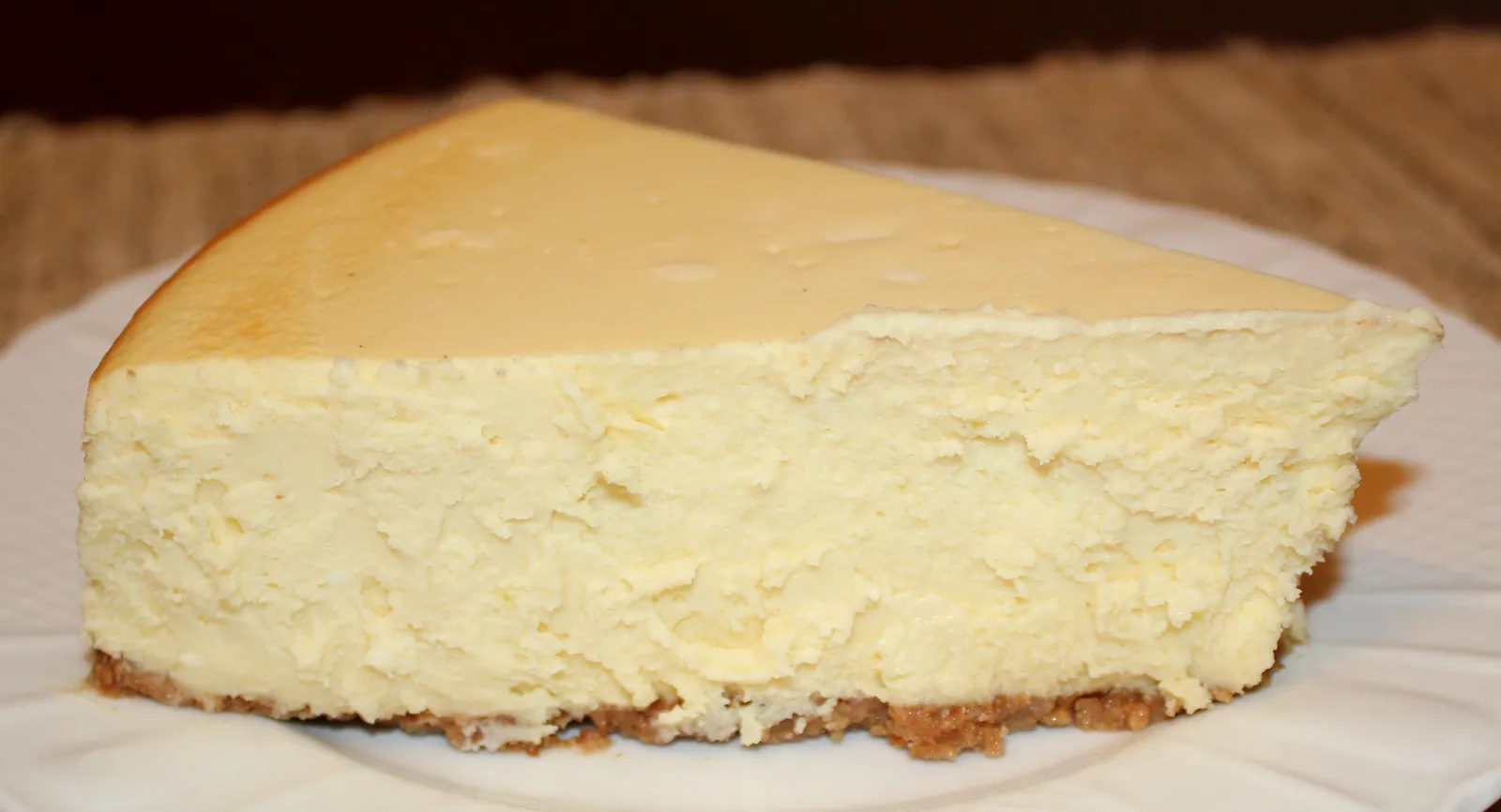
Done right, the slice is smooth, tangy and cuts clean.
This page is the baked one. If you would rather skip the oven, the no-bake cheesecake sets a lighter, softer filling in the fridge instead, and it has its own method.
New York cheesecake at a glance
This New York cheesecake table gives the planning numbers.
| New York cheesecake | |
|---|---|
| Yield | 12 slices from a 9 inch (23 cm) springform pan |
| Active time | About 40 minutes |
| Total time | About 11 hours with cooling and chilling |
| Oven | 350°F for the crust, 325°F for the filling |
| Best cheese | Full-fat block cream cheese, 32 oz (900 g) |
| Make ahead | Yes, needs at least 8 hours chilled |
How to make New York cheesecake
Making New York cheesecake takes a baked crust, a smooth batter and a slow bake in a water bath.
Ingredients for New York cheesecake
These ingredients for New York cheesecake make one 9 inch pan, and every cold ingredient should sit out for about an hour first.
- Crust: 1 1/2 cups (150 g) graham cracker crumbs
- Crust: 5 tablespoons (70 g) unsalted butter, melted
- Crust: 2 tablespoons granulated sugar
- Filling: 32 oz (900 g) full-fat block cream cheese, four 8 oz packages, at room temperature
- Filling: 1 cup (200 g) granulated sugar
- Filling: 3 tablespoons (24 g) all-purpose flour
- Filling: 1/2 cup (115 g) sour cream, at room temperature
- Filling: 1/4 cup (60 ml) heavy cream
- Filling: 1 tablespoon vanilla extract
- Filling: 1 teaspoon finely grated lemon zest
- Filling: 4 large eggs plus 2 large egg yolks, at room temperature
- Pan: 1 to 2 extra-wide sheets of heavy-duty foil, and a kettle of just-boiled water
Steps for making New York cheesecake
These steps for making New York cheesecake keep the batter low in air and the heat low and even.
- Heat the oven to 350°F (175°C), and wrap the outside of a 9 inch springform pan in two layers of heavy-duty foil so water cannot seep in.
- Stir the crumbs, butter and 2 tablespoons sugar until like wet sand, press them firmly over the pan bottom and 1 inch up the sides, and bake for 10 minutes until fragrant. Lower the oven to 325°F (160°C).
- Beat the cream cheese in a large bowl on medium-low for 2 to 3 minutes, scraping the bowl twice, until completely smooth and lump free.
- Add the sugar and flour and beat on low for 1 minute, then stir in the sour cream, heavy cream, vanilla and zest on the lowest speed.
- Add the eggs and yolks one at a time, mixing on low just until each disappears, and stop as soon as the batter is uniform. Do not whip it.
- Pour the batter over the warm crust, tap the pan twice on the counter, and pop any surface bubbles with a toothpick.
- Set the pan in a roasting pan, put it on the oven rack, and pour hot water into the roasting pan until it reaches halfway up the springform.
- Bake for 65 to 75 minutes, until the edges are set, the center 3 inches still jiggles slightly like gelatin, and a thermometer in the center reads about 160°F (71°C).
- Switch off the oven, crack the door open, and leave the cheesecake inside for 1 hour so it cools slowly.
- Lift it out of the water, cool it on a rack for 1 hour more, run a thin knife around the edge, then cover and refrigerate at least 8 hours before removing the ring.
The best cheese for New York cheesecake
The best cheese for New York cheesecake is full-fat block cream cheese, because the FDA standard requires at least 33 percent milkfat and no more than 55 percent moisture, which gives a firm, rich, tangy base. The cream cheese page covers block vs tub: blocks suit cheesecake and frosting, while tubs are softened for spreading and can leave a looser filling.
Take the blocks out about an hour ahead. Softened cream cheese blends with sugar without lumps, and lumps are much harder to remove once eggs go in. Neufchâtel can stand in for a lighter version, and you can replace half the cream cheese with mascarpone for a richer, milder slice, as explained in the cream cheese vs mascarpone comparison. Do not use whipped or reduced-fat tub cream cheese here.
Why New York cheesecake cracks
New York cheesecake cracks for a handful of reasons, and you can prevent every one. The main cause is too much air: beating after the eggs go in whips bubbles that puff up in the oven and collapse as the cake cools, tearing the top.
Overbaking dries the surface, and a sudden temperature drop pulls the cake away from the pan. The water bath prevents most of this, because the humid, gentle heat keeps the edges from drying before the center sets. Slow cooling in the switched-off oven handles the rest. If a crack still shows up, a sour cream or fruit topping hides it with no one the wiser.
New York cheesecake mistakes and fixes
New York cheesecake mistakes are easy to spot in the finished slice.
A soggy crust. Water leaked in. Use heavy-duty foil in two layers, or bake the cake in a larger pan set in an oven bag.
A soft center after chilling. The cake came out too early. The center should reach about 160°F, since this is an egg-based dish and USDA advises cooking egg dishes to 160°F. A faint wobble is fine, a wave is not.
Lumpy filling. The cream cheese was cold. Beat it alone first and scrape the paddle and bowl, because lumps will not go away after the eggs are added.
A brown top. The oven ran hot. Check the temperature with an oven thermometer and tent the top with foil in the last 20 minutes if it browns early.
New York cheesecake variations
New York cheesecake variations stay with the same base and change the finish. Top the chilled cake with fresh strawberries or a cooked berry compote, a layer of sweetened sour cream baked for the final 5 minutes, or a spoonful of lemon curd. For a chocolate crust, swap the graham crumbs for crushed chocolate wafers.
Storing and make-ahead New York cheesecake
Storing New York cheesecake is simple: it keeps covered in the refrigerator for 3 to 4 days, in line with USDA advice for leftovers, and it should not sit out for more than 2 hours. Slice with a thin knife dipped in hot water and wiped dry between cuts. For a longer wait, freeze whole slices on a tray, then wrap them. The freezing cheese guide explains why dairy fillings can turn grainy, so freeze only if you must.
Questions about New York cheesecake
These questions about New York cheesecake cover texture, timing and substitutes.
What makes New York cheesecake different?
New York cheesecake is denser and richer than other styles because it uses a high proportion of cream cheese and often extra yolks, with sour cream or cream for tang.
Is a water bath needed for New York cheesecake?
A water bath for New York cheesecake is the most reliable way to avoid cracks, because it bakes the cake gently and evenly. Wrap the pan in foil to keep it out.
How can you tell New York cheesecake is done?
New York cheesecake is done when the edges are set and the center still jiggles slightly. A thermometer in the middle should read about 160°F.
Does tub cream cheese work for New York cheesecake?
Tub cream cheese for New York cheesecake is a poor choice, since the softer, wetter texture gives a looser filling. Use full-fat blocks.
How long should New York cheesecake chill?
New York cheesecake should chill for at least 8 hours, ideally overnight, so it firms up and slices cleanly.
Is New York cheesecake possible without sour cream?
New York cheesecake without sour cream works if you use heavy cream instead, though you lose a little tang. Add a teaspoon of lemon juice to compensate.
Your New York cheesecake next step
A New York cheesecake rewards patience: block cream cheese, low-speed mixing, a water bath and a slow cool. Bake it the day before you need it. If the oven is off the table, choose the lighter chilled version.
Sources
- 21 CFR 133.133, Cream cheese, eCFR (FDA standards of identity)
- Shell Eggs from Farm to Table, USDA Food Safety and Inspection Service
- Egg Products and Food Safety, USDA Food Safety and Inspection Service
- Are You Storing Food Safely?, U.S. Food and Drug Administration