
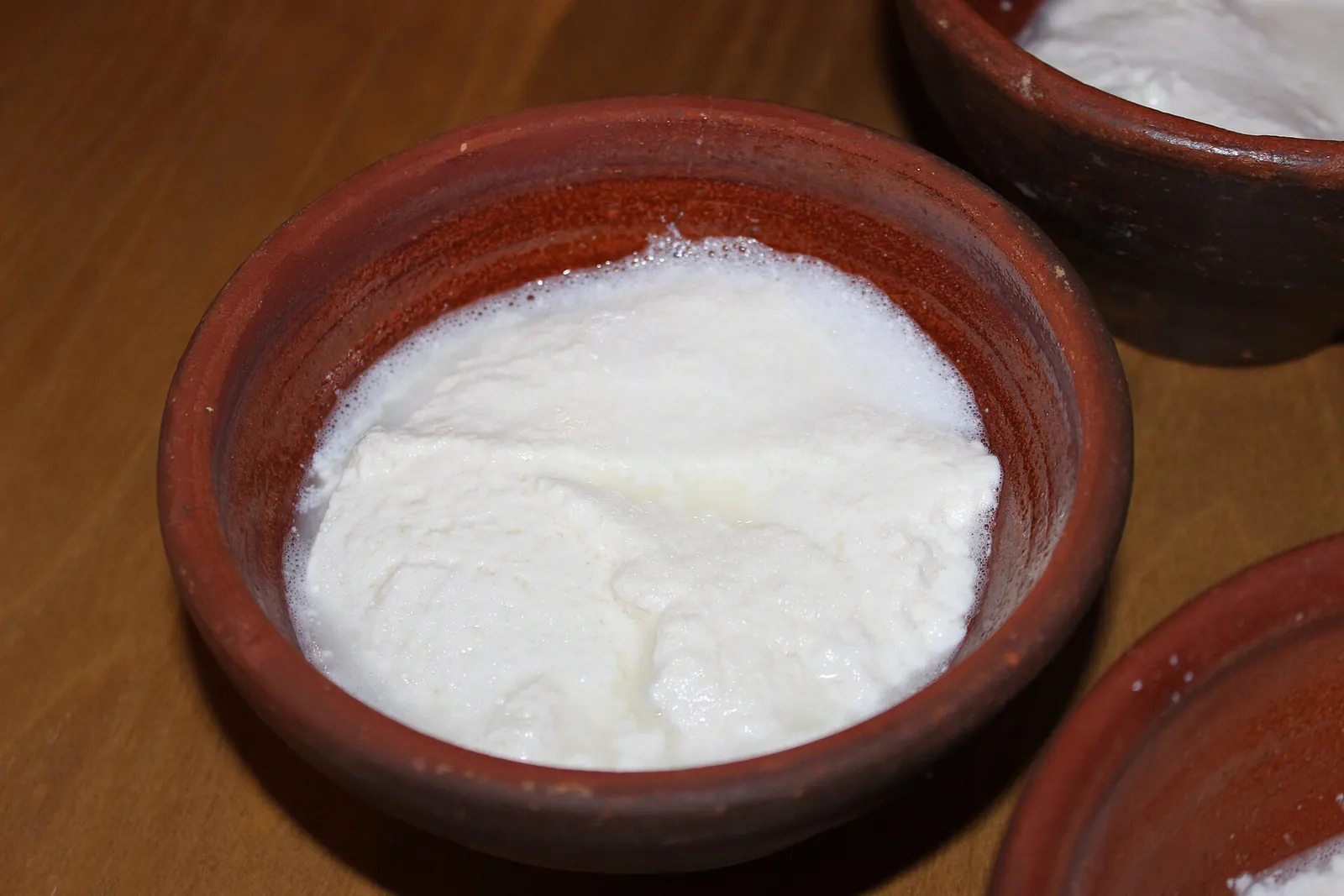
The name means "recooked": Treccani, the Italian reference dictionary, traces it to ricuocere, to cook again, and defines the cheese as made from the whey left after cheese has been cooked.
That origin explains the store shelf. Whey is mostly water with a little protein and fat, so whey ricotta is light and lean, while much American ricotta uses milk, which makes it richer and creamier. No federal standard of identity says which one a tub labeled ricotta has to be.
Ricotta cheese at a glance
This table summarizes ricotta cheese, with water and fat from USDA and the protected names from the EU register.
| Ricotta | |
|---|---|
| Milk | Whey from sheep's, cow's, goat's or water buffalo milk; much American ricotta uses whole or part-skim cow's milk, with or without whey |
| Made by | Heating whey or milk to about 176 to 203°F (80 to 95°C), with or without vinegar or citric acid |
| Rind | None |
| Age | Fresh; use within about a week |
| Texture | Soft, moist, fine grains |
| Flavor | Mild, milky, slightly sweet |
| Water | 73.7 g per 100 g whole milk; 74.4 g part-skim (USDA) |
| Fat | 10.2 g per 100 g whole milk; 7.9 g part-skim (USDA) |
| Protected names | Ricotta Romana PDO (2005); Ricotta di Bufala Campana PDO (2010) |
| US standard | None; 21 CFR Part 133 has no section for ricotta |
What ricotta cheese is made of
Ricotta cheese is made of whey or milk proteins set by heat and acid. After a cheese is drained, the leftover whey still holds whey proteins, and the University of Guelph's cheesemaking e-book notes that these begin to coagulate at about 158°F (70°C), forming a thick layer of curd on the surface as the whey nears 194°F (90°C). The cheesemaker lifts that layer off with perforated scoops and lets it drain. The Ricotta Romana PDO specification describes exactly this for sheep's milk whey: heated to 185 to 194°F (85 to 90°C) with no acid added, then drained in perforated baskets for 8 to 24 hours.
Making ricotta from whey alone has become uncommon, the Guelph authors say, for three reasons: sweet whey is not always available, skimming the curd by hand is hot, tedious work, and yields are low. Adding milk before heating avoids or eases all three, and vinegar or citric acid finishes the set. Their blend recipe uses up to 25 percent milk by weight, heats to 176 to 185°F (80 to 85°C) and then adds the acid. At home you can skip the whey: how to make ricotta in 30 minutes uses whole milk, an acid and salt.
Italian ricotta vs American ricotta
Italian ricotta vs American ricotta comes down to what goes in the kettle: whey in the traditional Italian cheese, and in much American ricotta whole or part-skim milk, sometimes blended with whey. Dairy Farmers of Wisconsin, for example, says its ricotta is made with fresh cow's milk and whey.
The difference shows up in the fat. The Ricotta Romana PDO allows 17 to 29 percent fat in its dry matter, and Treccani calls that sheep's milk style the fattier one. USDA's whole-milk ricotta works out to about 39 percent fat in its dry matter (10.2 grams of fat in 26.3 grams of solids per 100 grams) and part-skim to about 31 percent, so the milk-based tub is the richer cheese.
The label tells you less than you might expect. Federal standards in 21 CFR Part 133 cover cottage cheese, mozzarella, provolone and many others, but there is no section for ricotta. Read the name for whole milk or part-skim, then the ingredients: milk, whey and vinegar or citric acid is what the method calls for.
Ricotta cheese uses in sweet and savory cooking
Ricotta cheese uses run from pasta fillings to desserts, because its mild, milky flavor takes on whatever it is paired with. Treccani names ravioli fillings, cakes and sweets, and Dairy Farmers of Wisconsin adds lasagna, manicotti, cannoli, salads and pound cake.
Savory ricotta needs seasoning, since USDA lists only 31 milligrams of sodium an ounce for whole-milk ricotta against 201 for low-moisture mozzarella. Bind a baked filling with one egg per 15 ounces (425 g) so it slices cleanly. Ricotta softens in the oven but never melts into strings, so top lasagna and stuffed shells with mozzarella if you want a pull.
Sweet ricotta is the filling in cannoli and keeps cheesecake, pancakes and pound cake tender. Sweeten it with honey or confectioners' sugar, which dissolve, rather than granulated sugar, which stays gritty. Use whole-milk ricotta where the creaminess shows and part-skim inside baked pasta.
Ricotta cheese substitute
The best ricotta cheese substitute is cottage cheese, after a little work. USDA lists creamed cottage cheese at 79.8 percent water and 315 milligrams of sodium per 100 grams, against 73.7 percent and 110 milligrams for whole-milk ricotta, so drain it in a sieve for 15 minutes, pulse it smooth in a food processor and go easy on the salt. Use the same amount in lasagna, shells and other baked dishes. For desserts, mascarpone thinned with a spoonful of milk works in the same amount, though it is far richer. The Substitute Finder lists more swaps.
How to store ricotta
How to store ricotta is simple: keep it cold, covered and away from air. Dairy Farmers of Wisconsin calls it highly perishable. Once the tub is open, press plastic wrap onto the surface, and use a clean spoon each time. The watery liquid that collects is whey; stir it back in for a looser ricotta or pour it off for a drier one.
What most ricotta advice gets wrong
Most ricotta advice treats the tub as ready to use and the cheese as a single thing, and three details change the result.
Ricotta sits outside the cheese category in Italy. Treccani defines it as a latticinio, a dairy product, and the EU register files both protected ricottas under "other products of animal origin," not under cheeses. In the US it is sold as cheese, though the federal cheese standards never mention it.
Straight from the tub, ricotta is too wet for many recipes. USDA puts it near 74 percent water, against 48 percent for low-moisture mozzarella. Drain it in a fine sieve over a bowl for 30 minutes for lasagna and stuffed shells, and overnight in the refrigerator for cannoli and cheesecake.
Ricotta salata is not aged ricotta you can swap in. It is salted, pressed into a wheel and aged for several months, according to Dairy Farmers of Wisconsin, so it is salty and crumbly, closer to feta than to the tub. Grate it or crumble it over pasta and salads rather than using it as a filling.
Questions about ricotta cheese
These are the questions about ricotta cheese that come up most often.
Is ricotta cheese healthy?
Ricotta cheese is among the lighter cheeses: USDA lists 43 calories, 2.9 grams of fat, 2.1 grams of protein and 31 milligrams of sodium an ounce for whole-milk ricotta, and 39 calories, 2.2 grams of fat, 3.2 grams of protein and 28 milligrams of sodium for part-skim.
Is ricotta the same as cottage cheese?
Ricotta is not the same as cottage cheese: the FDA defines cottage cheese as dry curd mixed with a creaming mixture, with at least 4 percent milkfat and no more than 80 percent moisture, while ricotta is a heat-set cheese with no federal standard. The page on ricotta vs cottage cheese compares them for cooking.
How long does ricotta last?
Ricotta lasts about a week after you buy it, going by Dairy Farmers of Wisconsin's advice to use it within a week of purchase, so go by the date on the tub and discard it if it smells sour or turns slimy.
Is ricotta cheese safe during pregnancy?
The FDA's pregnancy guidance does not name ricotta cheese, but it says to avoid cheeses made with unpasteurized milk and queso fresco-type cheeses, which it lists as queso fresco, queso blanco and requesón, and it calls other cheeses made with pasteurized milk okay. Check the label for pasteurized milk, ask your doctor, and see cheese during pregnancy.
Can you eat ricotta straight from the tub?
You can eat ricotta straight from the tub, since the curds are heated during making: spoon it over fruit with honey, or onto toast with olive oil and salt.
Choosing ricotta cheese
Choosing ricotta cheese comes down to the dish: whole milk for desserts and toast, part-skim for baked pasta, and a short ingredient list either way. Drain it for the recipe, use it within a week, and for a first taste, try a spoonful of whole-milk ricotta on warm toast with honey and black pepper.
Sources
- Ricotta Romana PDO (EUGI00000013460) specification and register entry, with the Ricotta di Bufala Campana PDO entry, European Commission eAmbrosia register
- Ricotta (vocabolario), Treccani
- Heat-Acid Precipitated Cheese (Hill and Ferrer, 2021), Cheese Making Technology e-Book, University of Guelph
- Dairy Farmers of Wisconsin: Ricotta and Ricotta Cheese from Wisconsin
- USDA FoodData Central (SR Legacy): ricotta, whole milk, ricotta, part skim milk, cottage cheese, creamed and mozzarella, whole milk, low moisture, U.S. Department of Agriculture
- U.S. FDA: 21 CFR Part 133, Cheeses and related cheese products, 21 CFR 133.128, Cottage cheese and Listeria (Food Safety for Moms-to-Be)