
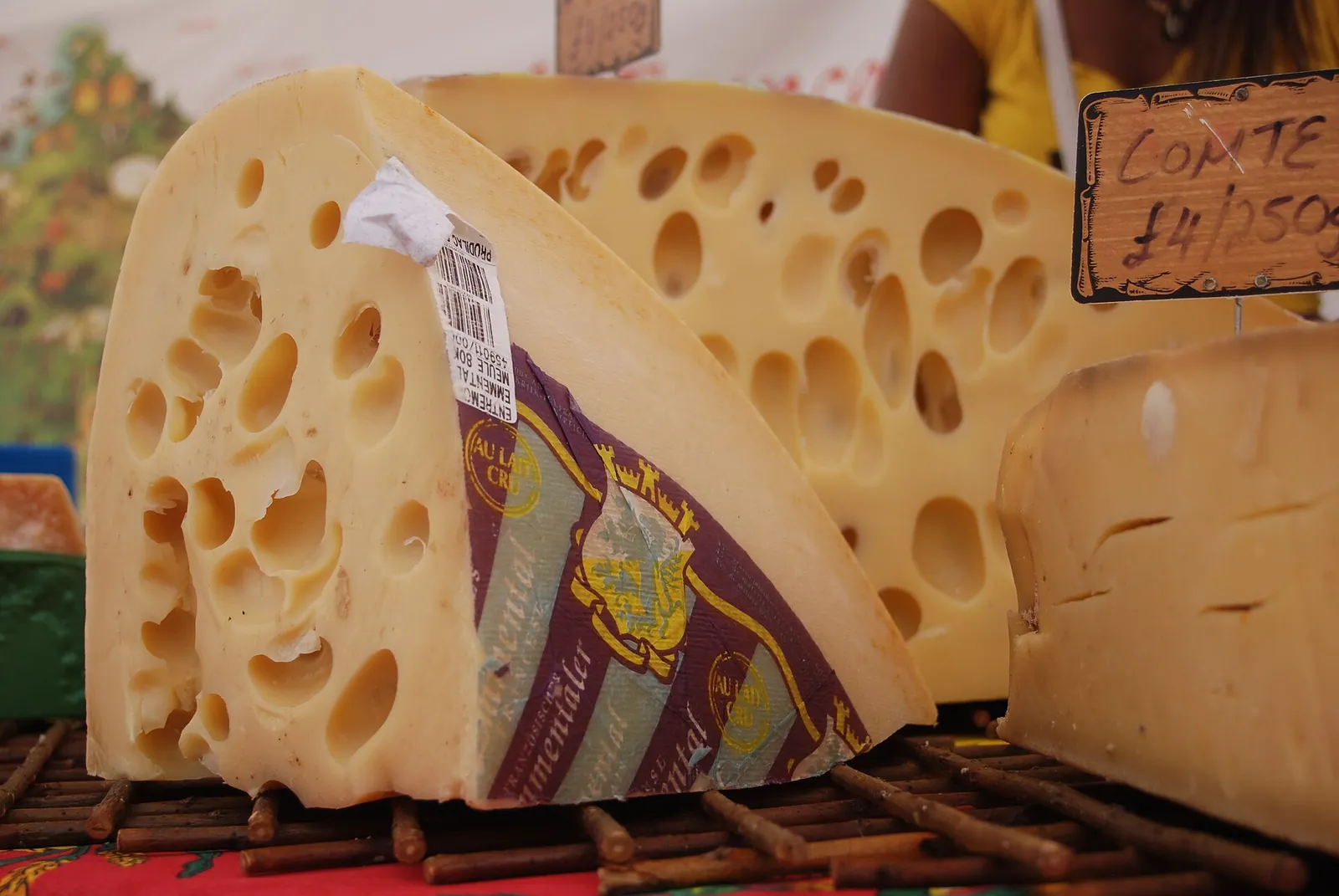
In Switzerland the name is spelled Emmentaler, and the protected Emmentaler AOP is made from raw milk and ripened for at least 4 months.
The holes are not decoration. They come from bacteria that release gas inside a paste elastic enough to trap it, and the same bacteria shape the flavor. Everything else about the cheese, from the huge wheel to the age labels, follows from that one process.
Emmental cheese at a glance
Here is Emmental cheese at a glance, taken from the Swiss registration summary and the producers' own range page.
| Detail | Emmentaler AOP |
|---|---|
| Milk | Raw cow's milk, milked no more than 24 hours before cheesemaking, no silage in the feed |
| Made in | Central and eastern Switzerland, from the Emmental valley in Bern to Zurich, Lucerne and St. Gallen |
| Protected name | AOP (the registration application was filed in 2002) |
| Age | At least 4 months, up to 36 months for Extra |
| Wheel | About 85 cm (33 in) across, 16 to 27 cm high, around 90 kg (200 lb) |
| Holes | Round, 2 to 4 cm (3/4 to 1 1/2 in) |
| Texture | Elastic, light yellow in summer and ivory in winter |
| Flavor | Sweet and sour, slightly salty, aromatic; sharper with age |
| Composition | At least 45 percent fat in the dry matter, at most 38 percent water |
What Emmental cheese is and where it is made
Emmental cheese gets its name from the Emmental valley in the canton of Bern, where, according to the Swiss registration summary, it has been made since the 12th century. A Langenthal register mentions it in 1542. Mountain pastures came first; dairies on the plains followed from 1813, and production spread across German-speaking Switzerland after 1840.
The protected area today covers Bern (minus the Moutier district), Aargau, Glarus, Lucerne, Schwyz, Solothurn, St. Gallen, Thurgau, Zug and Zurich, plus two districts of Fribourg. The producers say it comes from almost 100 village dairies, and each wheel carries a dairy number on its rind label, so you can trace a piece to its maker. The guide to PDO and PGI labels explains what the AOP seal promises, and Swiss vs Gruyère vs Emmental covers how it differs from American Swiss cheese.
How the holes in Emmental cheese form
The holes in Emmental cheese form because propionic bacteria, added to the milk, eat lactic acid during ripening and give off carbon dioxide. The paste is elastic, so the gas cannot escape. It gathers into pockets that swell into the round eyes you see when a wheel is cut, and the specification puts them at 2 to 4 cm.
The same fermentation is why the flavor is both sweet and sour, a little salty and aromatic, according to the registration summary. Too few eyes or a crack along them is a flaw, so makers watch the wheels through a warm cellar stage and then a cooler storage cellar.
How Emmentaler AOP is made
Emmentaler AOP is made from raw milk in copper vats, and the rules are strict. The milk comes from cows fed no silage, from farms within 30 km (about 19 miles) of the dairy, and it is processed within 24 hours of milking. Only non-GMO rennet, defined lactic cultures from the region, propionic bacteria, salt and drinking water are allowed.
The curd is cooked to 52 to 55°C (126 to 131°F), pressed, then brined for 24 to 72 hours. Ripening runs from the inside out, first in a warm cellar and then in a cooler one, for at least 4 months in the region. The label words "extra," "surchoix," "cave-aged," "réserve" or "premium" are allowed only after 8 months or more in a humid rock cellar.
How Emmental cheese tastes by age
Emmental cheese tastes mild and slightly sweet when young and turns tart, then spicy, as it ages. The producers' range page sets out the ladder:
- Classic (mild): 4 months, slightly sweet
- Réserve: 8 months, fine and tart
- Cave-aged: 12 months, intense
- Crown: 14 months, spicy
- Extra: 12 to 36 months, extra spicy
The younger the wheel, the springier the paste. Older wheels get firmer and more crystalline, and the flavor moves toward brothy and sharp. For a first bite, buy Classic; for a board that shows off how a cheese changes, pair it with a Réserve.
How Emmental cheese melts
Emmental cheese melts smoothly, but it goes elastic and stringy rather than creamy. Its paste is firm and fairly moist, so it softens fast, and the proteins stretch before they flow. That ropiness is great on a ham sandwich or a gratin and slightly awkward alone in a fondue pot, where it clings to the fork.
The classic fix is to blend. Half Gruyère and half Emmental gives a fondue the pull of one and the depth of the other; the classic fondue recipe has the wine and starch ratios. Grate it cold, melt it gently and stop at the first smooth moment, because overheating makes any Alpine cheese turn oily and tight. For other options, see the best melting cheeses.
Buying Emmental cheese in the US
Buying Emmental cheese in the US comes down to reading the label, because "Swiss cheese" and "Emmental" are not always the same product. Look for the words Emmentaler AOP and a rind label with a dairy number. That is the raw-milk, 4-month-minimum cheese. A generic deli slice marked Swiss follows the American standard and can be made anywhere.
Ask for a cut from the wheel instead of a pre-wrapped wedge, and ask the age. Classic is the everyday buy for sandwiches and fondue; Réserve or cave-aged earns its higher price on a board. Raw milk cheese carries the usual caution for pregnancy and weakened immune systems, so check FDA guidance if that applies to you. Store it wrapped in wax paper or parchment in the fridge, per the storing cheese guide, and take it out an hour before serving.
What most Emmental cheese advice gets wrong
Most Emmental cheese advice repeats a few shortcuts that cost you flavor or money.
Holes do not prove it is real Emmental
Holes do not prove a cheese is real Emmental, because American Swiss and other copies have them too. What counts is the AOP name and the dairy number on the rind label.
Bigger holes do not mean better cheese
Bigger holes do not mean a better Emmental. The specification asks for round holes of 2 to 4 cm, and a wheel with cracks or very uneven eyes is a defect. A wedge with a few well-spaced holes is a good sign.
Emmental cheese is not always mild
Emmental cheese is not always mild, since the label words describe age. A 12 month cave-aged wedge or an Extra is spicy and intense, so it will not behave like a bland sandwich slice.
Emmental cheese substitutes
The best Emmental cheese substitutes match its mild, nutty, elastic character, and the right one depends on the dish. Use the substitute finder for more pairs.
Jarlsberg is the easiest everyday swap, sweeter and softer with similar holes. Baby Swiss works in sandwiches. Leerdammer and Maasdam, compared here, are sweeter with big eyes. For fondue, Gruyère does the job alone and gives a smoother pot.
Questions about Emmental cheese
These are the questions about Emmental cheese that come up most often.
Why does Emmental cheese have holes?
Emmental cheese has holes because propionic bacteria release carbon dioxide during ripening, and the elastic paste traps the gas in pockets.
Is Emmental the same as Swiss cheese?
Emmental is the Swiss original, while "Swiss cheese" in the US is a generic style based on it. The AOP version is raw milk and aged at least 4 months, and the generic slice usually is not.
What does Emmental cheese taste like?
Emmental cheese tastes sweet and a little sour, slightly salty and nutty. Young wheels are mild, and aged ones turn tart and spicy.
Is Emmental cheese good for melting?
Emmental cheese melts well, although it goes stretchy rather than creamy. It suits fondue (best blended with Gruyère), sandwiches and gratins.
How big is a wheel of Emmental cheese?
A wheel of Emmental cheese is about 85 cm (33 in) across and weighs around 90 kg (200 lb) on average, among the largest of any cheese.
Your first Emmental cheese
For your first Emmental cheese, buy a small cut of Emmentaler AOP Classic with a dairy number on the rind, and eat half plain to taste the sweet, nutty base. Melt the rest with Gruyère for a small fondue, then try a Réserve next to it.
Sources
- Résumé de la demande d'enregistrement pour l'Emmentaler, Swiss Federal Office for Agriculture (FOAG)
- Emmentaler AOP product range, Emmentaler Switzerland
- Emmentaler AOP, Emmentaler Switzerland