
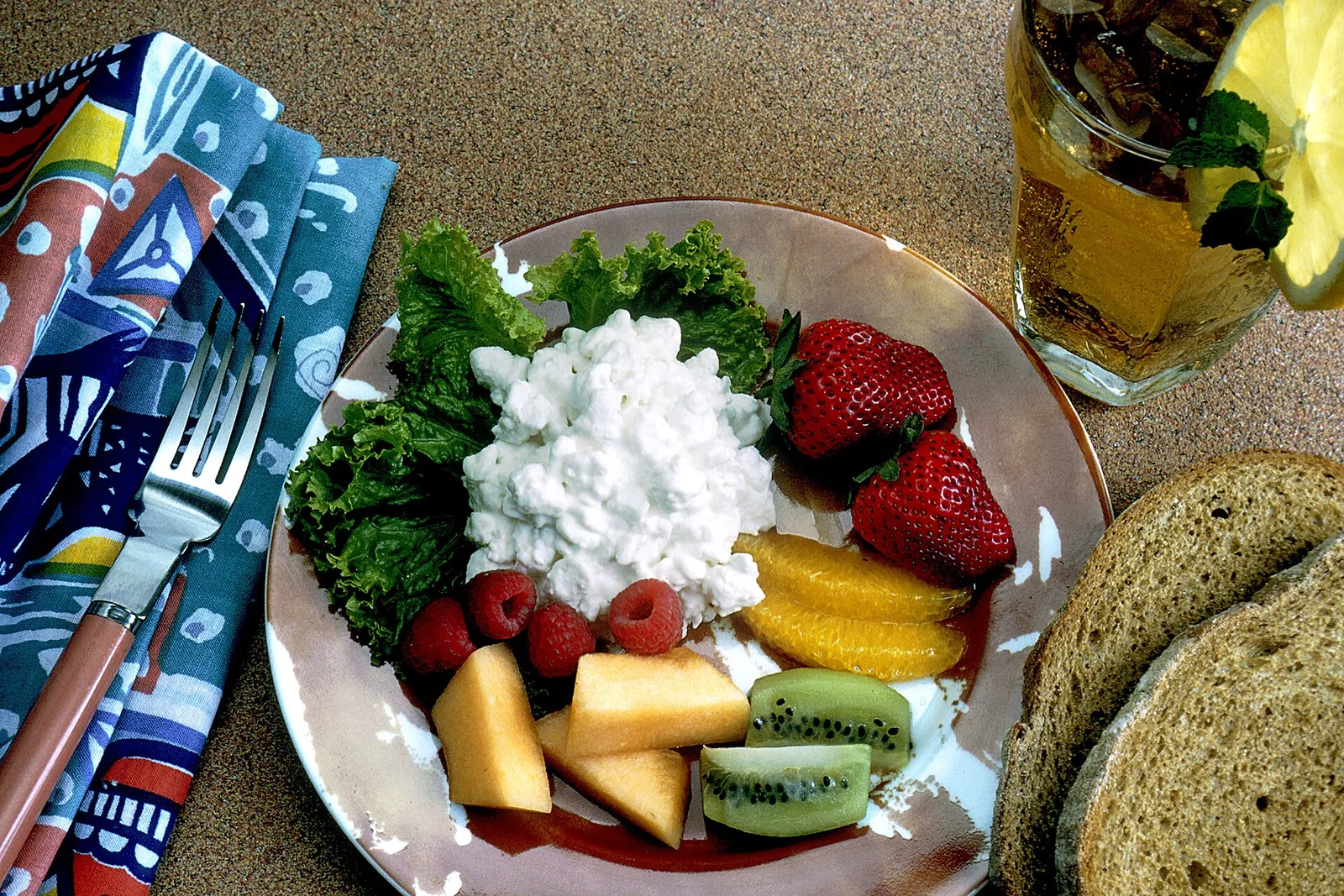
It is mild, a little salty and slightly tangy, and its texture is the whole point, so people tend to love it or leave it.
What separates one tub from the next is three things you can read on the label: the size of the curd, the fat level, and the sodium. This page covers those and the nutrition, and leaves the home recipe to the homemade cottage cheese page.
Cottage cheese at a glance
Here is cottage cheese at a glance, with the legal figures from the FDA standard for cottage cheese and the numbers from the USDA.
| Detail | Cottage cheese |
|---|---|
| Milk | Cow's milk, usually skimmed, plus a cream dressing |
| Set with | Culture, direct acid, or both, then cut and cooked |
| Curd sizes | Small curd (under 4 mm) and large curd (over 8 mm) |
| Milkfat (US rule) | Creamed: at least 4%; dry curd: under 0.5% |
| Moisture (US rule) | No more than 80% |
| Energy | 98 kcal per 100 g creamed; 72 kcal per 100 g at 1% (USDA) |
What cottage cheese is
Cottage cheese is made by culturing or acidifying milk, cutting the curd, cooking and washing it, then draining it into dry curd. Wikipedia describes a cultured method where milk is warmed to 86 to 90°F (30 to 32°C) and ferments for 4 to 8 hours, then the vat is heated to 120 to 130°F (49 to 54°C) during cutting and cooking; a direct-acid method adds food-grade acid to cold milk and about halves the time.
The dry curd is then mixed with a creaming mixture of pasteurized cream or milk and salt, which is what makes it moist rather than chalky. The US standard defines cottage cheese as the soft uncured cheese made by mixing dry curd with a creaming mixture, so the dressing is part of the legal definition. The term itself dates to 1831 in Philadelphia, per Wikipedia.
Cottage cheese curd sizes and fat levels
Cottage cheese curd sizes and fat levels are the two choices on every tub, and neither changes what the cheese is; they change how it feels.
Small curd and large curd
Small-curd cottage cheese has curds under 4 mm, and large-curd cottage cheese has curds over 8 mm, per Wikipedia. Small curd is creamier and spreads and blends more smoothly. Large curd feels more like a salad, with distinct, springy lumps that stay intact when you stir them into eggs.
Creamed, low-fat and dry curd
Creamed cottage cheese must have at least 4 percent milkfat under US rules, and dry curd cottage cheese must have less than 0.5 percent. Between them are the 1 percent and 2 percent tubs, which carry less dressing. Dry curd has no dressing at all, which makes it drier and better for recipes that need the curds without extra liquid. Labels must state the milkfat as a whole number, such as "not less than 4 percent milkfat."
Cottage cheese nutrition
Cottage cheese nutrition is mostly protein and water, with a light amount of fat and a lot of sodium compared with other fresh dairy. These USDA SR Legacy numbers are per 100 g, about 3.5 ounces.
| Type (USDA, per 100 g) | Protein | Fat | Energy | Sodium | Calcium |
|---|---|---|---|---|---|
| Creamed, large or small curd | 11.12 g | 4.3 g | 98 kcal | 315 mg | 83 mg |
| 2% milkfat | 10.45 g | 2.27 g | 81 kcal | 308 mg | 111 mg |
| 1% milkfat | 12.39 g | 1.02 g | 72 kcal | 406 mg | 61 mg |
| 1% milkfat, no sodium added | 12.4 g | 1.0 g | 72 kcal | 13 mg | 61 mg |
| Nonfat, uncreamed, dry curd | 10.34 g | 0.29 g | 72 kcal | 372 mg | 86 mg |
One ounce of creamed cottage cheese gives about 3.2 g of protein and 27.8 kcal. Wikipedia lists full-fat cottage cheese at 11.6 g of protein and 350 mg of sodium per 100 g, with vitamin B12 and phosphorus, which agrees with the USDA range. This is nutrition information, not medical advice; people watching sodium or lactose should read the label.
How to choose cottage cheese
To choose cottage cheese, start with the sodium line, then the curd size and the fat level you want. The sodium swings widely: 13 mg per 100 g for the no-salt-added 1 percent entry against 406 mg for regular 1 percent in the USDA table, so a quick label check matters more than the fat claim.
- Short ingredient list: milk, cream and salt, plus cultures, is a good sign. Extra thickeners are not a flaw, but you taste the milk less.
- Fat level: creamed for flavor and cooking, 2 percent as the middle, 1 percent for the lean option.
- Curd: small curd for blending and spreading, large curd for eating with a spoon.
- Date: buy the tub with the date furthest out, since it is a fresh cheese, and use it within a few days of opening.
If the label says "directly set" or "curd set by direct acidification," that is the standard disclosure for the quick acid method, not a defect. Expect a cleaner, simpler tang than a cultured tub.
How to use cottage cheese
Cottage cheese is used plain, blended, baked or sweetened, and it takes salt, pepper, fruit and herbs equally well.
- Savory: top with black pepper, cucumber, tomato, chives or everything-bagel seasoning; stir into scrambled eggs; blend smooth into dips and spreads.
- Pasta and baking: it can replace ricotta in lasagna and stuffed shells, and blended smooth it makes a lighter creamy sauce.
- Sweet: pair with peaches, berries or pineapple and a drizzle of honey, fold into pancake batter, or blend into smoothies.
Wikipedia lists fruit, vegetables, bread, salads and desserts as common uses, and it notes that cottage cheese is also used as a mayonnaise substitute. Blend it in a food processor for about a minute, since lumps disappear and you get a smooth, high-protein base. For the fitness angle, see cottage cheese for fitness, and the high-protein cheeses list shows how it ranks.
Cottage cheese substitutes
Cottage cheese substitutes depend on what you want from it, and Wikipedia names ricotta and paneer as alternatives. Ricotta is the usual swap in baking, though it is finer and sweeter, and the ricotta vs cottage cheese page covers the difference. Quark is smoother and has more protein per 100 g in fat-free form, and thick Greek yogurt works for dips and bowls. If you use any of them in place of cottage cheese in a recipe, drain wet ricotta or yogurt first so the dish does not turn watery. The substitute finder lists more options.
What most cottage cheese advice gets wrong
Most cottage cheese advice ranks it by protein alone, which skips three things you can check.
Low-fat is not always the better choice
Low-fat cottage cheese is not always the better choice. Creamed is only 98 kcal against 72 kcal at 1 percent per 100 g in the USDA data, a small difference, and the fuller dressing tastes better on a spoon and in a sauce.
Cottage cheese sodium varies by brand and type
Cottage cheese sodium varies by brand and type, and the number is easy to miss. The USDA entries range from 13 mg to 406 mg per 100 g, so compare labels and look for a no-salt-added tub if you are watching sodium.
Blended cottage cheese is not ricotta
Blended cottage cheese is not ricotta. It is smoother, but it is still tangier and saltier, so cut the salt in a recipe a little when you swap it in.
Questions about cottage cheese
These are the questions about cottage cheese that come up most.
Is cottage cheese healthy?
Cottage cheese is high in protein and calcium and low in fat, with 12.39 g of protein per 100 g at 1 percent in the USDA table, but its sodium can be high, so check the label.
What is the difference between cottage cheese and ricotta?
Cottage cheese has distinct, loose curds in a creamy dressing, while ricotta is a finer, smoother whey cheese that tastes sweeter; the ricotta page covers it.
What is the difference between small-curd and large-curd cottage cheese?
Small-curd cottage cheese has curds under 4 mm and large-curd has curds over 8 mm; the cheese is the same, only the cut differs.
Can you cook with cottage cheese?
Cottage cheese works in baked pasta, pancakes, eggs and blended sauces, and it can stand in for ricotta in many recipes.
Is dry curd cottage cheese the same as regular cottage cheese?
Dry curd cottage cheese is the curd without the cream dressing, and the US rule gives it under 0.5 percent milkfat.
Your first tub of cottage cheese
For your first tub of cottage cheese, buy a small-curd creamed one, eat a spoonful plain with black pepper and cucumber, then try a 1 percent tub and a no-salt-added tub to see which you prefer. Keep the next step simple: blend whatever is left into a dip.
Sources
- 21 CFR 133.128, Cottage cheese, Legal Information Institute, Cornell Law School (U.S. Code of Federal Regulations)
- 21 CFR 133.129, Dry curd cottage cheese, Legal Information Institute, Cornell Law School
- Cheese, cottage, creamed, large or small curd (FDC ID 172179), USDA FoodData Central, SR Legacy
- Cheese, cottage, lowfat, 1% milkfat (FDC ID 173417), USDA FoodData Central, SR Legacy
- Cottage cheese, Wikipedia