
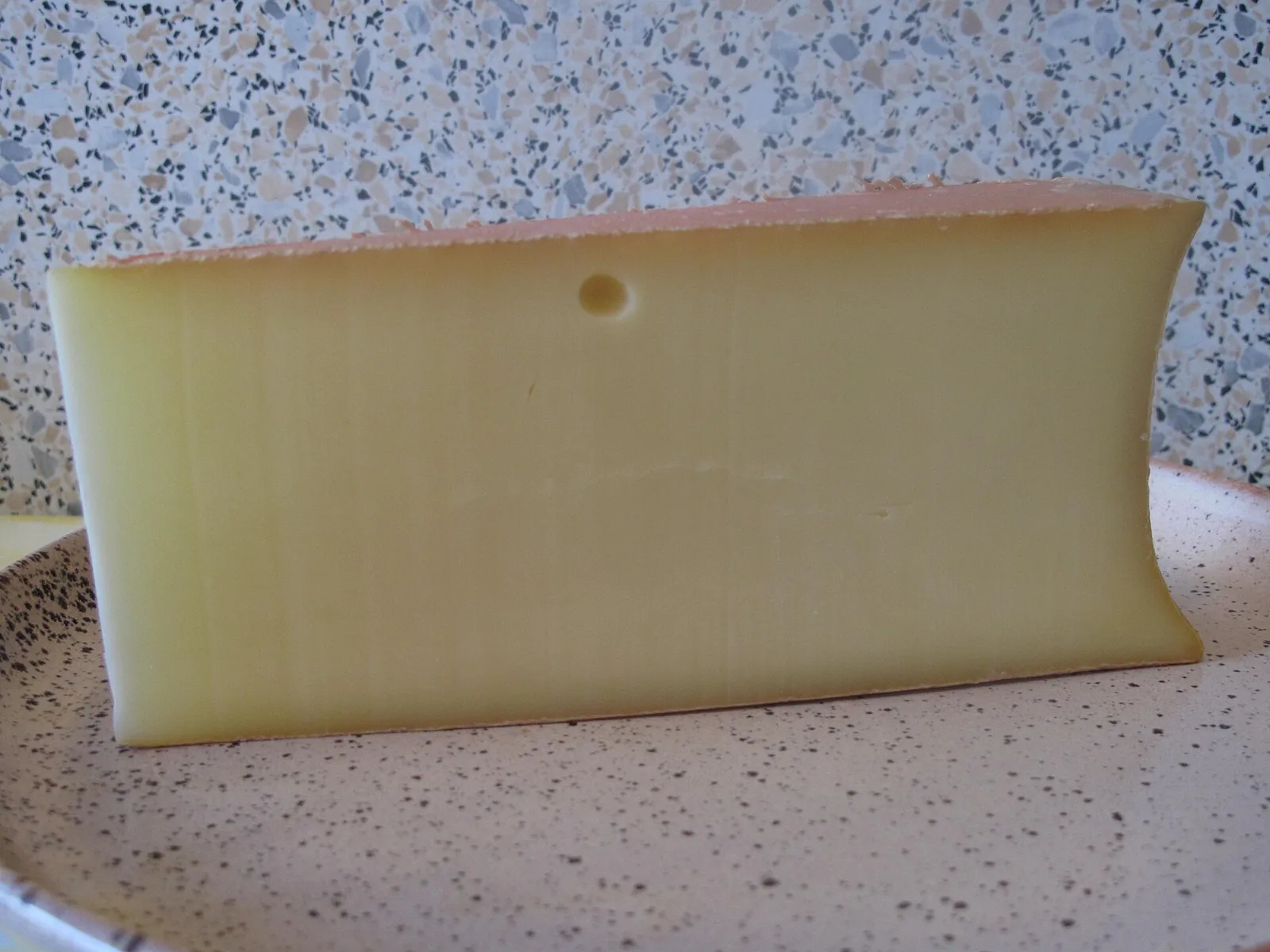
It ages at least 100 days and tastes of hazelnut and fruit, with a faint bitter finish that keeps it from tasting sweet.
The name does triple duty. The village of Abondance gave its name to a valley, a breed of cow and this cheese, and the protected designation ties all three together: the cheese must come from Haute-Savoie's mountains, and at least 45 percent of every herd must be Abondance cows.
Abondance cheese at a glance
This Abondance cheese at a glance table sums up the protected name and what it requires.
| Abondance | |
|---|---|
| Milk | Raw cow's milk from Abondance, Montbéliarde and Tarine cows; herds at least 45% Abondance |
| Where | Mountains of Haute-Savoie, France; birthplace the Abondance valley |
| Style | Semi-cooked, pressed curd, molded in a hoop that gives a concave side |
| Wheel | 13 to 26 lb (6 to 12 kg), usually about 22 lb (10 kg); about 16 in (40 cm) across, 3 in (7 to 8 cm) high |
| Minimum age | 100 days; about 4 months recommended |
| Rind | Amber, with the print of the linen cloth |
| Paste | Supple, ivory to pale yellow, a few small holes |
| Flavor | Hazelnut and fruit (apricot, pineapple, citrus), a light bitter edge |
| Versions | Farmhouse (green oval casein plaque) or dairy (red square plaque) |
| Protected name | French AOC 1990, EU PDO 1996 |
Where Abondance cheese comes from
Abondance cheese comes from the mountains of Haute-Savoie, and its birthplace is the Abondance valley in the Chablais, the northeastern corner of the department near Lake Geneva. Today the protected area covers 176 communes, from the Abondance valley to the Aravis range and the Mont Blanc country, according to INAO, France's appellation authority.
The cheese grew up around a monastery. The Abondance producers' syndicate ties its history to the Abbey of Abondance, whose canons worked with local farmers to clear pastures and develop the cheese; farmers paid for the abbey's land in cheese, a rent called ochéage. The syndicate dates the cheese's fame to 1381, when, by its account, Abondance was served at Pope Clement VII's table in Avignon.
Modern protection came with French AOC status in 1990 and EU protection in 1996. Production has grown about tenfold since 1990, to 3,387 tonnes in 2024, from 165 milk producers, 70 farmhouse cheesemakers, 16 dairies and 11 ripening houses.
The Abondance cow
The Abondance cow is a red-and-white mountain dairy breed named for the same valley, and you can spot it by its mahogany coat and the colored patches around its eyes that breeders call spectacles. It is a medium-size cow, about 650 kg (1,430 lb) and 1.40 m (4.6 feet) at the rump, built for steep pastures, with black hooves that hold up on wet, stony ground, according to the syndicate's breed profile.
The syndicate counts it as France's fourth dairy breed. It averaged 6,524 kg (about 14,400 lb) of milk a year in 2020, and its milk is approved for more than 14 protected cheeses, Beaufort among them. It also lasts: one Abondance cow in four is in her fifth lactation, against one Holstein in thirteen. In summer many herds move up to high pastures at about 1,300 to 1,850 m (4,300 to 6,100 feet).
The herd and feed rules
The herd and feed rules for Abondance cheese allow three breeds, Abondance, Montbéliarde and Tarine, but at least 45 percent of each herd must be Abondance cows. The cows must graze at least 150 days a year and eat mostly hay the rest of the time, with a limited amount of grain. Silage and other fermented feeds are banned, and so is GMO feed.
How Abondance cheese is made
Abondance cheese is made in copper cauldrons from raw milk, usually the evening's milking mixed with the morning's, warmed to the temperature it had in the udder before the rennet goes in. The set curd is cut into grains between the size of rice and corn kernels, then heated again to 113 to 122°F (45 to 50°C) and stirred, according to the syndicate's account of the make. That gentler heat is why Abondance is called semi-cooked: the curd gives up less whey than in the big cooked wheels, and the cheese stays supple.
On farms, the cheesemaker lifts the curd out of the whey in a cloth slung around the neck, arms deep in the warm vat; dairies drain it out by gravity. The curd goes into a hoop, the cheesemaker tightens it with a hammer, and a casein plaque goes on: green and oval for farmhouse cheese, red and square for dairy cheese. After a day under the press, the wheels soak 24 hours in brine, then age on spruce boards, turned every two days, for at least 100 days. It takes about 10 liters of raw milk to make 1 kg of cheese, roughly 1.2 gallons per pound.
Why Abondance has a concave rind
Abondance has a concave rind because of that hoop: INAO credits molding in the ring for the cheese's famous curved shape, and the amber rind still carries the print of the linen cloth. Beaufort shares the shape, and the Savoie cheese association says its curve once made wheels easier to carry down from the high pastures on mules.
What Abondance cheese tastes like
Abondance cheese tastes of hazelnut, with fruity notes the producers compare to apricot, pineapple or citrus and a light bitter edge that rounds out as the paste melts on your tongue. The inside is supple and ivory to pale yellow, sometimes with a few small, evenly spread holes.
It is at its best fairly young by Alpine standards: Les Fromages de Savoie recommends about 4 months of aging, against the 100-day minimum.
How to buy Abondance cheese in the US
Buying Abondance cheese in the US is legal despite the raw milk. The FDA lets cheese made from raw milk be sold only after at least 60 days of curing at 35°F or warmer, a rule written into its cheese standards such as the one for hard cheeses, and Abondance must age at least 100 days. Production is small, so look for it at specialty cheese counters and online cheese shops rather than the supermarket.
Check the casein plaque on the rind before you buy. Green and oval means farmhouse Abondance (fermier in French), made on one farm from that farm's own milk. Red and square means dairy Abondance (laitier), made from the pooled milk of several farms. The paste should look supple and evenly colored, with no dry or cracked edges.
Abondance and raw milk safety
Abondance and raw milk safety come down to who is eating. The CDC advises people who are pregnant, adults 65 and older and anyone with a weakened immune system to avoid cheese made from raw milk unless it is heated to 165°F (74°C) or until steaming hot, which a bubbling Berthoud reaches. More choices are in cheese during pregnancy.
How to serve and cook with Abondance cheese
Serve Abondance cheese the way its makers do, mostly on a board: keep it wrapped in paper in the vegetable drawer and take it out about half an hour before eating so the fruit comes through. It belongs to the family of Alpine cheeses that melt well, and one hot dish is built entirely around it.
The Berthoud
The Berthoud is the classic way to melt Abondance: a porcelain dish rubbed with garlic, filled with about 6 ounces (180 g) of sliced or grated Abondance, a splash of Savoie white wine, Madeira or port, and pepper, then baked about 10 minutes until the inside melts and the top browns. It was created in the early 1900s at a bistro in Thonon-les-Bains run by the Berthoud family, and in 2020 it became France's first protected recipe, registered under the EU's TSG label for traditional dishes. Serve it with boiled potatoes, cured meats and a green salad.
Other ways to cook with Abondance
Other ways to cook with Abondance start with potatoes: it melts smoothly enough to stand in for Reblochon in a tartiflette or for raclette cheese. It also works in gratins, quiches and a grilled cheese with ham.
Abondance pairings
Abondance pairings work best with light Savoie wines: a dry white such as Chasselas or Roussette de Savoie, a light red such as Chignin, or a Crémant de Savoie. A mild brown ale works too. On a board, add quince or chestnut jam, or a spoon of honey.
Abondance substitutes
The best Abondance substitutes are its mountain neighbors. Beaufort is the closest in style, a bigger cooked wheel with the same concave side; a Comté under a year old melts and tastes similar; Gruyère works almost anywhere. For a milder board cheese, try Tomme de Savoie.
What most Abondance cheese guides get wrong
Most Abondance cheese guides repeat a wrong breed figure and skip the label detail that tells you the most.
The herd rule is 45 percent, not 55. The rules require at least 45 percent Abondance cows in each herd. The 55 percent figure that circulates online does not match the rule the producers' syndicate publishes.
It is not a small Beaufort. Beaufort is a cooked cheese, far bigger and aged longer, from the high valleys of Savoie. Abondance is semi-cooked, moister and at its best at about 4 months, so it is softer and quicker to melt.
The plaque tells you who made it. A green oval plaque means one farm, one herd and curd lifted by hand in a cloth; a red square means a dairy pooling milk from several farms. A wedge may show only part of the plaque, so ask which one you are buying.
The cow is feminine and the cheese is masculine. In French you say une Abondance for the cow and un Abondance for the cheese, a detail INAO itself points out.
Questions about Abondance cheese
These are quick answers to common questions about Abondance cheese.
What does Abondance cheese taste like?
Abondance cheese tastes nutty and fruity, with a light bitter edge and a supple texture that melts in your mouth.
Is Abondance cheese pasteurized?
Abondance cheese is never pasteurized; the protected name requires 100 percent raw milk.
What are Abondance cows?
Abondance cows are a French red-and-white mountain dairy breed from the Abondance valley, known for mahogany coats, spectacle markings around the eyes and long working lives.
What is Abondance cheese similar to?
Abondance cheese is most similar to Beaufort, its Savoie neighbor, and to young Comté or Gruyère.
Is Abondance good for melting?
Abondance is good for melting: its supple, semi-cooked paste turns smooth in a Berthoud, gratin or fondue.
Can you eat the rind on Abondance?
You can eat the rind on Abondance, since it is a natural rind formed by brining and turning, but it is firm and chewy, so most people trim it. More in which cheese rinds you can eat.
Trying Abondance for the first time
For a first taste of Abondance cheese, buy a farmhouse piece with the green plaque and a dairy piece with the red one if your counter has both, let them warm for half an hour and taste them side by side. Then melt what is left into a Berthoud or over boiled potatoes.
Sources
- Abondance, INAO (Institut national de l'origine et de la qualité)
- Une vallée, Syndicat Interprofessionnel du Fromage Abondance (SIFA)
- Une vache, Syndicat Interprofessionnel du Fromage Abondance (SIFA)
- Un fromage, Syndicat Interprofessionnel du Fromage Abondance (SIFA)
- Le Berthoud, Syndicat Interprofessionnel du Fromage Abondance (SIFA)
- AOP Abondance, Les Fromages de Savoie (AFTAlp)
- 21 CFR 133.150, Hard cheeses, Electronic Code of Federal Regulations
- Preventing Listeria Infection, Centers for Disease Control and Prevention