
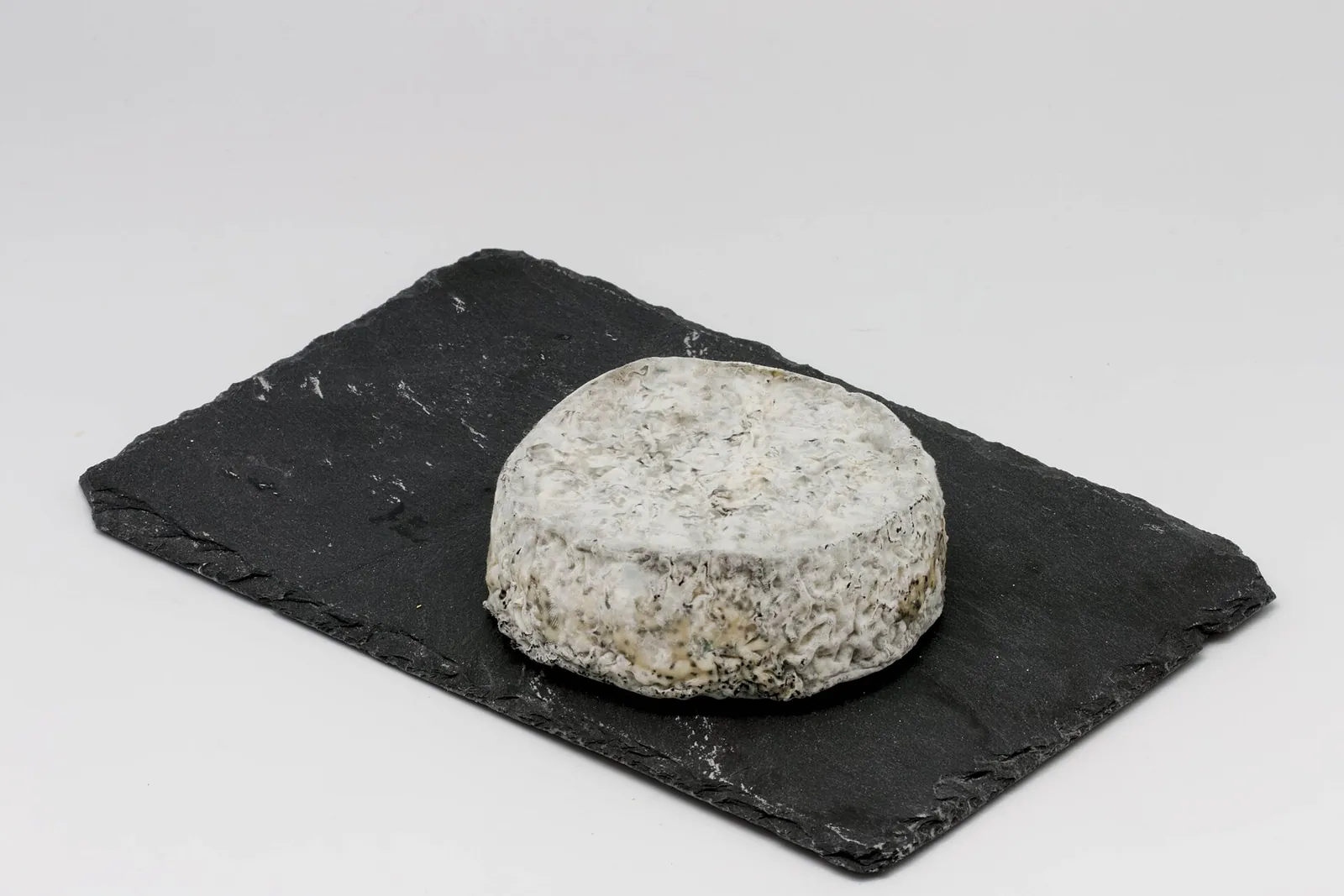
Its gray rind and ivory-white paste make it one of the easiest ripened goat cheeses to recognize and to like.
The cheese is mild for an aged goat cheese, because the curd is set mostly by slow lactic fermentation and the cheese ripens for only a short time. The ash, the salt and the molds that grow over them form the rind, and the rind changes from week to week.
Selles-sur-Cher cheese at a glance
Here is Selles-sur-Cher cheese at a glance, taken from the AOP specification at INAO, the French body that sets the rules for protected names.
| Detail | Selles-sur-Cher |
|---|---|
| Milk | Raw, whole goat's milk from Alpine and Saanen goats or their crosses |
| Made in | The Cher valley area where Touraine, Berry and Sologne meet |
| Protected name | AOC by decree of April 21, 1975, now AOP |
| Shape | Flat, slightly tapered disc with beveled edges, about 9 cm across and 3 cm thick |
| Fat | At least 45 g per 100 g of dry matter |
| Aging | At least 10 days from adding the rennet |
| Rind | Gray ash, from gray-white early to blue-gray as it ripens |
| Paste | Ivory white, smooth, fresh, melting and very slightly pasty |
Where Selles-sur-Cher cheese comes from
Selles-sur-Cher cheese takes its name from the town of Selles-sur-Cher in Loir-et-Cher, where it was collected and sold. The production area sits west of the Sologne forest, at the meeting of Touraine, Berry and Sologne, on sandy and clay-sandy soils along the Cher valley.
The spec describes a farm cheese that women first made at home, using a slow lactic method that fit around other farm work. Producers sought an appellation from 1935, and the decree followed on April 21, 1975. CNIEL, the French dairy trade body, counts 1,066 tonnes marketed in 2020, which makes it one of the most available French goat cheeses; its rundown of the 14 goat AOPs puts it in context, and the PDO and PGI labels guide explains the seal.
How Selles-sur-Cher cheese is made
Selles-sur-Cher cheese is made from raw, whole goat's milk with only a little rennet, so acid does most of the setting. The milk may come only from Alpine or Saanen goats and their crosses. The curd takes 18 to 48 hours to set at below 25°C (77°F), drains in a mold with a base of 9.3 to 9.6 cm and is unmolded 18 to 48 hours later; the whole stretch from adding rennet to unmolding runs 44 to 72 hours.
After unmolding, the cheese is salted and coated with vegetable charcoal, usually mixed with salt. Farm makers must use fresh raw milk, no more than 24 hours after the first milking, and no frozen curd. The cheese then ages at least 10 days from the rennet. The spec explains that ash once helped keep the cheese in the cellar, and today it works with the surface flora to balance moisture exchange in a warm, steady cellar.
Selles-sur-Cher cheese flavor by age
The flavor of Selles-sur-Cher cheese moves from fresh and lactic to nutty and goaty as it ages. The spec says the aroma starts as fresh goat and moves toward mushroom and goat notes late in aging, while the paste is fresh, melting and very slightly pasty.
CNIEL puts the ready point at about 10 days and the ideal at around 20 days. A young one tastes tangy and sweet, with a gray-white ash rind. With time it salts up, the rind turns gray-blue and the paste firms and smooths, with hazelnut notes. The rind is thin and attached, so it is eaten with the cheese.
How to buy Selles-sur-Cher cheese in the US
Buying Selles-sur-Cher cheese in the US depends on the raw-milk rule. The FDA's standard for soft ripened cheeses says cheese from unpasteurized milk must be cured at 35°F (2°C) or warmer for at least 60 days, while the AOP asks for only 10. So a raw-milk Selles-sur-Cher on a US counter is at least 60 days old, drier and stronger than the French one.
Ask for the cheese by name and check the rind for an even gray coat; the AOP calls for homogeneous cover. A pasteurized-milk ash disc may be sold as "Selles-sur-Cher style" but is not the protected cheese. The raw-milk cheese guide covers the safety questions.
How to serve Selles-sur-Cher cheese
Serve Selles-sur-Cher cheese at room temperature, out of the fridge for about 30 minutes, cut in wedges so each piece gets rind and paste. It looks sharp on a board next to pale cheeses, and the cheese board guide shows where to place it.
Loire whites are the classic drink: Sauvignon Blanc, Touraine whites and Chenin Blanc, with Cheverny red also suggested by CNIEL. Honey, figs, walnuts and crusty bread suit it, and the goat cheese pairing guide and the Pairing Guide list more. It can be crumbled over salads or warmed briefly on toast.
Selles-sur-Cher cheese substitutes
A Selles-sur-Cher cheese substitute is another ash-coated ripened goat cheese: Valençay is bigger and stronger, and a young Sainte-Maure log is similar, and Humboldt Fog is a pasteurized California goat cheese with a line of edible ash through the center. A plain soft goat round with a thin rind also works. The Substitute Finder lists more swaps.
What most Selles-sur-Cher cheese advice gets wrong
Most Selles-sur-Cher cheese advice gets a few details wrong.
The ash is not just for looks
The ash on Selles-sur-Cher cheese is not just decoration, because the spec says the ash and salt form a complex with the surface flora that regulates exchange with a warm, constant cellar. It is salted charcoal, not soot.
Selles-sur-Cher is not the same as Valençay
Selles-sur-Cher is not the same as Valençay: it is a flat disc with beveled edges, while Valençay is a truncated pyramid. Both are ashed raw goat cheeses of the Loire area, but the shape and size differ.
The rind color is not a flaw
The rind color on Selles-sur-Cher cheese is not a flaw, because the spec expects a coat that moves from gray-white early to blue-gray as it ripens. A wet, slimy or sour-smelling rind is the sign to discard it.
Questions about Selles-sur-Cher cheese
These questions about Selles-sur-Cher cheese come up most often.
What is the black coating on Selles-sur-Cher?
The coating on Selles-sur-Cher is vegetable charcoal, usually mixed with salt, which gives the rind its gray color. You can eat it with the cheese.
Is Selles-sur-Cher made from raw milk?
Selles-sur-Cher is always made from raw, whole goat's milk, because the AOP requires it. In the US it must be aged at least 60 days.
How long is Selles-sur-Cher aged?
Selles-sur-Cher is aged at least 10 days from adding rennet, and CNIEL suggests about 20 days as ideal.
What does Selles-sur-Cher taste like?
Selles-sur-Cher tastes mild, lactic and tangy when young and saltier and nuttier when older.
What wine goes with Selles-sur-Cher?
Loire Sauvignon Blanc and Chenin Blanc go with Selles-sur-Cher, and CNIEL also lists Cheverny red.
Your first Selles-sur-Cher cheese
For your first Selles-sur-Cher cheese, buy a small disc, let it warm for 30 minutes and serve wedges with honey and a Loire white. Eat it within a few days of cutting.
Sources
- Cahier des charges de l'appellation d'origine Selles-sur-Cher, INAO (Institut national de l'origine et de la qualité)
- Selles-sur-Cher, AOP goat cheese, CNIEL (Interprofession laitière)
- 21 CFR 133.182, Soft ripened cheeses, Legal Information Institute, Cornell Law School