
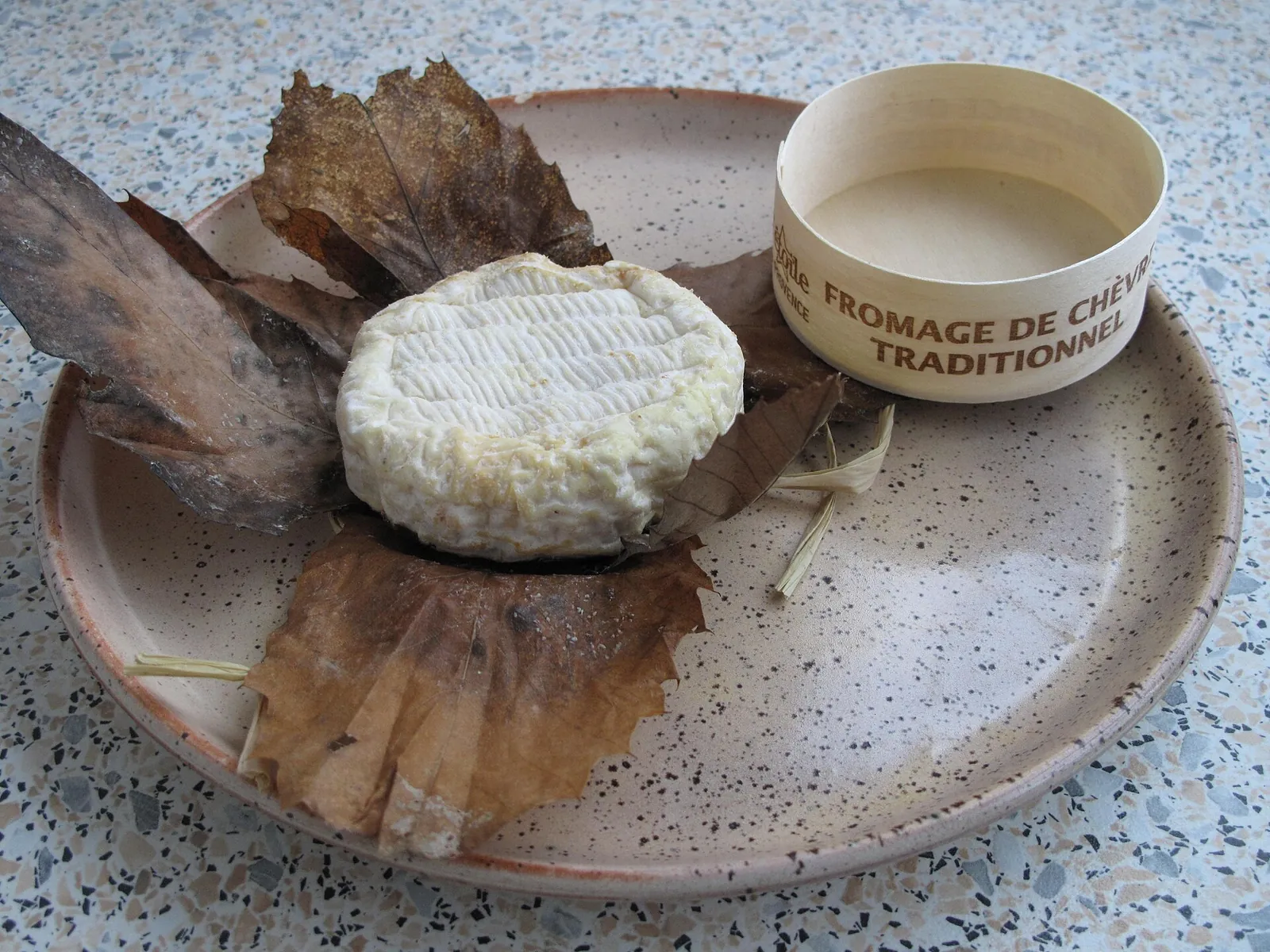
The leaves are not decoration: they are what separates Banon from every other goat cheese in the protected-name family.
What makes the cheese unusual is the order of events. It is first set mostly with rennet into a soft, sweet curd, drained and aged bare for a few days, and only then folded into the leaves for a second stretch of ripening. The wrapping holds the cheese together and gives its rind a faint tannic flavor.
Banon cheese at a glance
Here is Banon cheese at a glance, taken from its AOP specification at INAO, the French body that sets the rules for protected names.
| Detail | Banon |
|---|---|
| Milk | Raw, whole goat's milk, not standardized |
| Made in | Haute-Provence, around the village of Banon (Alpes-de-Haute-Provence), with parts of neighboring areas including Vaucluse |
| Protected name | AOP (the French form of the EU's PDO) |
| Wrapping | Brown natural chestnut leaves tied with natural raffia in 6 to 12 rays |
| Size | 75 to 85 mm (about 3 in) across with leaves, 20 to 30 mm (about 1 in) high; 90 to 110 g (3.2 to 3.9 oz) without leaves |
| Aging | At least 15 days, including at least 10 days under the leaves |
| Texture | Homogeneous, creamy, smooth and supple |
| Rind | Cream-yellow under the leaves |
Where Banon cheese comes from
Banon cheese takes its name from the village of Banon in the Alpes-de-Haute-Provence, a place of fairs and trade since the Middle Ages, the specification says. The cheese can be made only inside the defined area of Haute-Provence and parts of nearby Vaucluse, dry, hilly Mediterranean country on limestone soils where goats browse scrub and pasture rather than lush meadow. It is a small cheese: CNIEL, the French dairy trade body, counts 74 tonnes marketed in 2024.
The spec dates the first written mention of folded goat cheese tied to the Banon name to 1886, in Marius Morard's La Cuisinière provençale. It also gives a practical reason for the leaves: wrapping let households keep cheese through winter, when the goats were dry. For a wider look at the other goat cheeses with protected names, see the guide to French chevre, which lists all 14, and the PDO and PGI labels guide explains what the seal promises.
How Banon cheese is made
Banon cheese starts with raw, whole goat's milk, never standardized for fat or protein. Since 2014 the AOP specification has allowed milk only from Provençal Commune, Rove and Alpine goats and crosses of those breeds. The goats must graze the area's scrub and pasture at least 210 days a year, and herd output is capped at 850 kg of milk per lactating goat a year, which keeps the milk concentrated.
The curd is a sweet one, set quickly with rennet, ladled off within 2 hours and turned in the mold at least twice in the first 12 hours. The bare cheese, called a tome, is salted dry or in brine and aged 5 to 10 days at 8°C (46°F) or warmer until it carries a fine, creamy white rind and a supple center.
Then it is folded. The leaves must be natural, brown chestnut leaves, softened beforehand in boiling water or in water with 5 percent vinegar. Makers may dip the cheese in wine brandy or grape marc brandy first. The wrapped cheese ripens at least 10 more days at 8 to 14°C (46 to 57°F). The spec says chestnut leaves won out over vine, plane and walnut leaves because their structure is strong and they are rich in tannins.
Banon cheese flavor and texture
Banon cheese tastes mild, lactic and creamy, with a gentle goat tang and a woody, slightly tannic edge from the leaves. The spec describes the paste of a ripe Banon as homogeneous, creamy, smooth and supple, with a cream-yellow rind under the leaves.
Age shifts the balance. A cheese closer to the 15-day minimum is fresher and more lactic, with a soft white rind showing through. The longer it sits under the leaves, the softer it gets near the rind, the darker the leaves turn, and the stronger the goat and leaf notes become. These are general ripening patterns, not figures from the spec. Because the cheese is so small and so moist, the change from week to week is quick.
How to buy Banon cheese in the US
Buying Banon cheese in the US comes down to the raw-milk rule. The AOP requires raw milk and only 15 days of aging, but the FDA's standard for soft ripened cheeses says cheese from unpasteurized milk must be cured at 35°F (2°C) or warmer for at least 60 days. So a genuine raw-milk Banon sold in the US has to be at least 60 days old, far older than one eaten in Provence, and it will be drier and stronger.
A pasteurized goat cheese wrapped in leaves is not AOP Banon, because the spec allows only raw milk. Ask the counter whether the cheese is real AOP Banon, check for the leaves tied with raffia, and expect a firmer paste than the creamy one in the spec. Pregnant people and others who avoid raw-milk cheese can read the raw-milk cheese guide and follow FDA advice.
How to serve Banon cheese
Serve Banon cheese at room temperature and unwrap it at the table. Take it out of the fridge 30 to 45 minutes ahead (the room temperature guide has the details), cut the raffia, peel back the leaves and scoop or slice the paste. Do not eat the leaves; they are packaging.
It works as a spread on a baguette or crisp toast. Honey, figs and walnuts suit its tang, and CNIEL's pairing notes list white wines from Coteaux de Pierrevert, Côtes de Provence and Côtes du Luberon, plus seeded baguette or fruit bread. The goat cheese pairing guide and the Pairing Guide cover more drinks. For a wrapped cheese from another country, Cornish Yarg is wrapped in nettle leaves.
Banon cheese substitutes
A good Banon cheese substitute is any soft, creamy goat cheese with a thin rind: a small bloomy goat round or a young ripened chevre has the same lactic tang. You lose the leaf flavor, so a spoon of honey and a few walnuts help. The Substitute Finder lists more swaps, and How to Choose Goat Cheese helps narrow the field.
What most Banon cheese advice gets wrong
Most Banon cheese advice repeats the same shortcuts, and a few of them cost you flavor.
Banon is not made with an ash coat
Banon is not an ash-coated cheese like Selles-sur-Cher or Valençay, because the AOP rules wrap it in chestnut leaves instead. Its rind is cream-yellow under the leaves, not gray.
The leaves do not need to look perfect
The leaves on Banon cheese do not need to look perfect: they are brown, natural, bound with raffia and may carry a leaf stem on the underside. Leaf color is not a freshness test, so judge the cheese by its smell and the give of the paste.
Banon is not just a goat cheese in leaves
Banon is not just any goat cheese in leaves, because the name is protected. The spec fixes the area, the raw milk, the breeds, the tome aged first and the 10 days under leaves. A leaf-wrapped cheese without those rules is a different product.
Questions about Banon cheese
These questions about Banon cheese come up most often.
Why is Banon wrapped in chestnut leaves?
Banon is wrapped in chestnut leaves because they hold the soft cheese together, add a tannic flavor and let it keep longer. The spec says chestnut leaves were chosen over other leaves for their strong structure and tannic quality.
Can you eat the chestnut leaves on Banon?
You should not eat the chestnut leaves on Banon cheese, because they are tough packaging and their job is to flavor the rind. Peel them off before you eat.
Is Banon cheese made from raw milk?
Banon cheese is always made from raw whole goat's milk, because the AOP spec allows nothing else. In the US that means it must be aged at least 60 days.
How long is Banon cheese aged?
Banon cheese is aged at least 15 days, with at least 10 of them under the leaves, according to the specification.
What does Banon cheese taste like?
Banon cheese tastes creamy and tangy, with a slight woody, tannic note from the leaves. It is milder and rounder than a sharp aged goat cheese.
Your first Banon cheese
For your first Banon cheese, ask a cheese counter for AOP Banon, check the leaves and raffia, and plan to eat it within a few days of opening. Unwrap it at room temperature, spread it on bread and add honey.
Sources
- Cahier des charges de l'appellation d'origine Banon (version of 19 June 2013), INAO (Institut national de l'origine et de la qualité)
- Banon, AOP goat cheese, CNIEL (Interprofession laitière)
- 21 CFR 133.182, Soft ripened cheeses, Legal Information Institute, Cornell Law School