
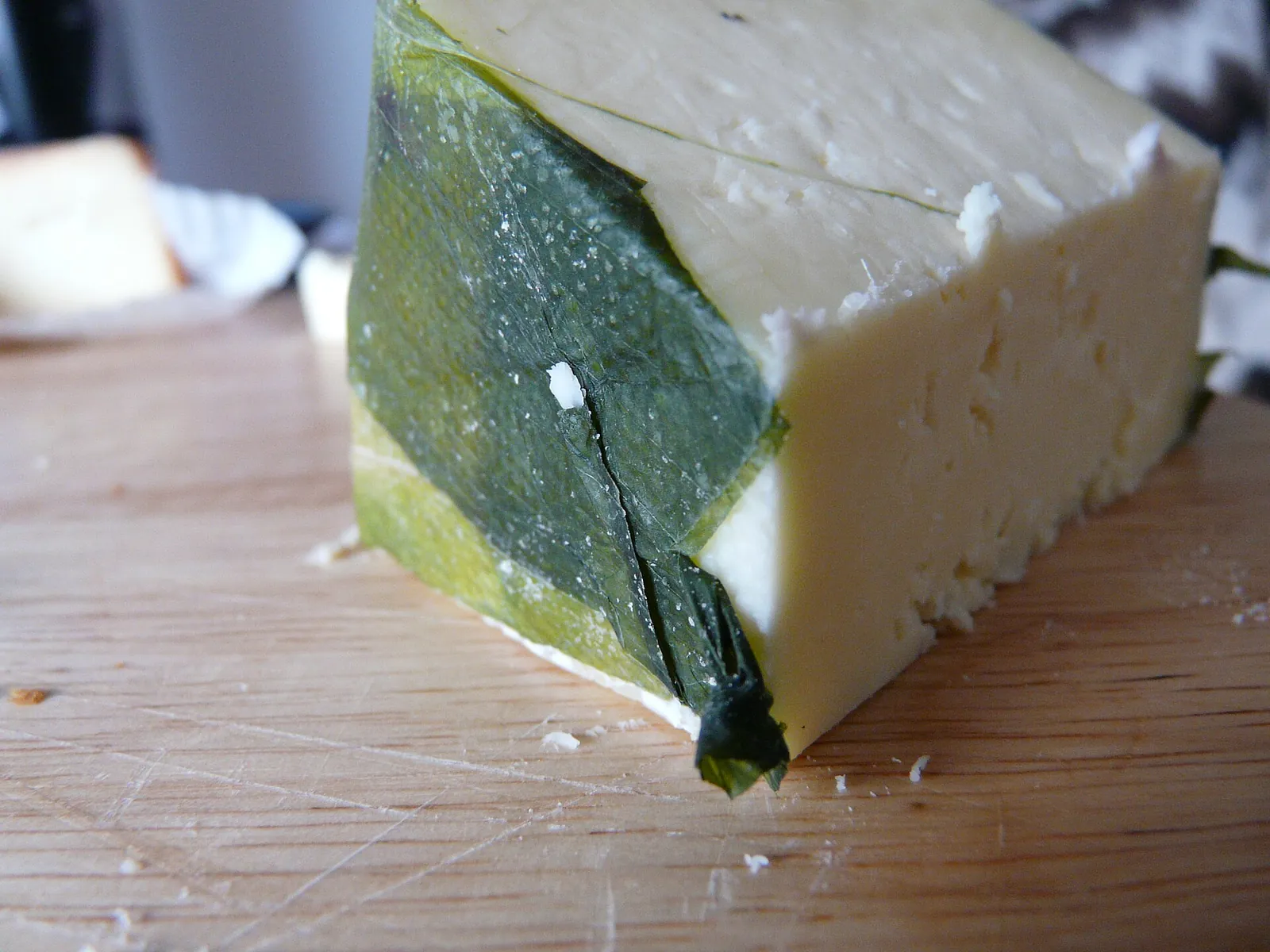
Under the leaves the paste is soft and creamy; further in it turns pale, crumbly and lemony.
The leaves are not a garnish. They change the acidity on the outside of the cheese, and that decides how the curd breaks down as it ages, which is why the layers of a wedge taste so different from edge to center.
Cornish Yarg at a glance
Here is Cornish Yarg at a glance, drawn from the maker's own pages and a reference summary.
| Detail | Cornish Yarg |
|---|---|
| Milk | Pasteurized cow's milk from neighboring farms |
| Made in | Lynher Dairies, Pengreep Farm near Truro, Cornwall |
| Rind | Edible: a coat of nettle leaves applied by hand, with natural mold growing beneath |
| Age | Matured about 4 to 8 weeks |
| Texture | Creamy and soft under the leaves, crumbly in the middle, like a young Caerphilly |
| Flavor | Fresh, lemony and clean in the center; earthier and more mushroomy toward the rind |
| Related cheese | Wild Garlic Yarg: the same cheese wrapped in ramson leaves |
Why Cornish Yarg is called Yarg
Cornish Yarg takes its name from the Gray family spelled backwards. The story goes that Alan and Jenny Gray, Cornish farmers, found a 1615 recipe by Gervase Markham for a nettle-wrapped cheese; they sold the recipe in 1984, according to its Wikipedia entry. Catherine Mead joined in 1985, and production moved fully to Lynher Dairies in 2006.
So the name is modern whimsy, and the cheese is a revival of an old idea rather than a continuous tradition: a 1980s product with a 17th century recipe behind it.
How Cornish Yarg is made
Cornish Yarg is made from pasteurized cow's milk, formed into rounds, and then coated in nettle leaves by hand before it matures. The leaves matter chemically: the nettles change the acidity of the outer layer, which alters how the curd breaks down and ripens, and Food Manufacture reports that they are picked wild, frozen for year-round use, and attract natural molds that help the cheese mature.
That is the mechanism behind the texture. The rind end softens and creams as the cheese ripens inward, while the heart stays firmer and crumbly. Wheels mature for roughly 4 to 8 weeks, so Yarg is a young cheese by cheddar standards, sold while it is still fresh.
Wild Garlic Yarg uses the identical cheese recipe. Lynher Dairies hand-picks about a metric ton of ramson leaves each spring, freezes them for the year, and ages the wrapped cheese for six weeks. The wild garlic leaf gives a slightly firmer paste than nettles and a gentle garlic note; the dairy says it whispers rather than shouts.
What Cornish Yarg tastes like
Cornish Yarg tastes fresh, clean and a little lemony in the middle, then earthier and more savory toward the rind. Eat a wedge from the tip toward the rind and you can taste the progression: tangy and almost cheesecake-light inside, mushroom and damp leaf outside.
The nettle coat is edible, and most people eat it with the paste. Its flavor is mild and vegetal rather than sharp, so it reads as earthiness. If you dislike the texture of the leaves, trim them; you lose the savory edge but nothing else.
Buying Cornish Yarg in the US
Buying Cornish Yarg in the US means buying an import, so expect it at cheese shops and well-stocked counters rather than a regular grocery aisle, and expect the price to reflect the trip. Ask for a wedge cut from a round and look for an intact, even leaf coat with no wet or slimy patches.
Freshness matters more than age here. Wheels are made to be eaten young, so a piece with a cleanly cut creamy edge and a pale, slightly crumbly center is what you want. Skip a dried, cracked face. Compare it with the other British regional cheeses at the counter, such as Caerphilly, Wensleydale and Cheshire, which sit in the same crumbly, fresh family but have no leaf coat.
How to use Cornish Yarg
Cornish Yarg is best as a table cheese, served at room temperature so the creamy band under the rind softens. Pair it with something sharp and bright: apples, pears, chutney or pickled onions, and crusty bread or plain crackers. The cheese and chutney guide covers the sweet-and-sour matches, and cider with cheese is a natural drink match for the fresh tang.
It also crumbles over salads and baked potatoes, and a few crumbs on hot new potatoes or a green salad works well. Because it is young and moist, it is not a cheese for long cooking; the center goes sticky rather than melting smoothly, so add it at the end.
For a board, serve a whole small wedge with the rind facing up so people can see the leaf pattern: the cheese board guide covers how to build around a showpiece like it.
Cornish Yarg substitutes
The nearest substitute for Cornish Yarg is a young Caerphilly, which has the same crumbly, lemony center, though without the creamy rind layer. Wensleydale and Cheshire are moist, crumbly English cheeses that fill the same role on a board or in a salad. None has a nettle rind, so for the look you need the real thing. The substitute finder lists more options.
Cornish Yarg storage
Cornish Yarg keeps best wrapped in wax paper, in the fridge below 8 degrees Celsius (46 degrees Fahrenheit), and served at room temperature, which is the dairy's own instruction for the wild garlic version and sound advice for the nettle one. Because it is a young, moist cheese, eat it within a week or two of cutting. The guide to storing cheese covers wraps and containers.
What most Cornish Yarg advice gets wrong
Most advice on Cornish Yarg repeats a few shaky ideas.
The name does not mean Cornish Yarg is ancient
The name Yarg is Gray backwards, so Cornish Yarg is modern, and the 1615 recipe is the inspiration, not an unbroken tradition. Where an old description calls it a traditional Cornish cheese, read it as a revival.
Cold Cornish Yarg is a waste
Serving Cornish Yarg straight from the fridge flattens the creamy layer and the lemony center. An hour on the counter brings back the contrast the leaves create.
Wild Garlic Yarg is not a flavored add-in
Wild Garlic Yarg is the same cheese as the nettle version, wrapped in a different leaf for a firmer paste and a quiet garlic note. If you expect a garlic-spread cheese you will think it is bland.
Questions about Cornish Yarg
These are the questions about Cornish Yarg that come up most.
Why is it called Yarg?
Cornish Yarg is called Yarg because the name is Gray spelled backwards, after Alan and Jenny Gray, who revived a 1615 nettle-wrapped cheese recipe.
Can you eat the nettle leaves on Cornish Yarg?
You can eat the nettle leaves on Cornish Yarg, because the leaf coat is an edible rind. Some people trim it for texture, but it is meant to be eaten.
Is Cornish Yarg pasteurized?
Cornish Yarg is made from pasteurized cow's milk from neighboring farms, which makes it simple to import and sell in the US.
What does Cornish Yarg taste like?
Cornish Yarg tastes fresh, lemony and crumbly in the middle and earthier and creamier near the nettle rind.
Is Cornish Yarg vegetarian?
Cornish Yarg's wild garlic version is labeled suitable for vegetarians; for the nettle version, check the label of the cheese you are buying.
Your first Cornish Yarg
For your first Cornish Yarg, buy a small wedge cut to order, let it warm up for an hour, and eat it with a crisp apple and a little chutney. Try Wild Garlic Yarg next to compare the leaves.
Sources
- Cornish Yarg, Wikipedia
- Wild Garlic Yarg, Lynher Dairies
- Dairy doubles output of nettle and garlic Yarg, Food Manufacture