
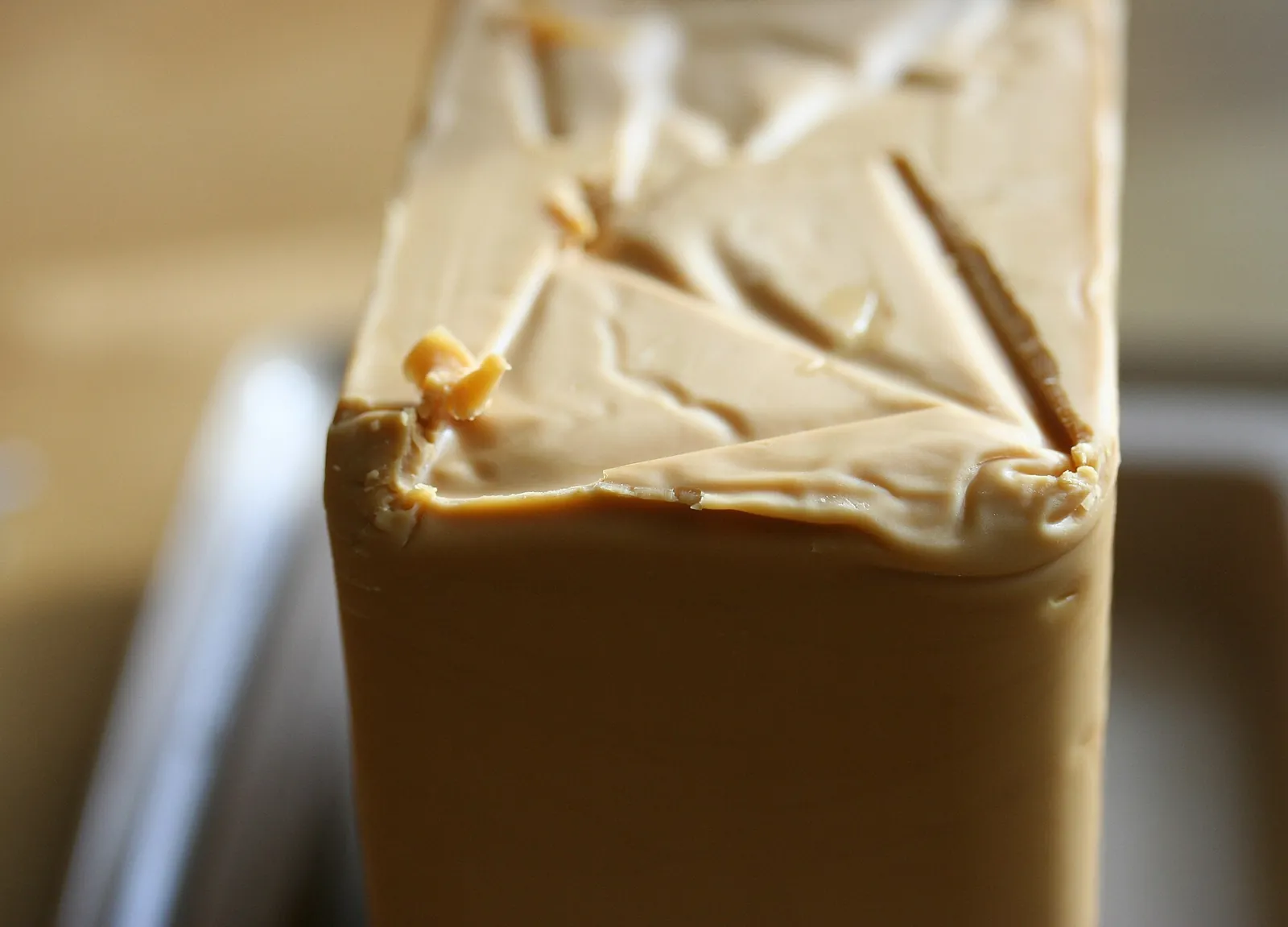
It is a dense, fudge-like block the color of milk caramel, sweet and a little tangy, and Norwegians slice it thin onto bread at breakfast and into packed lunches.
The reason is its starting material. Most cheese is made from curds; brunost is made from the whey that drains off them, boiled down with milk and cream until the milk sugar browns. That is why it tastes closer to dulce de leche than to cheddar.
Brunost at a glance
Here is brunost at a glance, with the figures taken from the Brunost entry on Wikipedia and the USDA entry for gjetost.
| Detail | Brunost |
|---|---|
| Made from | Whey, usually with milk and cream, boiled for several hours |
| Milk | Cow, goat, or a blend, depending on the type |
| Origin | Norway; the modern version dates to 1863 (Gudbrandsdalen valley) |
| Texture | Firm, smooth, sliceable like fudge |
| Flavor | Sweet, caramel and milky, with a tang that grows with goat's milk |
| Energy | About 132 kcal per ounce (USDA, gjetost) |
How brunost is made
Brunost is made by boiling whey, milk and cream together for several hours until the water evaporates. Heat does the rest: the milk sugar (lactose) caramelizes, the way sugar does in a pan, which gives brunost its brown color and its sweetness without adding sugar.
The modern version has a named inventor. Anne Hov, a milkmaid in Gudbrandsdalen, added cream to the whey in 1863 and reduced it in an iron pot, which produced a firmer, richer product than plain boiled whey. She first called it "feitost," meaning fat cheese, and received the King's Medal of Merit in 1933. Because the whey is cooked down rather than set into curds, it is a whey cheese like ricotta, only cooked far longer and much darker.
Types of brunost
The main types of brunost differ by which milk goes in with the whey, and the more goat's milk, the stronger the tang. Tine is the world's largest producer and markets 13 varieties, and Synnøve Finden markets two.
Gudbrandsdalsost
Gudbrandsdalsost is the most popular brunost in Norway, and it contains cow's milk, goat's milk, cream and whey. The Tine brand you are most likely to find in US stores is Ski Queen, sold as gjetost; read the ingredient list on the pack to see which milks it contains. This is the one to buy first.
Ekte Geitost
Ekte Geitost is the goat version: it contains only whey and goat's milk, and "ekte" means genuine. Expect the sharpest, most goaty tang of the three, which is a plus if you like chèvre and a minus if you want pure caramel.
Fløtemysost
Fløtemysost is the milder brunost, made without goat's milk, with cream in the name ("fløte" is cream). It is the second most popular type in Norway and the easiest place to start for anyone wary of goat flavor.
How brunost tastes
Brunost tastes sweet, milky and caramel-like, with a tang that sits underneath the sweetness rather than on top of it. It does not taste like a savory cheese at all, which is why first-timers often describe it as fudge or toffee.
The numbers back that up. The USDA lists gjetost at 466 kcal per 100 g, with 42.65 g of carbohydrate, 29.51 g of fat and 9.65 g of protein, and only 13.44 g of water, so it is concentrated milk solids. Per ounce that is about 132 kcal, 8.4 g of fat, 12.1 g of carbohydrate and 2.7 g of protein. Wikipedia notes that brunost has a high lactose content, unlike most cheeses, which is worth knowing if you avoid lactose; the lactose in cheese page explains why most aged cheeses are low.
How to slice and serve brunost
The way to serve brunost is to shave it into thin slices and put it on something plain. Wikipedia notes that it is usually sliced very thinly, and Norwegians eat it on sandwiches, crispbread, biscuits and waffles, and in packed lunches (matpakke).
A cheese plane or slicer works much better than a knife, because brunost is firm and a knife cuts thick, heavy slabs. Draw the plane across the flat of the block for curls you can fan across a slice of buttered bread or crispbread. Good partners are:
- warm waffles with a spoon of jam or lingonberries
- pear or apple slices on crispbread
- coffee, hot chocolate or a cup of tea alongside
- a pairing of tawny port or a coffee stout in the evening
In cooking, a small piece stirred into a pan sauce at low heat adds sweetness and depth, a classic touch for game dishes. Keep the heat gentle so it melts smoothly. See the Norway page and Scandinavian cheeses for the rest of the neighborhood, including Jarlsberg.
Brunost substitutes
There is no real brunost substitute, because nothing else is a caramelized whey cheese. You can come close in role rather than flavor, and the substitute finder can narrow the options if you need to swap a cheese in a recipe.
For a breakfast slice, a mild, creamy cheese such as Jarlsberg with a thin layer of jam gives you the sweet and savory pairing, but not the fudge. For a sauce, a little caramel or dulce de leche with a mild cheese gets nearer the sweetness. If goat tang is what you are missing, a mild goat cheese with honey does it.
What most brunost advice gets wrong
Most brunost advice treats it as a novelty spread, and that hides three useful facts.
Brunost is not a light cheese
Brunost is not a light cheese, despite how thin it is sliced. At about 132 kcal and 12 g of carbohydrate per ounce, it is an energy-dense food, so the thin slice is the right portion, not a style point.
Brunost keeps its taste at room temperature
Brunost keeps its taste at room temperature, unlike most soft cheeses. Wikipedia notes its texture changes if it is not refrigerated, but its taste does not, so a block left out on the counter at a brunch is fine for flavor. Still, wrap it and refrigerate between uses; the storing cheese guide has wrapping tips.
One iron pot used to matter
One iron pot used to matter for brunost, because the old method left a good amount of iron in the cheese. Norway has banned iron fortification of brunost since September 1, 2001, so the modern product no longer carries that extra iron.
Questions about brunost
These are the questions about brunost that come up most.
Why is brunost brown?
Brunost is brown because the whey is boiled for hours, which caramelizes the milk sugar (lactose) the way caramel forms in a pan.
Is brunost really cheese?
Brunost is a whey cheese, made from the whey that drains off regular cheesemaking, plus milk and cream, rather than from curds. Strictly, it is a concentrated whey product built mostly on caramelized milk sugar, with little coagulated protein, so it counts as cheese by tradition more than by definition.
Is brunost the same as gjetost?
Brunost is the whole family and gjetost (geitost) is one branch of it; the gjetost vs brunost page covers the difference.
How do you eat brunost?
Brunost is eaten in thin shavings on bread, crispbread, biscuits or waffles, usually with jam, and it is a classic breakfast and packed-lunch food in Norway.
Does brunost have to be refrigerated?
Brunost does not change taste when left out, but its texture does, so refrigerate it between servings.
Your first brunost
For your first brunost, buy a small block of Ski Queen or a Fløtemysost if you can find one, shave it with a cheese plane onto warm toast or a waffle, and add a little jam. If the goat tang surprises you, switch to the milder type.
Sources
- Brunost, Wikipedia
- Cheese, gjetost (FDC ID 171240), USDA FoodData Central, SR Legacy
- Whey cheese, Wikipedia