
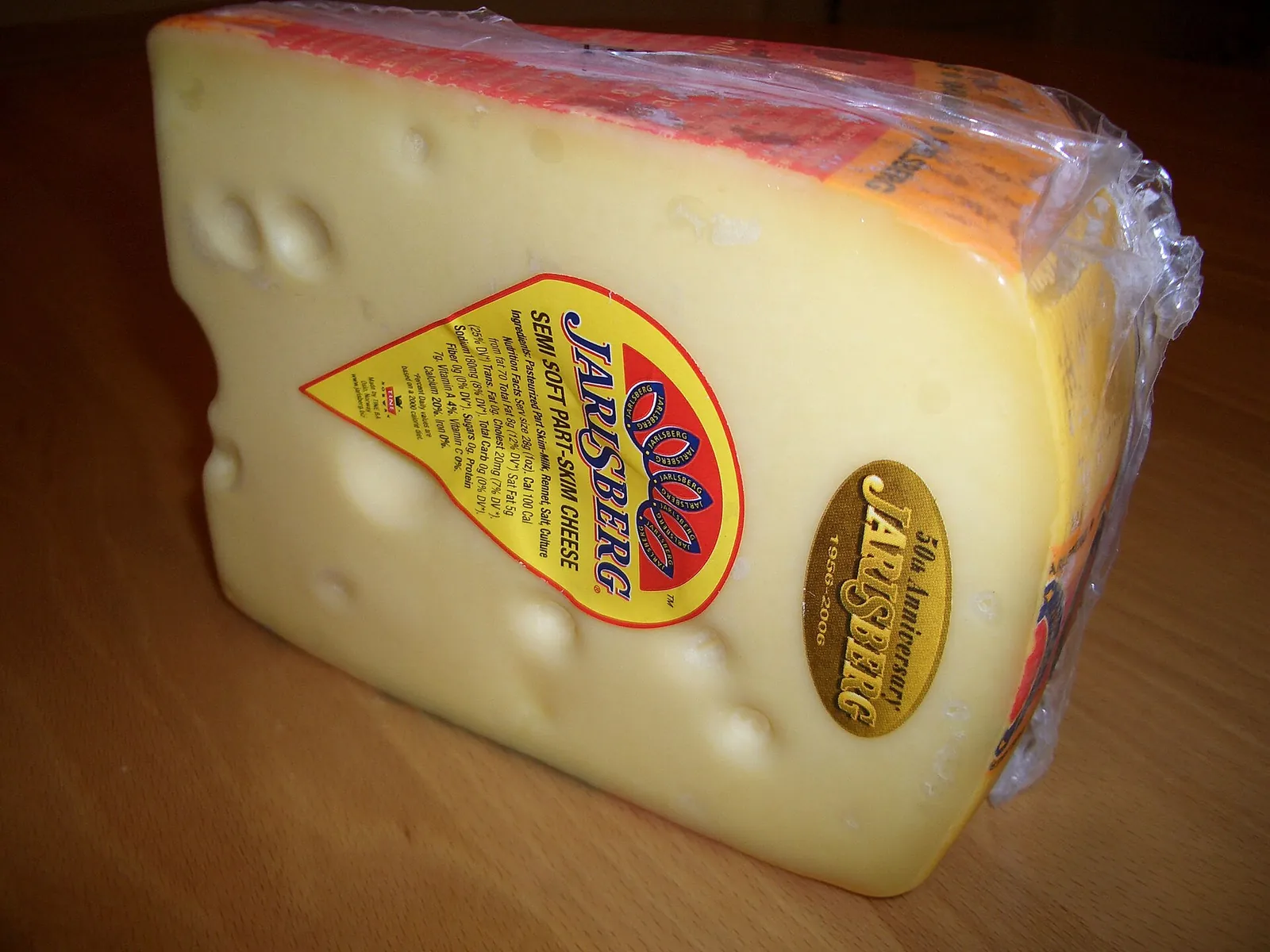
It slices cleanly, melts smoothly and is sweet enough to please most people, so it works in sandwiches, gratins and fondue as well as on a board.
What explains the cheese is the cross. Jarlsberg pairs the lactic acid bacteria used for Gouda with the propionic acid bacteria used for Emmental, which gives it Gouda's smooth body and easy melt with Swiss-style holes. When a recipe calls for Swiss, Emmental or Gruyère, it is the easy stand-in.
Jarlsberg cheese at a glance
Here is Jarlsberg cheese at a glance, drawn from the maker's US pages, the university where it was developed and Culture magazine's cheese library.
| Detail | Jarlsberg |
|---|---|
| Milk | Pasteurized, part-skimmed cow's milk |
| Origin | Norway, developed at the Dairy Institute of the Agricultural University of Norway |
| Name | After Jarlsberg Manor in Vestfold |
| Brand began | 1956, made on an industrial scale from 1957 |
| Made today in | Norway, Ireland and the USA |
| Cultures | Mesophilic lactic acid bacteria plus propionic acid bacteria |
| Rind | Waxed |
| Texture | Smooth and firm, with large round holes |
| Flavor | Mild, buttery, slightly sweet and nutty |
| Fat (Original) | 27 g per 100 g, or 45 percent of the dry matter |
| Per ounce (Original) | About 100 calories, 7.7 g protein, 125 mg sodium, converted from the label |
How Jarlsberg cheese was developed
Jarlsberg cheese was developed in the 1950s at the Dairy Institute of the Agricultural University of Norway (now NMBU, the Norwegian University of Life Sciences), under Professor Ole Martin Ystgaard. According to the university's own account, a graduate student named Per Sakshaug used propionic acid bacteria to research how to get better holes in Gouda, and the result became Jarlsberg. Ystgaard tasted it in 1956 and saw its potential, and the maker's Our Story page dates the Jarlsberg brand to that year. The cheese was being made on an industrial scale by 1957, and Ystgaard led its further development for ten years.
The name comes from Jarlsberg Manor in Vestfold, a Norwegian dairy region, and jarl is the Norwegian word for earl, Culture magazine notes.
Why Jarlsberg cheese has holes
Jarlsberg cheese has holes because propionic acid bacteria added to the cheese milk give off carbon dioxide as the cheese ripens, as Swiss dairy researchers describe it, and the gas collects into round pockets called eyes. The university says the same bacteria are behind both the holes and the taste, so the culture that opens the cheese also builds its sweet, nutty flavor.
Jarlsberg flavor, texture and melt
Jarlsberg has a mild, buttery, slightly sweet flavor and a smooth, firm texture that slices cleanly and melts easily. The maker's own words for the taste are sweet and nutty, and Culture calls it balanced. The maker's melting guide adds that the cheese turns sweeter when heated, with a chewy, stretchy pull.
How to buy Jarlsberg cheese in the US
Buying Jarlsberg cheese in the US mostly comes down to choosing between Original and Lite, and Original is the one for anything you will heat. The maker's US products page lists Original as slices, blocks and sticks, a pre-cut Original Wheel, and Lite as chunks, in sizes that include 8.8 and 17.6 ounces (250 and 500 grams).
Read the package for the country of origin, since the maker produces Jarlsberg in Norway, Ireland and the USA. Slices suit sandwiches and burgers; a block is better when you want to shred it into a gratin. A whole wheel wears a waxed rind, which you cut away. Wrap a cut piece in wax or parchment paper and keep it in the fridge.
How to use Jarlsberg cheese
Use Jarlsberg cheese wherever you want a mild, sweet cheese that melts without taking over the dish. The maker suggests quesadillas, paninis, gratins, pies, pastas, pizzas and burgers, and grilled cheese is the obvious first stop. For other cheeses that melt well, see the best melting cheeses.
For grilled cheese and paninis, cook over medium-low heat so the cheese is fully melted by the time the bread browns. In fondue and raclette, the maker says Jarlsberg can replace Emmental or Gruyère, and because it is milder, a good starting point for fondue is half Jarlsberg and half Gruyère.
On a board, cut it into thin slices or cubes, let it sit out for about 30 minutes, and serve it with apples, pears, grapes, figs, ham, dark bread or nuts, all on Culture's list of pairings. A crisp white such as Chardonnay or Riesling suits it, as does a light red such as Pinot Noir or a pilsner.
Jarlsberg cheese substitutes
The best Jarlsberg cheese substitutes are Swiss, Emmental and Gruyère, and the right one depends on how much flavor the dish can take.
| Swap | What it matches | What changes | Best for |
|---|---|---|---|
| Swiss | Holes, nutty flavor, clean slicing | Less sodium, usually less sweet | Sandwiches, burgers, snacking |
| Emmental | Holes and nutty flavor | More aromatic and tangier | Gratins, fondue, quiche |
| Gruyère | Easy melt and nutty depth | More savory, usually no big holes | Fondue, French onion soup, gratins |
| Young Gouda | Smooth body and easy melt | No holes, less nutty | Grilled cheese, mac and cheese |
| Leerdammer or Maasdam | Big holes, mild sweetness | Dutch cheeses, so a different recipe | Sandwiches, snacking |
Baby Swiss is another easy swap on a sandwich. The Swiss, Gruyère and Emmental comparison sorts those three out in detail, and Leerdammer and Maasdam have their own page.
What most Jarlsberg advice gets wrong
Most Jarlsberg advice skips three details that change how you buy it and cook with it.
Jarlsberg's holes need a starting point as well as gas
Jarlsberg's holes need a starting point as well as gas, because carbon dioxide from the bacteria has to collect somewhere or it escapes. Agroscope, the Swiss federal agricultural research center, says hole formation in cheese has two main triggers: bacteria that make carbon dioxide, and plant particles such as hay dust, which hold tiny air bubbles that the gas then enlarges into eyes. The hay decides where and how many holes form, and roughly 5 to 10 milligrams per 1,000 kilograms of milk is enough for typical eyes. In the 10 to 15 years before 2015, Swiss Emmental had a "hole shortage" that the researchers tied to cleaner milk from modern milking systems.
Jarlsberg Lite does not melt like Original
Jarlsberg Lite does not melt like Original, because the maker says its lower fat content changes the melting properties. The label shows the gap: Lite lists 13 grams of fat and 255 calories per 100 grams, against 27 grams and 351 calories for Original. Keep Lite for the snack plate and use Original for grilled cheese, gratins and fondue.
Jarlsberg is saltier than Swiss
Jarlsberg is saltier than Swiss, at about 125 milligrams of sodium per ounce against 53 milligrams for natural Swiss in USDA data. The Jarlsberg figure is converted from the label's 440 milligrams per 100 grams. Calories and protein are close, with about 100 calories and 7.7 grams of protein per ounce for Original against 111 and 7.6 for Swiss, so salt is the difference to plan around. Taste before adding any in a recipe that swaps one for the other.
Questions about Jarlsberg cheese
These are the questions about Jarlsberg cheese that come up most.
Is Jarlsberg the same as Swiss cheese?
Jarlsberg is not the same as Swiss cheese, though the holes make them look alike. Swiss follows the Emmental style from the Alps, while Jarlsberg is a Norwegian brand with Gouda in its family, which shows in its sweet, stretchy melt.
Is Jarlsberg cheese a good melting cheese?
Jarlsberg cheese is a good melting cheese, and the maker calls it stretchy and says it gets sweeter as it heats.
Is Jarlsberg cheese lactose free?
Jarlsberg cheese is lactose free, according to its maker, which says the lactose leaves with the whey and the ripening bacteria consume the rest. The US label lists 0 grams of sugars per 100 grams, and the National Institute of Diabetes and Digestive and Kidney Diseases says hard cheeses are lower in lactose than other dairy foods; the lactose in cheese guide ranks more of them. Lactose free is not milk free, so a milk allergy is a question for a doctor.
Where is Jarlsberg cheese made?
Jarlsberg cheese is made in Norway, Ireland and the USA, the maker says. The package shows which dairy made yours.
Is Jarlsberg cheese pasteurized?
Jarlsberg cheese is made from pasteurized, part-skimmed cow's milk, according to Culture magazine's cheese library.
Your first Jarlsberg cheese
For your first Jarlsberg cheese, buy a block of Original, eat a few slices at room temperature with an apple and melt the rest into a grilled cheese. If you like it, make the same sandwich with Swiss and then with Gruyère to taste how the flavor shifts.
Sources
- Jarlsberg: Our Story, Products, Made to melt and Lactose free, Jarlsberg
- Savouring success, Norwegian University of Life Sciences (NMBU)
- Jarlsberg, Culture magazine
- Riddle of Hole Formation in Cheese Solved, Agroscope, Swiss Federal Department of Economic Affairs, Education and Research, May 28, 2015
- Cheese, swiss, USDA FoodData Central (SR Legacy)
- Eating, Diet, & Nutrition for Lactose Intolerance, National Institute of Diabetes and Digestive and Kidney Diseases